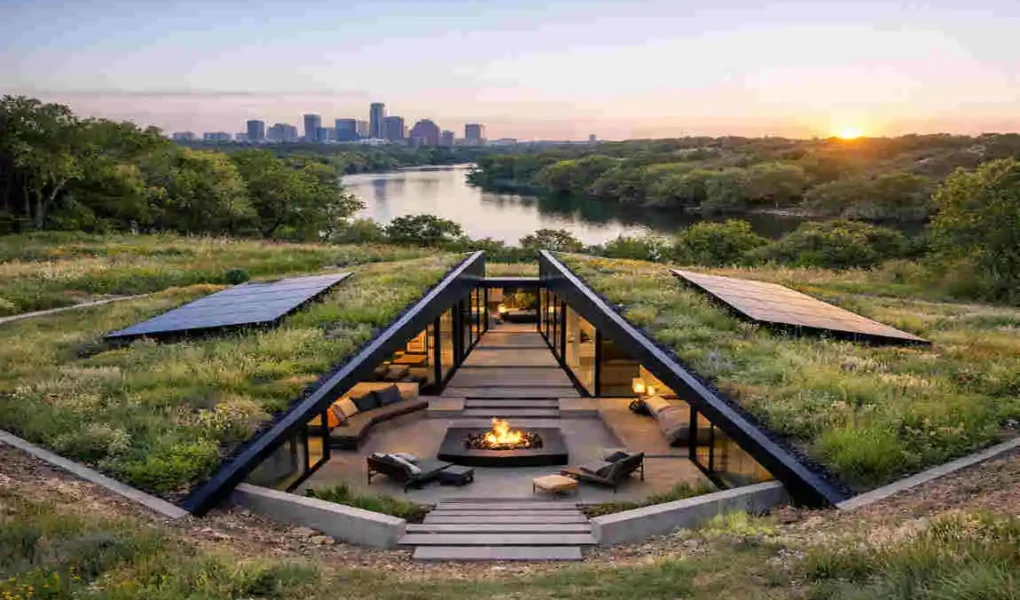
Imagine a house that essentially disappears. It doesn’t tower over the landscape or demand attention with flashy chrome and steel. Instead, imagine a home camouflaged as a Texas hill, blending so seamlessly into the Austin landscape that you might walk right over it without realizing someone lives beneath your feet.
This isn’t just another modern home; it is a groundbreaking architectural statement that slashes energy bills and challenges everything we think we know about residential design. Located on the banks of the Colorado River, Edgeland House is a modern reinterpretation of one of the oldest housing concepts in North America: the Native American pit-house.
Designed by the visionary architects at Bercy Chen Studio, this project sits on a site that was once a scar on the land—a former brownfield used as an industrial dump for an oil pipeline. Today, it stands as a lush, green ecosystem.
But why should you care about a hole in the ground? Because this specific “hole” represents the future of sustainable living. By utilizing the earth’s natural thermal mass, Edgeland House stays cool during the scorching Texas summers and warm during the winters, all while restoring the local environment.
Design Inspiration: Ancient Roots, Modern Vision
To understand Edgeland House, you have to look back—way back. We aren’t talking about mid-century modern or Victorian eras; we are talking about ancient history.
The Pit-House Concept
For centuries, the indigenous peoples of North America used a brilliant, low-tech method to survive harsh climates: the pit house. These dwellings were typically sunken about seven feet into the earth.
Why dig down? The answer lies in thermal stability.
The Earth is an incredible insulator. While the air temperature in Austin might swing from a blistering 100°F in August to a freezing 30°F in January, the soil temperature seven feet underground remains relatively constant (usually around 60-70°F). By sinking the home into the ground, ancient builders utilized the earth to regulate indoor temperatures naturally.
Edgeland House takes this vernacular tradition and updates it for the 21st century. It proves that we don’t always need high-tech gadgets to solve modern problems; sometimes, the oldest solutions are the best ones.
Bercy Chen Studio’s Vision
The architects at Bercy Chen Studio didn’t just want to build a bunker. They wanted to create a dialogue between the industrial past of the site and the natural future they hoped to build.
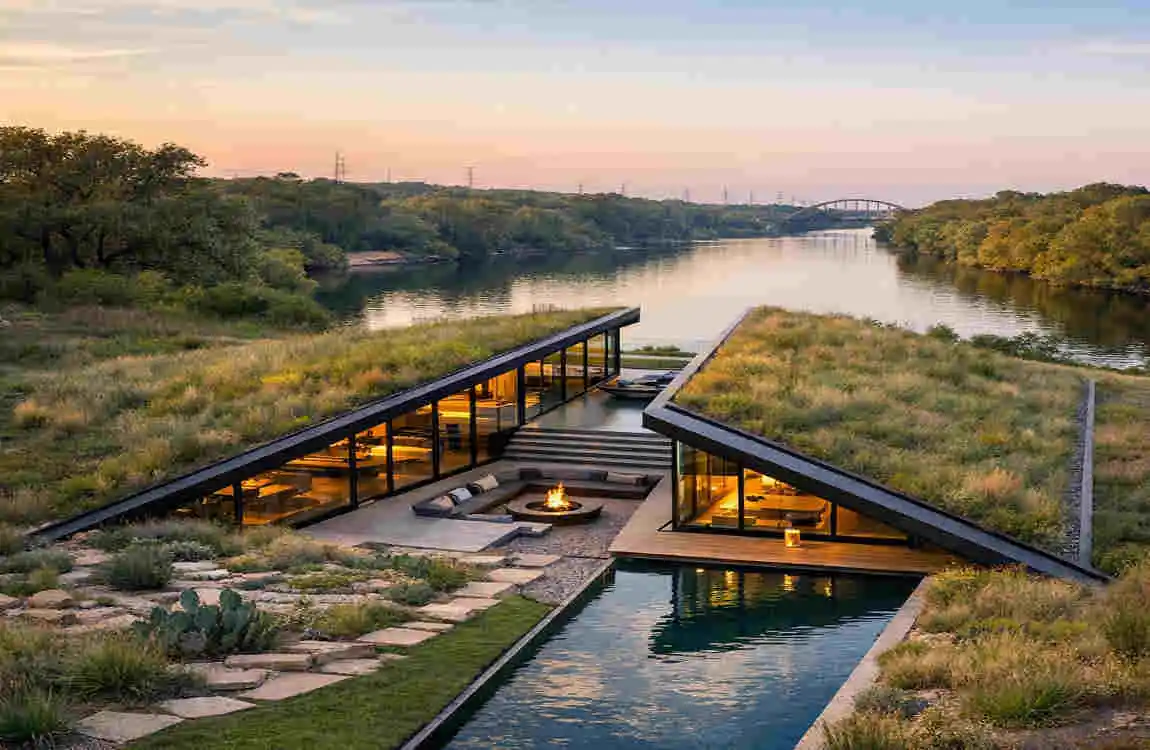
The design is visually striking. It features two distinct pavilions—one for sleeping and one for living. These two sections are pulled apart, creating a rift, or “scar,” through the middle of the home. This wasn’t an accident.
This design choice is metaphorically linked to the site’s history. The land was previously damaged by industrial use, specifically an excavation for an old oil pipeline. The architects viewed the house as a way to heal that wound. The “cut” through the house represents the industrial scar, while the green roof and surrounding landscape symbolize nature’s healing as it takes back the land.
Transforming a Brownfield
Before Edgeland House existed, the site was a mess. It was a “brownfield”—a term in urban planning for land previously used for industrial or commercial purposes with known or suspected pollution.
Transforming this derelict plot into a habitable, beautiful space was no small feat. It required:
- Extensive soil rehabilitation.
- The removal of invasive species.
- The reintroduction of native flora.
Architectural Features: Anatomy of the Edgeland House
When you look at Edgeland House, you aren’t seeing a traditional four-walled structure. The architecture is a complex interplay of geometry, glass, and earth. Let’s break down the physical elements that make this structure so unique.
The Bifurcated Layout
As mentioned earlier, the house is split into two separate pavilions.
- The Living Pavilion: This creates a social space for cooking, dining, and lounging.
- The Sleeping Pavilion: a private sanctuary for rest.
To get from the bedroom to the kitchen, you have to walk outside. This is a radical design choice, especially for a modern luxury home. However, it serves a specific purpose: it forces the residents to engage with the natural world every single day. You cannot ignore the weather, the birds, or the temperature. It breaks down the barrier between “indoor” and “outdoor” living.
Materials and Construction
The materials chosen for Edgeland House are as functional as they are beautiful.
- Rammed Earth and Concrete: The sunken walls utilize heavy materials to hold back the earth and provide thermal mass. This helps store heat during the day and release it slowly at night.
- Reflective Glass: The angled, glass-clad polygons allow natural light to flood the sunken spaces. This prevents the “basement” feeling you might expect from a pit-house. The glass creates a sense of openness and provides privacy from neighboring properties through carefully calculated angles.
- Steel Framing: To support the heavy green roof and the dramatic geometric shapes, a robust steel frame is utilized, giving the home its sharp, modern aesthetic (often described as sci-fi or origami-like).
The Green Roof
The roof is the star of the show. Spanning roughly 2,300 square feet, the roof is a living extension of the surrounding ground.
It isn’t just a patch of grass; it is a meticulously engineered ecosystem. The roof slopes seamlessly from the ground up over the living spaces. Visually, this connects the house to the river and the sky. Practically, it acts as a massive insulation blanket, shielding the interior from the sun’s direct rays.
For readers interested in how these features stack up against traditional builds, here is a quick breakdown:
Feature Description Benefit
Green Roof 2,300 sq ft of native plants and grasses. Provides superior insulation, reduces stormwater runoff, and supports local biodiversity.
Earth Excavation Structure sunken 7 feet deep. Uses the earth’s natural temperature to keep the home cool in summer and warm in winter.
Glass Polygons South-facing clerestory windows maximize passive solar gain (heating) in winter while offering privacy and sky views.
Hydronic System Radiant floor heating and cooling Offers 50%+ energy savings compared to forced-air HVAC systems.
Sustainability Innovations: Beyond “Going Green”
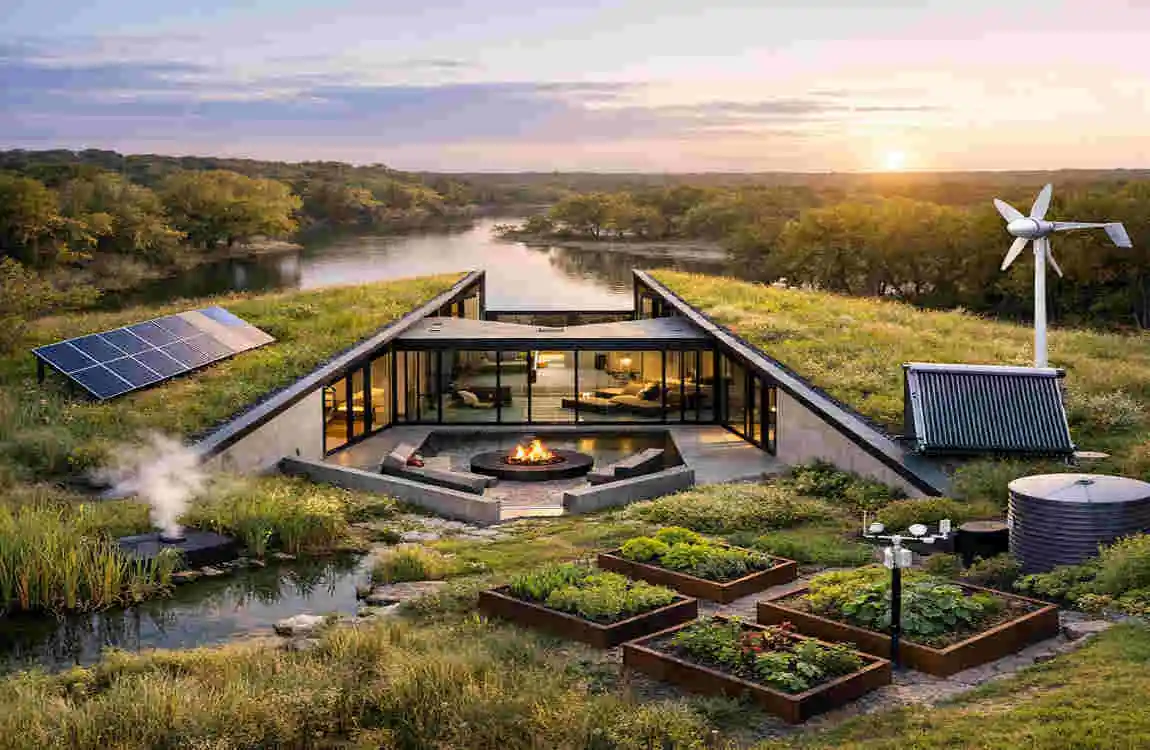
In the world of real estate, “green” is a buzzword that gets thrown around a lot. Sometimes it just means a house has LED lightbulbs. Edgeland House, however, is the real deal. It pushes toward a zero-net energy reality.
Thermal Efficiency and HVAC
The primary sustainability engine of the house is the pit-house design itself. By burying the house, the architects drastically reduced the load on the heating and cooling systems.
But they didn’t stop there. The home employs a hydronic heating and cooling system.
- How it works: Water circulates through tubes embedded in the floors and ceilings.
- The Benefit: Water conducts heat much better than air. This system is far more efficient than blowing hot or cold air through ducts. It keeps the indoor climate comfortable without the noise and energy waste of traditional AC units.
Additionally, the house uses geothermal heat exchange. The system uses the earth’s stable temperature to help heat and cool the water circulating in the home, further reducing electricity use.
Ecosystem Restoration
True sustainability isn’t just about using less electricity; it’s about repairing the environment.
The collaboration with the Lady Bird Johnson Wildflower Center was critical here. The site was previously overrun with invasive species that choked out local wildlife. The team removed these and planted native Texas grasses and wildflowers.
This creates a habitat for:
- Butterflies
- Bees
- Local birds
- Small fauna
By turning a brownfield into a green haven, Edgeland House helps combat the “Urban Heat Island” effect. In this phenomenon, concrete and asphalt make cities significantly hotter than the surrounding countryside.
Water Conservation
In Texas, water is liquid gold. Edgeland House respects this resource. The green roof absorbs a significant amount of rainwater, reducing runoff that can carry pollutants into the Colorado River.
Furthermore, the site is designed with permeable surfaces. Instead of concrete driveways that shed water, the landscape allows rain to soak back into the aquifer, replenishing the groundwater supply.
The Business of Sustainability
For our readers interested in the economics of eco-architecture, this house presents a compelling case. While the upfront costs of excavation and geothermal systems are higher than a standard wood-frame build, the long-term ROI is substantial.
- Energy Bills: Can be reduced by over 30-50%.
- Maintenance: Green roofs actually protect the roof membrane from UV damage, often doubling its lifespan.
- Property Value: Unique, high-efficiency homes are increasingly commanding premiums in the real estate market.
Impact on Austin Eco-Architecture
Austin, Texas, is known for being a hub of innovation, but it is also a city facing rapid growth and environmental challenges. Edgeland House has become a symbol of what is possible when developers and architects think outside the box.
Setting a Precedent for Brownfields
One of the most significant impacts of this project is how it treats damaged land. Cities across America are full of brownfields—old factories, gas stations, and industrial dumps that sit empty because they are difficult to develop.
Edgeland House proves that you don’t need a pristine, untouched plot of land to build a nature-centric home. You can take a scarred piece of land and heal it. This opens up significant opportunities for urban regeneration in Austin’s industrial river zones.
Influencing Zoning and Regulation
Building a house seven feet underground isn’t “business as usual” for city inspectors. Projects like this challenge local building codes and force city planners to adapt.
By successfully navigating the zoning requirements for sunken builds and green roofs, Edgeland House has paved the way for future eco-projects. It makes it easier for the next architect to get approval for a green roof or a geothermal system.
Awards and Recognition
The project hasn’t gone unnoticed. It has received prestigious recognition, including features in top architectural publications and awards from the American Institute of Architects (AIA).
This visibility matters. It shifts the public perception of what a “luxury home” looks like. It moves the needle from “big mansions with columns” to “smart homes that save the planet.” It inspires students, other architects, and builders to experiment with pit-house hybrids and earth-sheltered designs.
Lessons for Homeowners: Adapting the Edgeland Concept
You might be reading this and thinking, “This is amazing, but I can’t dig a 7-foot hole in my suburban backyard.”
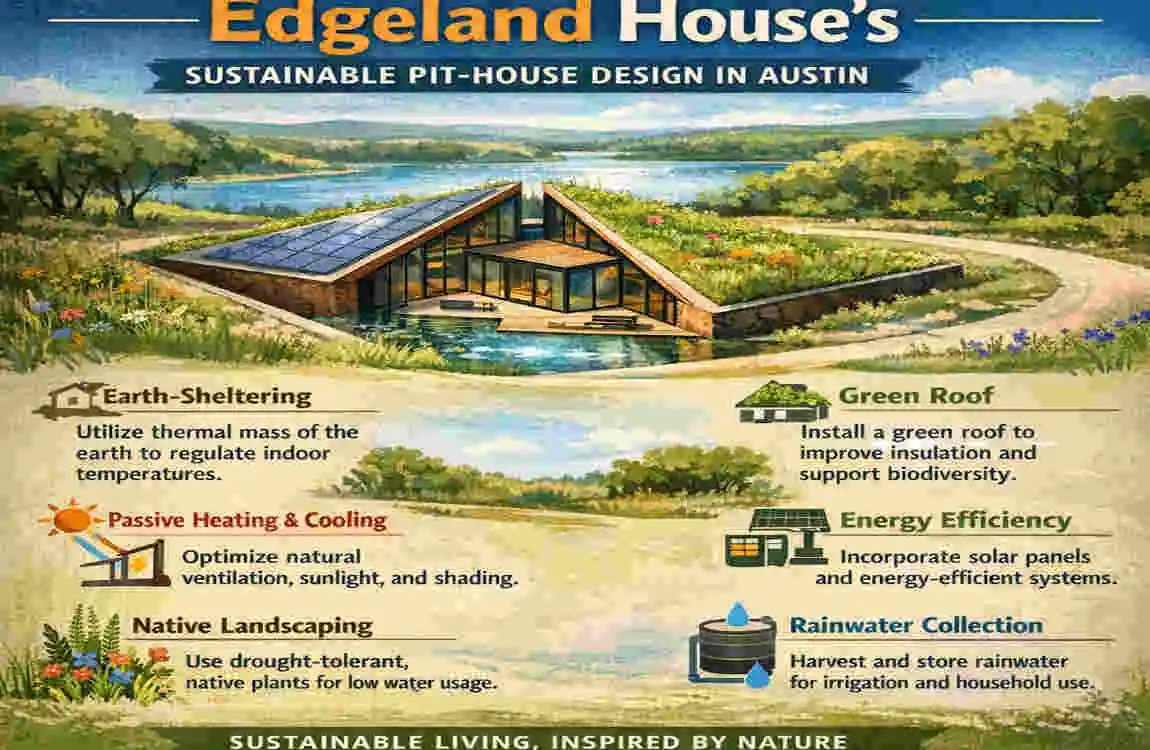
That is totally fair. However, the principles used in Edgeland House can be scaled down and applied to almost any home renovation or new build. Here are practical takeaways for you.
Retrofit with Green Roofs
You don’t need a heavy earth roof to get benefits. Lightweight green roof trays are available for residential use.
- Cost: Generally runs between $10 and $25 per square foot.
- Benefit: Instantly improves insulation and lowers your roof’s temperature, helping your AC work less in the summer.
Embrace Native Landscaping
This is the easiest and most affordable lesson. Stop planting thirsty, high-maintenance lawns that require chemicals and gallons of water.
- Action: Look for plants native to your region (such as the Blackland Prairie grasses used at Edgeland).
- Benefit: They survive droughts, attract pollinators, and require zero fertilizer.
Thermal Mass is Your Friend
If you are building an addition or a new home, consider materials with high thermal mass for your floors or interior walls.
- Materials: Concrete, stone, tile, or rammed earth.
- Benefit: These materials absorb heat during the day and release it at night, naturally stabilizing your indoor temperature.
Solar Orientation
Edgeland House uses glass facing specific directions to catch the winter sun but block the summer sun.
- DIY Tip: Plant deciduous trees on the south and west sides of your home. They provide shade in summer (when they have leaves) and let light through in winter (when they lose their leaves).
ROI Calculation
If you are hesitant about the cost of eco-upgrades, look at the timeline. Most energy-efficient retrofits pay for themselves in 5-7 years via lower utility bills. After that, it is pure savings. Plus, data shows that “green” homes sell faster and for higher prices (often a 10-15% boost in value).
Comparisons with Similar Projects
Edgeland House is unique, but it isn’t the only project pushing the envelope. Let’s see how it compares to other famous eco-structures to give you a better sense of its place in the architectural world.
Project Location Key Similarity: The “Edgeland” Edge
Bullitt Center, Seattle, WA, Net-Zero Energy. While the Bullitt Center relies heavily on solar panels, Edgeland House prioritizes passive thermal mass (the pit design) to reduce energy needs first.
Hobbiton Houses, Matamata, NZ, Earth-Sheltered. The Hobbit houses are whimsical and vernacular. Edgeland House takes that concept but modernizes it with high-tech glass and sharp geometry for a contemporary lifestyle.
Loblolly House, Taylors Island, MD Prefab / Eco-Friendly The Loblolly House sits on the land (on stilts) to minimize impact. Edgeland House goes into the land to actively heal a brownfield site.
FAQs: Common Questions About Edgeland House
What exactly is Edgeland House? Edgeland House is a modern, sustainable residence in Austin, Texas, designed by Bercy Chen Studio. It is a “pit-house,” meaning it is sunken seven feet into the ground to utilize the earth for insulation and energy efficiency.
How does Edgeland House achieve sustainability? It uses a combination of ancient and modern techniques: earth-sheltering for thermal mass, a large green roof for insulation and biodiversity, hydronic heating/cooling, and geothermal energy. It strives for zero-net energy consumption.
Can I build an Edgeland House-style home? Yes, but it requires specialized engineering. You need to account for water drainage (so your pit doesn’t become a pool) and soil pressure. However, you can adopt its features—like green roofs and native landscaping—quite easily with standard permits.
Where is Edgeland House located? It is located in East Austin, Texas, on a rehabilitated brownfield site near the Colorado River.
Is the house open for tours? The house is a private residence, so it is generally not open to the public for walk-ins. However, it is occasionally featured on architectural home tours in the Austin area.