
It happens in the blink of an eye. You let the dog out for a final late-night potty break. You hear a rustle in the bushes, a low hiss, and then your dog comes sprinting back to the porch. Before you even see them, the wall of scent hits you. It’s thick, oily, and smells like burning rubber mixed with rotten eggs.
Panic sets in. You don’t want that smell in your house, but you can’t leave your whimpering pet outside. You check under the sink and realize you don’t have any specialized enzymatic cleaners. What do you do?
This is where understanding natural remedies becomes a lifesaver. You don’t need harsh industrial chemicals to fight this battle. You likely have the answer sitting in your pantry right now.
The Science of Skunk Spray: Know Your Enemy
To effectively fight skunk odor, you have to understand what you are actually cleaning. It isn’t just a “bad smell” like garbage or gym socks. It is a complex chemical weapon.
The Chemistry of the Stink
Skunk spray is an oily, yellow liquid produced by the anal glands of the skunk. It is composed primarily of volatile chemical compounds called thiols (specifically (E)-2-butene-1-thiol and 3-methyl-1-butanethiol).
Thiols are sulfur-based compounds. If you think about the smell of rotten eggs or natural gas, those are sulfur smells. Now, concentrate that by a factor of a thousand, and make it sticky.
However, the smell isn’t the only problem. The spray also contains thioacetates. These are sneaky compounds. Initially, they don’t smell as bad. But when they are exposed to water or humidity over time, they slowly convert into more smelly thiols. This is why a dog can smell fine for a week, get wet in the rain, and suddenly smell like a skunk all over again two weeks later.
Why Natural Removers Work
If you try to wash a skunked dog with just water, the oil repels the water, spreading the thiols over a larger area. You need chemistry on your side.
What is a natural skunk odor remover doing at a molecular level? It usually performs one of three actions:
- Oxidation: This is the heavy hitter. Ingredients such as Hydrogen‘s’s’s peroxide add oxygen molecules to thiols. This changes their chemical structure, turning them into sulfonic acids, which are completely odorless.
- Absorption: Ingredients like baking soda or activated charcoal physically trap the odor molecules within their porous structures, pulling them off surfaces.
- Emulsification: This is where soap comes in. It breaks down the oily binder that holds the smell to your pet’s fur, allowing it to be rinsed away.
Busting the Tomato Juice Myth
We have all heard the old wives’ tale: “Bathe the dog in tomato juice!”
Please, save the juice for your Bloody Mary. Tomato juice does not work.
Here is why: deeply pungent smells can cause “olfactory fatigue.” This means your nose gets so overwhelmed by the skunk smell that it stops registering it. When you introduce a new, strong smell (tomatoes), your brain latches onto it. You think the skunk smell is gone because you smell tomatoes, but you’re just masking it. As soon as the tomato scent fades, the skunk returns. Plus, you’ll have a pink dog.
The Scope of the Problem
You aren’t alone in this. Statistics show that there are over 1 million skunk-spraying incidents in the United States each year. These incidents peak in the fall (when skunks are fattening up for winter) and late spring (mating season).
Now that we know the science, let’s get to the mixing bowl.
Top Natural Recipes: The DIY Arsenal
When you ask, “What is a natural skunk odor remover?” the answer isn’t just one single recipe. Different surfaces and severity levels require different approaches. Here are the top four proven methods.
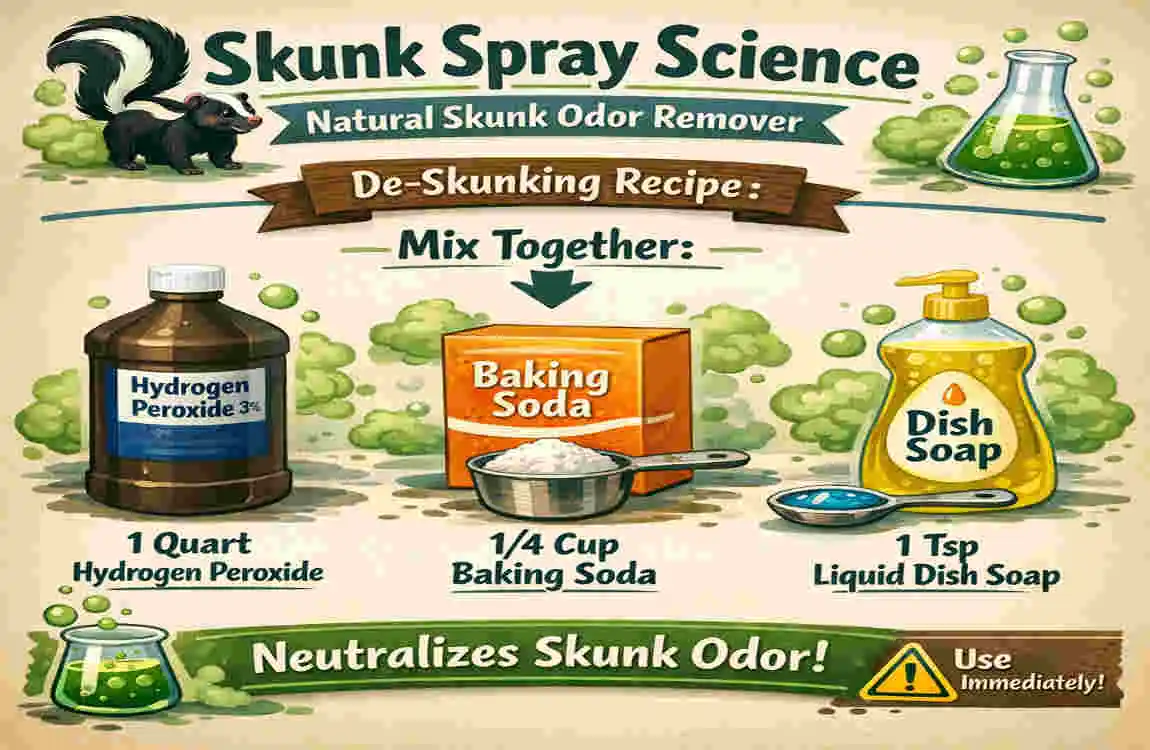
Recipe 1: The “Magic” Peroxide Mix (The Gold Standard)
Chemist Paul Krebaum popularized this recipe in the 1990s. It is widely considered the most effective homemade solution. It works by rapidly oxidizing the thiols.
Ingredients:
- 1 quart of 3% Hydrogen‘s’s’s Peroxide (fresh is best—if the bottle has been open for a year, it’s basically water).
- ¼ cup of Baking Soda (Sodium Bicarbonate).
- 1 to 2 teaspoons of liquid dish soap (Dawn is highly recommended for its grease-cutting power).
How to Use It:
- Mix Immediately: You must mix this right before use. Do not mix it in a closed bottle. The chemical reaction releases oxygen gas, which can cause a closed container to explode. Use an open bucket or bowl.
- Apply Dry: Ideally, apply this to the animal or surface while they are dry. Don’t hose them down first (remember the water activation issue).
- Lather and Wait: Rub the mixture deep into the fur or fabric. It should foam up—that’s the oxygen working! Let it sit for 5 to 10 minutes.
- Rinse: Rinse thoroughly with lukewarm water.
Yield: This makes enough for one medium-sized dog. Cost? About $1.50.
The Vinegar-Baking Soda Spray
If you don’t have peroxide, or you are treating delicate fabrics where peroxide might bleach the color, this is your backup.
Ingredients:
- 1 cup White Vinegar.
- 1 cup of water.
- 2 tablespoons Baking Soda.
How to Use It: Mix the water and vinegar first, then slowly add the baking soda over a sink (it will fizz aggressively). Pour into a spray bottle once the fizzing stops.
The Enzyme-Probiotic Blend
This answers “what is a natural skunk odor remover” from a biological perspective. Instead of chemistry, we use biology.
Ingredients:
- Yogurt whey (the liquid on top of natural yogurt).
- Water.
- Alternatively, purchase a natural enzyme powder from a health store.
How to Use It: Mix the whey with water and saturate the area. Keep it damp.
Why it works: Bacteria and enzymes literally “eat” the organic matter, causing the smell. This takes longer (often overnight), but it is the most thorough way to remove smells from porous surfaces like concrete or wood. Soospets highlights that probiotic blends are often safer for animals with ultra-sensitive skin.
The Citrus-Essential Oil Rinse
This is best used as a finishing rinse after using the Peroxide Mix, or for minor whiff impacts.
Ingredients:
- 1 cup Lemon Juice.
- 10 drops of Orange or Eucalyptus Essential Oil.
- 1 gallon of water.
How to Use It: Mix and pour over the affected area. Do not rinse off immediately; let it air dry if possible (on surfaces, not pets). The citric acid helps cut remaining oils, and the natural oils provide a fresh scent.
Comparison Table: Which Method Should You Choose?
Recipe Best Used For: Preparation Time, Estimated Effectiveness, Risk of Discoloration
Peroxide Mix Pets (Dogs), Skin, Color-safe clothes 2 Minutes 95% (Highest) Moderate (Can bleach dark fur/fabric)
Vinegar Spray Furniture, Carpets, Walls 5 Minutes 80% Low
Probiotic Blend Concrete, Wood, Old odors Overnight 90% None
Citrus Rinse Finishing touch, mild odors 2 Minutes 70% Low
Pet-Specific Fixes: Saving Your Furry Friend
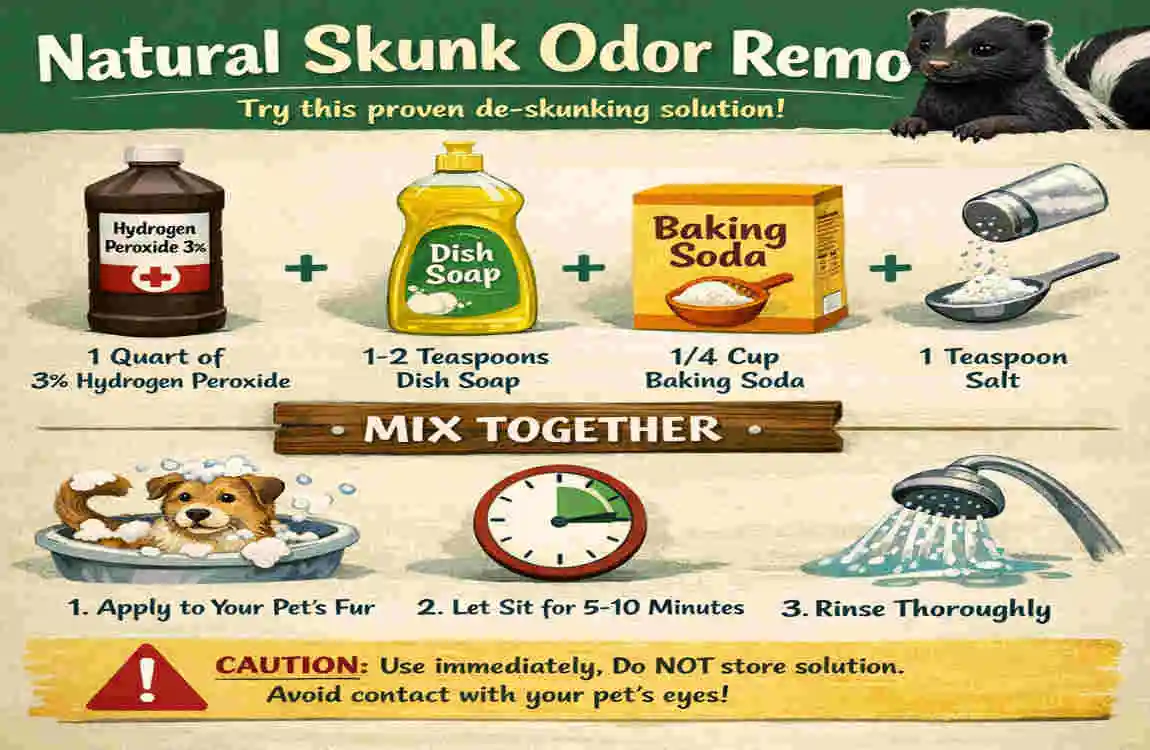
If your dog or cat has been sprayed, your immediate reaction is to grab the hose. Stop! As mentioned, water can set the oils. Here is the step-by-step protocol for pet owners.
Containment
Keep the pet outside. If you bring them in, the volatile oils will instantly attach to your drapes and carpet. If you must bring them inside, head straight to the bathroom and close the door. Open a window.
Check the Eyes
Skunks aim for the face. If your pet’s eyes are red, swollen, or they are pawing at them, the spray got in their eyes. Flush them immediately with cool water or a sterile saline solution for 10 minutes. Do not use the peroxide mix in the eyes!
The Wash (Dogs)
Put on rubber gloves and old clothes. Apply Recipe 1 (The Peroxide Mix).
- Work it into the fur, starting from the collar and working back.
- Be very careful around the face. Use a washcloth to dab the solution on their muzzle, avoiding the eyes and nose.
- Let it sit for at least 5 minutes. You might hear the fizzing sound—that is good.
- Rinse thoroughly.
- Follow up with a regular pet shampoo to remove the sticky residue.
Special Care for Cats
Cats are different. Their skin is thinner, and they groom themselves. While peroxide is generally safe, it can be harsh on a cat’s delicate skin.
- Dilute the peroxide mix with a little more water.
- Be prepared for a struggle; wrap the cat in a towel to control limbs while you apply the solution to the affected area.
- Warning: Never use essential oils (like tea tree or citrus) on cats, as their livers cannot process them, and they can be toxic.
Post-Bath Care
Towel dry your pet. Do not use a hair dryer on hot; the heat can bake remaining oils into the hair shaft. Once they are dry, sprinkle cornstarch over their coat and brush it out. This acts as a final dry shampoo to absorb any trace moisture and odors.
Home and Surface Cleaning: When the Smell Gets In
Maybe the dog ran through the living room, or perhaps a skunk sprayed directly under your floorboards. Now your house smells like a chemical plant.
Fabrics and Carpets
If the smell is in the carpet, act fast before it settles into the padding.
- The Sprinkle Method: Liberally sprinkle baking soda over the entire carpet. Let it sit overnight. The baking soda acts as a sponge.
- Vacuum: Vacuum it up the next day.
- Steam Clean: If the smell persists, use a steam cleaner, but add Recipe 2 (Vinegar Mix) to the tank instead of commercial chemical cleaners. The heat plus vinegar helps lift the oils.
For laundry, throw washable items in the washer. Add your regular detergent plus 1 cup of white vinegar to the rinse cycle. Do not put clothes in the dryer until you are sure the smell is gone, as heat sets the odor permanently.
Walls and Furniture
Skunk oil is volatile, meaning it travels through the air and sticks to vertical surfaces.
- Walls: Wipe down walls with a mixture of water and 10% white vinegar.
- Hard Furniture: Wood furniture can be wiped with a wood-safe oil soap.
- Ventilation: This is critical. Open all windows. Turn on ceiling fans. You need to swap the air in the house. Place bowls of white vinegar in the corners of the room to absorb odor particles that float in the air over the next 48 hours.
Outdoor and Yard Cleaning
If the spray happened on your deck or porch:
- Hose down the area.
- Scrub the deck with a stiff broom and Recipe 2.
- The Coffee Trick: If the smell is coming from the soil (maybe under a porch), spread used coffee grounds over the area. The nitrogen in the coffee helps break down the oils, and the strong coffee scent helps mask the transition.
Car and Outdoor Gear Fixes
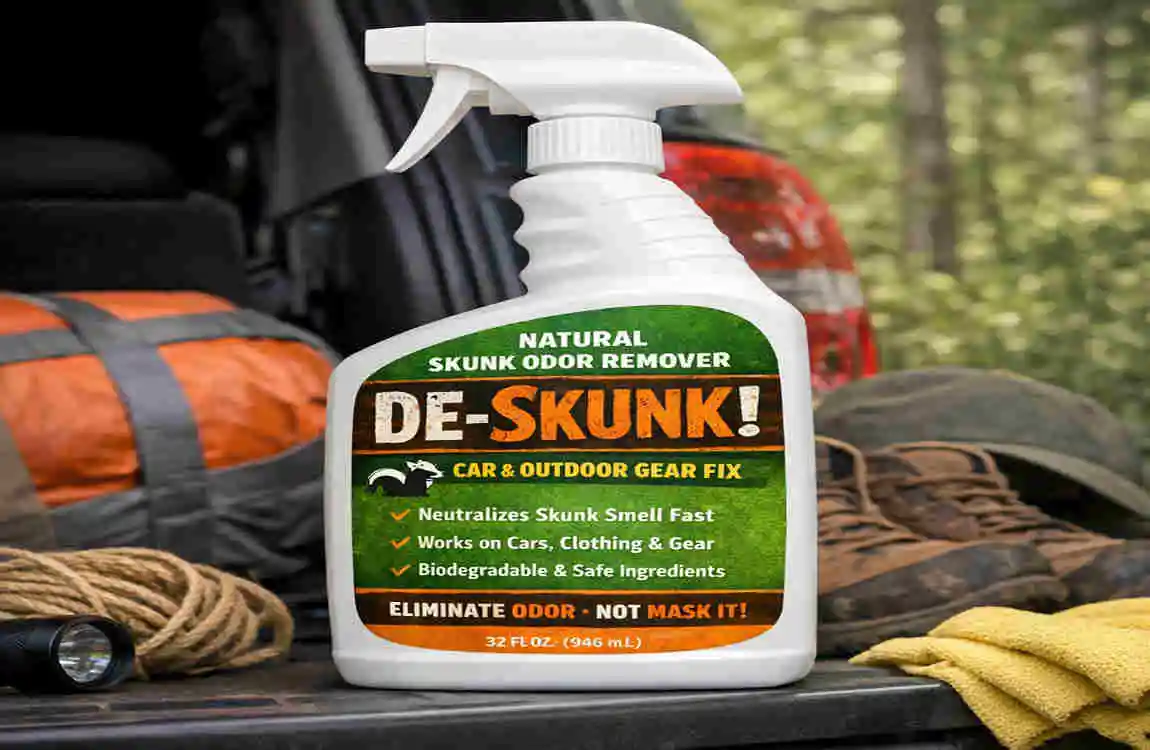
There are a few things worse than a skunk spraying near your car air intake or your hiking gear getting hit on the trail.
De-Skunking Your Car
Because a car is a small, enclosed metal box, smells intensify rapidly.
- Air it out: Leave the doors open in a safe place for as long as possible. Sunlight (UV rays) helps break down the thiols.
- The Tire Trick: Skunks often spray tires. Wash the tires and undercarriage with the Peroxide Mix.
- Upholstery: Sprinkle baking soda on the seats and floor mats. Wait 3 hours, then vacuum.
- The Vents: This is the tricky part. If the smell is coming from the AC, replace the cabin air filter immediately. Then, place a few dryer sheets or coffee filters filled with baking soda inside the vents while the car is parked.
Camping and Hiking Gear
For backpacks and tents, you cannot usually throw them in a washing machine.
- The Bathtub Soak: Fill a bathtub with warm water and a cup of enzyme cleaner or Recipe 3.
- Submerge the gear and let it soak for an hour.
- Hang to dry in direct sunlight. UV light is a powerful natural oxidizer.
Prevention Tips: Keeping the Stripe Away
The best natural skunk odor remover is not having to use one at all. Skunks are generally docile and only spray when threatened, but they are attracted to food and shelter.
- Remove Food Sources: Skunks love pet food, fallen fruit, and grubs. Feed pets indoors and secure your garbage cans with bungee cords or locking lids.
- Light it Up: Skunks are nocturnal and prefer shadows. Motion-sensor floodlights are a great deterrent.
- Citrus Peels: Skunks dislike the smell of citrus. Scatter orange and lemon peels around the perimeter of your porch or shed.
- Block Access: Inspect your home for holes under porches or decks. Use chicken wire (buried 6 inches deep) to prevent them from digging a den under your house.
If you are a homeowner, regular property maintenance is key. Check out our related articles on [Real Estate Cleaning Tips] for more on maintaining your property value.
FAQs: Quick Answers for Stinky Situations
Q: What is a natural skunk odor remover? A: It is a homemade mixture, usually consisting of Hydrogen‘s’s’s’s’s’s’s’s peroxide, baking soda, and dish soap, that chemically neutralizes the odor-causing compounds in skunk spray without toxic chemicals.
Q: Does Hydrogen peroxide actually work on skunk smell? A: Yes! As explains, the oxygen molecules in the peroxide react with the thiols (sulfur) in the spray, changing their structure so they no longer have a scent.
Q: How long does skunk smell last if untreated? A: If you do nothing, the smell can linger for 2 to 4 weeks. However, if the oils seep into porous surfaces like wood or drywall, they can last for months during humid weather.
Q: Is the peroxide recipe safe for all pets? A: It is generally safe for dogs and cats if kept out of their eyes and mouths. However, it can bleach black fur slightly if left on too long. Always rinse thoroughly.
Q: Are commercial removers better than natural ones? A: Not necessarily. Many commercial removers use the same enzymatic or oxidation principles, but they cost 10 times as much. Natural remedies are fresher (more active oxygen) and cheaper. Nature’s Miracle is a great product, but the DIY version is just as effective if mixed fresh.