Have you ever pulled into your driveway, looked at that massive moving wall we call a garage door, and wondered, “How tall is a garage door supposed to be, anyway?”
It’s a question that usually pops up in two specific scenarios: you are building a dream home and staring at blueprints, or worse, you just bought a lifted truck with a roof rack, and you’re terrified it won’t fit inside. If you are nodding your head right now, don’t worry—you are definitely not alone. The garage is the workhorse of the modern home, yet its dimensions are often a mystery until it’s time for an upgrade or a repair.
However, knowing the numbers is just the tip of the iceberg. The difference between a 7-foot door and an 8-foot door might seem like just 12 inches, but that single foot can determine whether you park your SUV inside or leave it out in the rain. Proper garage door height prevents vehicle damage, boosts your home’s curb appeal, and can even significantly add to your property value.
Standard Garage Door Heights: The Core Standards
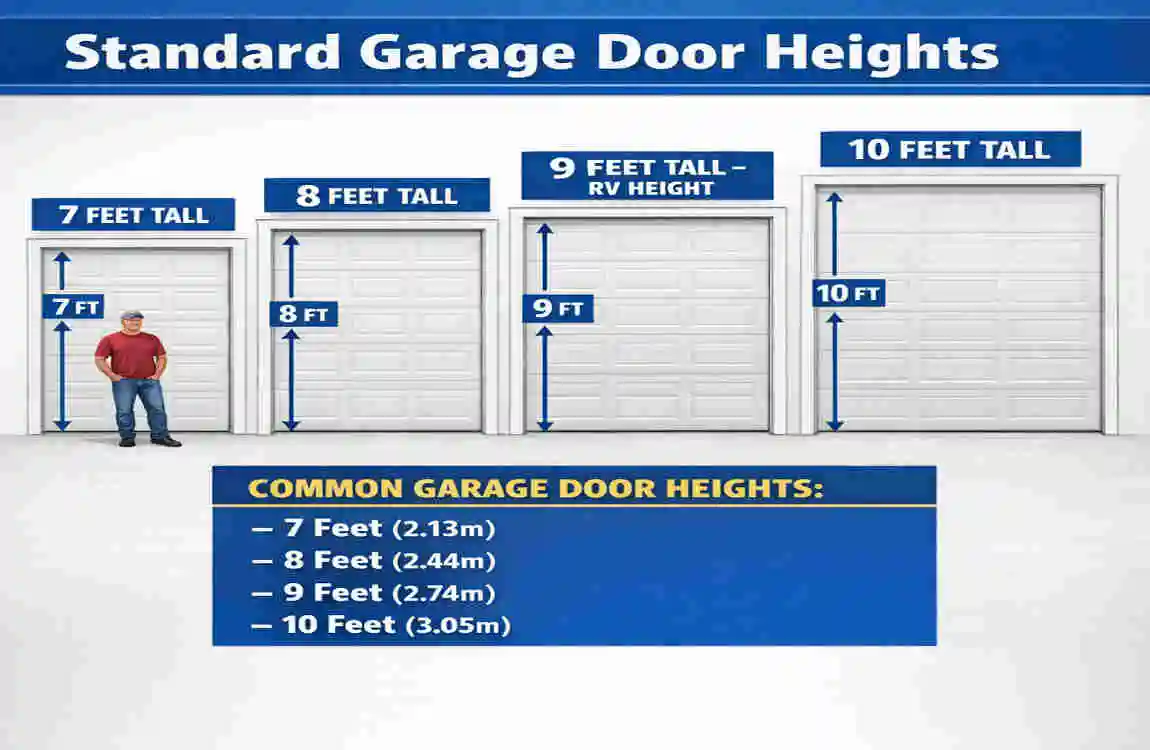
When we talk about residential real estate, standardisation is key. It keeps costs down and ensures that products are readily available. When asking how tall a garage door is, you will almost always encounter two specific measurements.
The 7-Foot Standard (The Classic Choice)
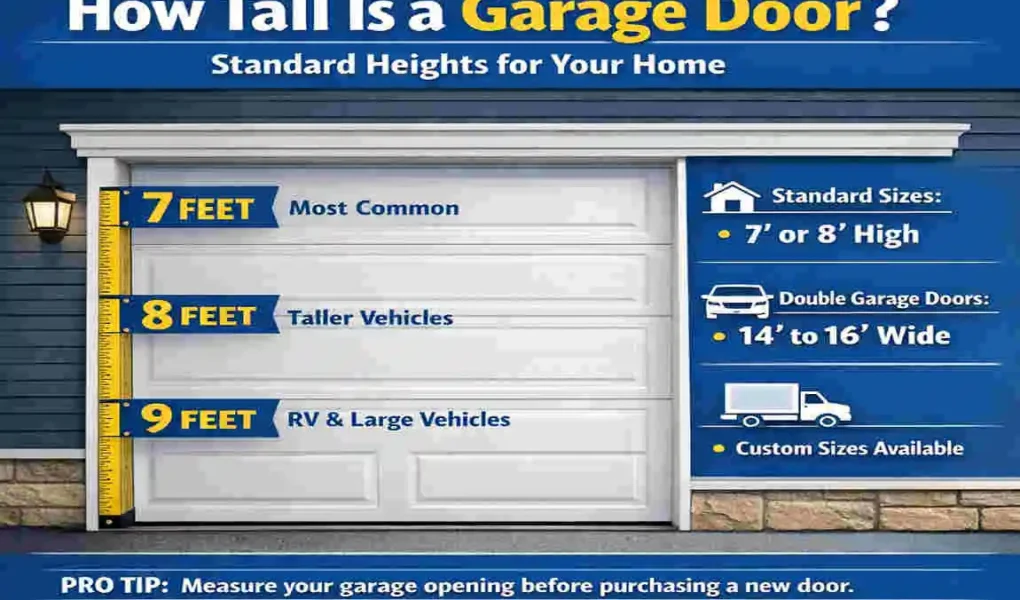
For decades, the 7-foot (84-inch) garage door has been the undisputed king of residential construction. If you live in a home built between the 1950s and the early 2000s, there is a very high probability—roughly 90%—that your garage door is exactly 7 feet tall.
Why is this size so common? It comes down to utility. Standard sedans, compact cars, and even most stock SUVs fit comfortably under a 7-foot header. In metric terms, this is approximately 2.13 meters. For the vast majority of homeowners using their garage for a Toyota Camry or a Ford Explorer, a 7-foot door provides plenty of clearance without wasting building materials.
The 8-Foot Trend (The Modern Upgrade)
In recent years, particularly in homes built after 2010, we have seen a significant shift toward 8-foot (96-inch) doors. This isn’t just an aesthetic choice; it’s a lifestyle necessity.
As our vehicles have gotten larger—think full-size pickup trucks, large SUVs with roof racks, and cargo vans—the need for vertical clearance has increased. An 8-foot door (approx. 2.44 meters) offers that critical extra breathing room. It effectively “future-proofs” your home. Even if you drive a small sedan now, the next owner of your house might drive a lifted Jeep.
Understanding the Height vs Width Dynamic
While height is our main focus, it is impossible to choose a door without considering the width. The height usually remains the same (7 or 8 feet) regardless of whether the door is for one or two cars.
Here is a quick comparison table to help you visualise standard dimensions:
Door Type Standard Height Common Widths Best For
Single-Car 7 ft (84 in) 8 ft, 9 ft, 10 ft Sedans, small SUVs, motorcycles
Double-Car 7–8 ft (84–96 in) 16 ft, 18 ft Households with two vehicles
Oversized/RV 10–14 ft 10–12 ft, up to 20 ft Lifted trucks, boats, RVs
The Pros and Cons of Standard Heights
Choosing between 7 and 8 feet often comes down to budget versus utility.
The 7-Foot Door:
- Pros: It is the most affordable option. Replacement parts are available at any hardware store, and it is highly energy-efficient due to its smaller surface area.
- Cons: It feels tighter. If you add a roof box to your car for a ski trip, you might scrape the top.
The 8-Foot Door:
- Pros: Maximum versatility. It makes the garage feel cavernous and open. It accommodates tall vehicles effortlessly.
- Cons: It costs more upfront for the door and the installation. It requires higher ceilings in the garage structure (typically 9 feet or more).
How Panels Dictate Height
Have you ever noticed the horizontal lines on a garage door? Those are the sections, or panels. Understanding these panels helps you do the math on height.
Most manufacturers produce panels in heights of 18, 21, or 24 inches.
- For a 7-foot door: You typically see four sections that are 21 inches tall (4 x 21 = 84 inches).
- For an 8-foot door: You might see four sections of 24 inches, or a different combination depending on the design.
If you are ever unsure about your current door’s height and don’t have a tape measure handy, just count the panels! If there are four panels, it’s likely a standard 7-footer.
Garage Door Types by Height
Not all garages are created equal. The answer to how tall a garage door is is can vary widely depending on the building’s intended use. Let’s break down the different categories.
Single vs Double Car Doors
It is a common misconception that double-car doors are taller than single-car doors. Generally, they are the same height.
Single Car Doors: These are the standard “bays” you see in older homes or townhouses. They are typically 7 to 8 feet tall and 8 to 9 feet wide. The challenge here isn’t usually the height; it’s the width. Parking a wide truck in a single bay requires precision. However, the vertical clearance remains standard.
Double Car Doors: These are the massive doors that span the width of two vehicles. They maintain the 7 to 8-foot height standard but stretch to 16 or 18 feet wide. In modern suburban homes, the 16×7-foot door is the most ubiquitous size in America. It allows two cars to park side by side comfortably.
Commercial and Custom Options
Once you leave the residential zoning, the rules change. Commercial garage doors are beasts of burden. They need to accommodate forklifts, semi-trucks, and heavy machinery.
Commercial doors often range from 10 to 24 feet tall, or more. They use different hardware, such as vertical lift tracks that run straight up the wall to the ceiling, rather than curving back into the room. If you run a home-based business that involves box trucks, a standard residential door won’t cut it.
RV and Oversized Garage Doors
This is a rapidly growing category. As more Americans buy recreational vehicles (RVs) and boats, the demand for “RV Garages” attached to the main home has skyrocketed.
So, how tall is a garage door for an RV?
- Class B Motorhomes (Camper Vans): Usually require a 10-foot door.
- Class A and C Motorhomes: These are the big bus-style rigs. They typically need 12 to 14 feet of vertical clearance.
If you are building a custom home with an RV bay, the golden rule is: Go taller than you think you need. If your RV is 12 feet tall, install a 14-foot door. This accounts for AC units on the roof, satellite dishes, and ease of entry.
Height Requirements by Vehicle Type
To make this easier, here is a breakdown of what height you need based on what you drive:
Vehicle Type Minimum Door Height Recommended Door Height
Sedan / Hatchback 7 ft 7 ft
Small SUV (CR-V, RAV4) 7 ft 7 ft
Large SUV (Suburban, Escalade) 7 ft 8 ft (for comfort)
Lifted Truck / 4×4 8 ft 8 ft+
Car with Roof Box 8 ft 8 ft
RV / Boat on Trailer 10 ft 12–14 ft
Material Impact on Height
Believe it or not, the material can dictate the size.
- Steel/Aluminium: These come in highly standardised rolls and stamped panels. Getting a 7-foot or 8-foot steel door is easy and cheap.
- Wood: Wood doors are heavy. A very tall wood door (over 8 feet) puts immense strain on the opener and springs. Custom wood doors often require heavy-duty industrial hardware.
- Glass/Aluminium Frame: These are popular in modern architecture. Because glass is heavy and fragile, the frame structure must be robust. These are fully customizable, but can get very expensive as you increase height.
Factors Influencing Height Choice
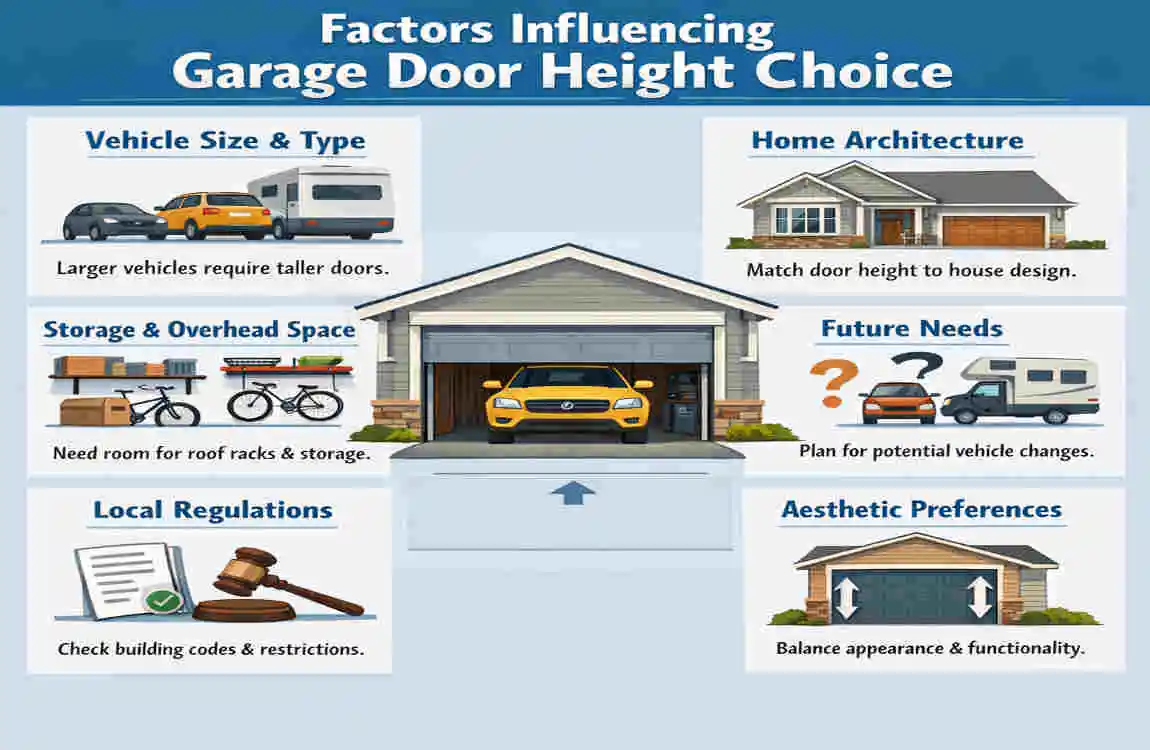
If you are in the position to choose your garage door height, do not just pick the cheapest option. Several factors should influence your decision to ensure you don’t regret it later.
Vehicle and Lifestyle Needs
This is the most obvious factor. Take a tape measure to your current vehicle. Measure from the ground to the absolute highest point.
Crucial Tip: Do you use a Thule or Yakima cargo box? Do you carry kayaks on J-cradles? Do you mount mountain bikes on the roof? A standard SUV might be 6 feet tall, but add a bike rack with a bike on it, and you are suddenly at 9 feet. A 7-foot door will strip your expensive gear right off the roof (a painful and expensive mistake that happens more often than you’d think). If you lead an active outdoor lifestyle, an 8-foot door is practically mandatory.
Future-Proofing
Think about the car you want in five years, not just the car you have today. Electric Vehicles (EVs) are changing the game. While sedans like the Tesla Model 3 are low, new electric trucks and SUVs are trending larger and taller to accommodate battery packs and offer aggressive styling. By installing an 8-foot door now, you ensure your garage remains usable for the lifespan of your home ownership.
Home Architecture and Structural Limits
You can’t just slap an 8-foot door into any garage.
- Headroom: The garage door needs space to roll up. To install an 8-foot door, your garage ceiling must be at least 9 feet tall.
- The Header: The structural beam above the door opening (the header) supports the roof. Moving this to make a door taller is a major renovation involving contractors and engineers.
- Tracks: The horizontal tracks need to hang from the ceiling. If you have ductwork or storage racks hanging low, they might interfere with a taller door.
Regional Trends
Where you live matters; in older suburbs in the Northeast or Midwest, 7-foot doors are the norm. In the Southwest and newer developments in Texas or Florida, 8-foot doors are becoming standard to accommodate the popularity of larger trucks. Sticking to regional standards helps with resale value; you don’t want to be the only house on the block that can’t fit a pickup truck.
Cost Breakdown
Money talks. How much more does that extra foot cost?
- The Door: Expect to pay about 20% to 30% more for an 8-foot door compared to a 7-foot door of the same style.
- The Labour: Installation costs are slightly higher due to the weight and size.
- The Opener: You may need a longer rail for your garage door opener, which is a small upcharge but necessary.
- Range: A standard 7-foot steel door might cost $800–$1,500 installed, whereas an 8-foot version could run $1,100–$2,000.
Installation & Measurement Guide
Okay, you are ready to move forward. How do you measure correctly? This is where many DIY enthusiasts make mistakes. You don’t measure the door; you measure the opening.
Step-by-Step Measurement Guide
Measure the Width: Measure the width of the structural opening at three points: the left side, the right side, and the centre. Use the widest measurement. This is the distance between the two sides of the finished frame.
Measure the Height: This is the big one. Measure from the concrete floor to the underside of the header (the top of the opening). Measure at the left, centre, and right.
- Note: If one side is lower due to the floor settling, you need to address that level issue, or the door won’t seal properly.
Measure the Sideroom: Measure the distance from the side of the opening to the nearest wall. You generally need 3.75 to 5 inches on each side for the vertical tracks.
Measure the Headroom: Measure from the top of the door opening to the ceiling (or the lowest obstruction like a light fixture).
- Standard Track: Needs 10–12 inches of headroom.
- Low Headroom Track: Can work with as little as 4–6 inches (requires special hardware).
Measure the Backroom: Measure the depth of the garage. For a 7-foot door, you need about 8.5 feet of depth unobstructed. For an 8-foot door, you need 9.5 feet.
Pro-Tips for Success
- Don’t Guess: “It looks like standard size” is a recipe for disaster. Custom doors are non-returnable.
- Check the Floor: If your concrete floor is cracked or heaved, the door won’t close flush. You might need a thicker bottom weather seal.
- Call a Pro: Garage door springs are under immense tension and can be dangerous. While measuring is a safe DIY task, installation is best left to certified professionals.
Frequently Asked Questions
How tall is a garage door for a single car? The standard height for a single-car garage door is 7 feet. However, 8-foot-tall doors are available and becoming more common. The width is what usually defines a “single car” door (typically 8 to 10 feet wide).
Are 8-foot garage doors more expensive? Yes, typically. You can expect to pay a premium of roughly $100 to $300 more for the door itself compared to a 7-foot model. You may also need to purchase an extension kit for your garage door opener, which adds a small cost.
Can I customisecustomise the height of my garage door? Yes, but it is complicated. Custom heights are available (e.g., 7 feet 6 inches), but they are usually “cut down” from larger doors, which increases labour costs. Additionally, changing the height of an existing opening requires structural carpentry to move the header, which is a significant renovation project.
How tall is a garage door in meters? For our friends using the metric system:
- A 7-foot door is approximately 2.13 meters.
- An 8-foot door is approximately 2.44 meters.
Does a taller garage door increase home value? Generally, yes. It increases the “usability” of the home. If a potential buyer has a lifted truck or an oversized SUV, a garage with an 8-foot door becomes a major selling point compared to a neighbour’s house that only has a 7-foot clearance.