Consider adding a garage to your house. If you are tired of scraping ice off your windshield in the winter or burning your hands on the steering wheel in the summer, a garage is probably on your mind. You are probably wondering: how much does a house garage cost?
It is the ultimate question for any homeowner looking to upgrade their property. Whether you want a simple spot to park your sedan, a dedicated workshop for your weekend projects, or a massive storage area for your family’s bicycles and holiday decorations, understanding the financial commitment is your very first step.
We will also break down how the specific type of garage you choose—whether it is safely attached to your home or sitting beautifully detached in the backyard—drastically affects the final price tag. Furthermore, we will dive into regional differences, material costs, and the sneaky hidden fees that catch so many homeowners off guard.
Why You Should Care About Garage Costs for Your House
Before we start crunching the numbers, we need to talk about why building a garage is such a big deal. Why should you care so deeply about garage costs? Because this is not just an expense; it is a true investment in your daily life and your financial future.
First and foremost, a garage adds incredible functional value to your house. Think about the peace of mind that comes with knowing your vehicles are completely protected from harsh weather. Whether it is pounding hail, heavy snow, or blistering sun, a garage extends the life of your car’s exterior.
Furthermore, it protects your vehicles from theft and vandalism. By moving your cars off the street and into a secure building, you dramatically lower your risk of break-ins. It also frees up valuable driveway space and significantly improves your property’s curb appeal. Nobody likes looking at a driveway cluttered with cars, trash cans, and random outdoor gear!
Beyond the daily convenience, we need to discuss the property’s impact on value. When you ask, ” How much does a house garage cost, you should also be asking, ” How much value will this add to my home?
Real estate experts continually agree that an attached garage can vastly increase your home’s resale value. Buyers actively look for homes with secure parking. In many suburban neighborhoods, a house without a garage is actually a dealbreaker for potential buyers.
Of course, the costs will vary wildly depending on whether you are doing new construction alongside a brand-new house build, or if you are doing a renovation and extension on an existing property. Retrofitting a garage onto an older home often requires more complex engineering and design.
Ultimately, understanding the cost of adding a garage helps you budget for a project that pays dividends over time. Building a garage on an existing house might seem intimidating at first glance. Still, when you look at the cost of an attached vs. detached garage as a long-term investment, the numbers make a lot of sense.
What Determines How Much a House Garage Costs?
When you ask a contractor, “How much does a house garage cost?” their first response is usually, “Well, it depends.” While that might sound frustrating, it is entirely true.
A garage is essentially a mini-house. It requires a foundation, walls, a roof, and sometimes electricity and plumbing. Let us break down the primary factors that affect your final bill.
Garage Size (Single-Car vs Multi-Car)
The sheer physical size of your project is the biggest cost driver. The more square footage you build, the more materials and labor you have to pay for.
Typical square footage breaks down like this:
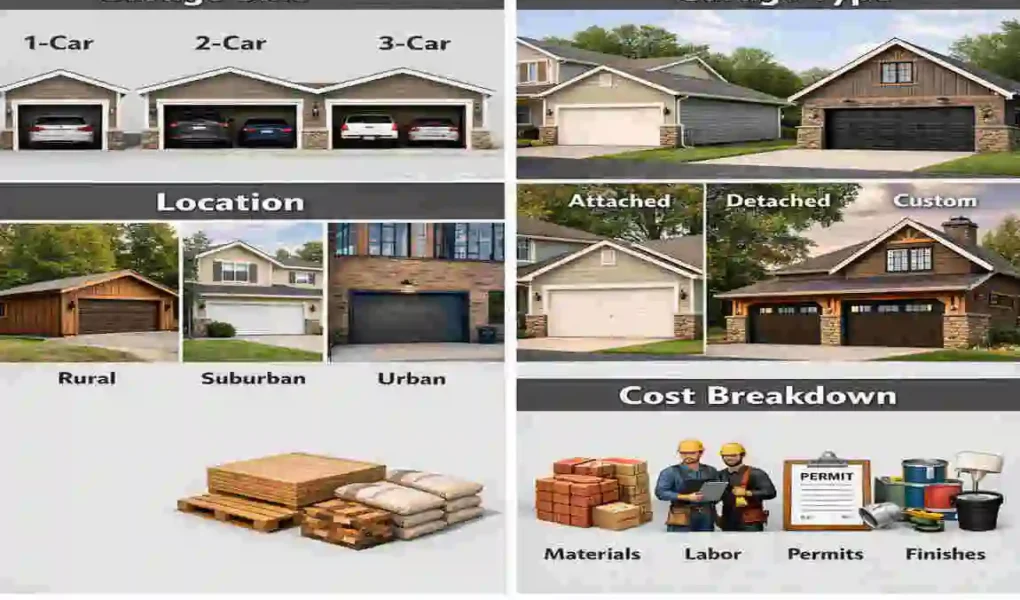
- 1-car garage: Usually ranges from 200 to 300 square feet. It is compact, designed for one vehicle, and offers a bit of storage.
- 2-car garage: Generally ranges from 400 to 600 square feet. This is the American standard, offering room for two cars or one car and a generous workspace.
- 3-car garage: This beast takes up 600 to 900 square feet. It is perfect for multi-vehicle families, boat owners, or serious hobbyists.
Naturally, a larger size equals a higher total cost. However, there is a silver lining. Because of the economies of scale, the per-square-foot price actually drops slightly as you build bigger. So, if you are wondering how much a house garage costs for a 2-car setup, you might find it offers the best bang for your buck compared to building a tiny 1-car unit.
Garage Type (Attached vs Detached vs Carport)
The structural style you choose drastically affects the cost of a house garage.
- Attached garages are directly connected to your house. They offer incredible convenience—you can carry your groceries inside without getting rained on. However, they come with a higher cost because builders must carefully tie the new structure into your home’s existing foundation and roofline. They also require better fire-rated insulation.
- Detached garages sit entirely separate from your main house. They are often cheaper to build structurally because contractors do not have to worry about matching your home’s exact architecture or altering your current roof. However, you may need to spend extra money trenching the yard to run electricity or water out to the building.
- Carports are your lowest cost option. They feature a roof supported by posts, but they lack walls. They offer minimal protection from blowing rain or snow, but they are incredibly budget-friendly.
Construction Materials and Finish Level
Are you building a basic shed for your car, or a luxury showroom? The “finish level” drives massive price swings.
If you stick to basic materials, you will keep costs low. This means standard wood framing, simple vinyl siding, exposed interior studs, and basic, uninsulated garage doors.
If you upgrade to Premium finishes, your costs will skyrocket. Adding thick insulation, smooth drywall, interior paint, custom cabinetry, epoxy-coated floors, and high-end carriage-style doors will make your garage feel like an extension of your living room. Still, you will pay a Premium for that luxury.
Location and Local Market Rates
Where you live dictates how much you will pay for almost everything. Local labor and material costs vary wildly between urban, suburban, and rural areas.
If you live in a high-cost metropolitan area, contractors charge more for their time. You will also face higher local permitting and inspection fees. Conversely, building a garage in a lower-cost, rural region will usually come with a much friendlier price tag. However, you may pay more to have materials delivered out to the country.
Foundation, Roof, and Utilities
Finally, the bones of the structure matter.
Most garages sit on a simple concrete slab foundation. However, if your property is on a steep hill, you might need a more expensive foundation with deep footings or even a basement-style setup.
Your roof complexity also plays a role. A simple gable roof (the classic triangle shape) is cheap and easy to build. If your attached garage requires a complex roof that seamlessly blends into your home’s intricate roofline, expect to pay more.
Lastly, do not forget about utilities. Basic electrical wiring for a few lights and outlets is standard. But if you want to run heavy-duty 240-volt outlets for power tools, install an electric vehicle (EV) charging station, or add an HVAC system for climate control, your costs will climb rapidly.
Now, let’s break down actual price ranges for different sizes.
How Much Does a House Garage Cost by Size?
To give you a realistic idea of what to expect in 2026, let us look at the numbers. Keep in mind that these are national averages, and your specific quotes will depend heavily on the factors we just discussed.
How Much Does a 1-Car House Garage Cost?
A 1-car garage is perfect if you have limited yard space or a strict budget.
For a typical 1-car garage, you are looking at a cost range of roughly $15,000 to $25,000. If we break that down by square footage, it usually lands in the mid-hundreds per square foot.
For example, a basic 1-car attached garage with simple vinyl siding might run around $16,000. At the same time, a high-end version built with custom brick to match an older home could easily exceed $28,000.
The main cost drivers for these small garages are the concrete foundation slab, the framing lumber, the roofing materials, and the single garage door. Because the footprint is small, you don’t get much of a bulk discount on labor or materials.
How Much Does a 2-Car House Garage Cost?
The 2-car garage is the undisputed king of the American suburbs. It is the most common choice for family homes because it offers the perfect balance of vehicle parking and extra storage space for lawnmowers, bikes, and tools.
In 2026, the current average range for a 2-car garage is $30,000 to $55,000.
If you want a mid-range option with standard siding and basic power, you will likely land around $40,000. If you step up to high-end options with finished drywall and insulated doors, you will push toward the higher end of that scale.
As mentioned earlier, the per-square-foot cost often dips slightly compared with a 1-car build. Your contractor is already on-site with the cement trucks and framing crew; scaling the building up by 15 feet doesn’t double their logistical efforts.
How Much Does a 3-Car House Garage Cost?
If you have a large family, multiple drivers, or a serious passion for woodworking or auto restoration, a 3-car garage is a dream come true.
However, this larger footprint requires significantly more materials and much higher labor costs. You can expect to pay anywhere from $50,000 to $85,000, or more, for a 3-car structure.
Total costs for a massive 3-car garage can easily approach or exceed the cost of a small home addition. These structures often require additional utility sub-panels, wider driveways, and heavy-duty roof trusses to span the wide-open space inside.
When you start adding “dream garage” features—like a dedicated workshop zone, built-in compressed air lines, or a car lift—the price inflates very rapidly. If you are asking how much a house garage costs for a 3-car setup, prepare your budget for a major construction project.
Cost Ranges by Size (2026)
To make things easy to digest, here is a quick reference table outlining the costs based on 2026 market averages:
Size (Car Capacity)Typical Sq Ft Avg Cost Range (2026)Notes
1-car 200–300 $15,000–$25,000 Smallest footprint, basic finish level
2-car 400–600 $30,000–$55,000 Most common choice, better value per sq ft
3-car 600–900 $50,000–$85,000+ Significantly higher cost, usually requires more utilities
How Garage Type Affects How Much a House Garage Costs
Beyond the building’s physical size, how your garage integrates with your property plays a major role in your budget. Let us look at how the structure’s style dictates the final bill.
Attached Garage Cost
Building an attached garage is the most popular route for homeowners who prioritize comfort.
The Pros: The convenience is unbeatable. You can walk straight from your kitchen into your car. They offer better security since they are physically connected to your home’s alarm system. They also benefit from the shared insulation of the house wall, making them slightly easier to keep warm in the winter.
The Cons: They almost always cost more. This is due to the complex structural tie-ins required. A contractor must carefully strip back your home’s siding, tie the new roof into your existing roof to prevent leaks, and ensure the new foundation does not compromise your home’s foundation. You will also face stricter permitting, as building codes require heavy firewalls between living spaces and garages.
Generally speaking, you can expect an attached garage to cost roughly 10% to 15% more than a detached garage of the same size.
Detached Garage Cost
If you have a large backyard or a long driveway, a detached garage is a fantastic option.
The Pros: They are much easier to site and design. Because they stand alone, contractors can often use cheaper materials and build a much simpler roof structure without worrying about matching the exact pitch of your house. They are also perfect for messy or loud hobbies; if you are running a table saw at 9 PM, you won’t wake up the whole house.
The Cons: They are less integrated with the house, meaning you have to brave the elements to get to your car. Furthermore, you will need additional utility work. Trenching electrical wires and plumbing lines across your yard adds to the bottom line.
Despite the trenching, if you want to know how much a house garage costs on a tight budget, choosing a detached layout often significantly lowers the price.
Carport vs Full Garage
What if you want to keep the sun off your car? A carport is your low-cost alternative.
Because it is essentially just a roof structure with no full enclosure, no automatic doors, and no heavy foundation walls, you can often build a great carport for $3,000 to $10,000.
However, we must emphasize that a carport does not answer the same use case as a full garage. It will not protect your tools from thieves, keep mice out of your engine block, or provide a warm place to work in the winter.
FAQ: Is an attached garage always more expensive than a detached one? In almost all typical residential scenarios, yes. The required structural engineering, roof integration, and strict firewall code compliance make tying a new structure into an existing home more labor-intensive and costly than building a standalone box in the backyard.
How Location Affects How Much a House Garage Costs
You know the old real estate saying: location, location, location. Well, it applies to construction, too! Your zip code has a massive impact on your final quote.
When you compare high-cost regions, such as major coastal cities or booming tech hubs, with low-cost regions, such as mid-size midwestern towns or rural agricultural areas, the differences are staggering.
Why does this happen? First, local labor rates vary. A master carpenter in San Francisco costs significantly more per hour than a master carpenter in rural Ohio. Second, material shipping plays a part. If you live far away from lumber mills or concrete plants, you pay more for transportation.
Finally, weather-related building codes change the price. If you live in a snowy northern climate, local codes require reinforced roof trusses to handle heavy “snow loads,” plus a foundation that reaches below the deep frost line. If you live in a hurricane zone, you have to pay for expensive wind-resistant garage doors and hurricane-tie framing.
How much does a house garage cost in Pakistan?
If we look at an international context, such as building a house garage in Pakistan, the entire pricing model changes.
In Pakistan, typical construction materials differ vastly from Western-style timber framing. Garages are predominantly built using brick masonry, Reinforced Cement Concrete (RCC) roofs, or, for cost-effective shading, corrugated zinc sheets. Labor is considerably cheaper, but materials like Premium cement and steel rebar fluctuate with global markets.
Therefore, a brick-and-mortar garage in a high-cost area like a posh sector of Islamabad will still cost significantly more than a simple structure in a rural village. Still, the overall cost will be a fraction of the US dollar amounts listed above.
Whether you are asking, “How much does a house garage cost in a city vs. thevs. the countryside?” When exploring international markets, remember that where you build is just as important as what you build.
Extras That Make How Much a House Garage Costs Climb
When homeowners start budgeting, they usually look at lumber, concrete, and a garage door. But several sneaky line items can bust your budget if you aren’t prepared. Let us look at the extras that drive up the cost.
You need to consider permits and inspections. These are non-negotiable legal fees. Your city or county will require you to pay for building permits before you break ground, and they will send inspectors out to ensure the work is up to code. Depending on your municipality, this can add anywhere from $500 to $2,000 to your budget.
Don’t forget about site preparation. Is your yard perfectly flat and clear? Probably not. You have to pay for grading the soil, excavating for the foundation, and possibly removing old structures or deep tree roots. If you hit a massive boulder while digging the foundation, your costs will jump.
Utilities and upgrades are another major factor. Adding basic electrical wiring is one thing, but running heavy 220v lines, installing abundant LED lighting, installing multiple outlets, or installing a small HVAC mini-split system for climate control will add thousands of dollars.
Drainage and waterproofing are critical for the long-term durability of your garage. You may need to install French drains around the foundation or slope your new driveway perfectly to ensure rainwater doesn’t flood your new space.
Your choice of garage doors and openers matters a lot. A standard aluminum door is cheap. But if you want Premium insulated wooden carriage doors with ultra-quiet, Wi-Fi-enabled smart openers, you can easily add $3,000 to $5,000 to your bill.
Finally, think about interior finishes. If you leave the walls as bare wooden studs, you save money. If you add sheetrock, paint, beautiful epoxy flooring, and custom built-in shelves, you are essentially paying for interior remodeling.
These are the things people simply don’t think about when they ask, “How much does a house garage cost?”
How to Save Money When Building a House Garage
If those numbers are making you sweat, do not panic! There are plenty of smart, strategic ways to keep your budget under control. Here is how to lower the cost of a house garage within your budget.
First, choose a simpler design. Every time you add a corner, an angle, or a custom roof pitch to a building, the cost goes up. Sticking to a standard rectangular shape, standard wall heights, and a basic gable roof is the absolute best way to save money on labor and materials.
Second, use standard materials instead of custom or Premium finishes. Vinyl siding is significantly cheaper than brick veneer or real stone. Standard asphalt roof shingles are vastly cheaper than metal roofing or clay tiles. Choose durable, mass-produced materials.
Third, consider building a detached garage instead of an attached one, assuming your local zoning rules permit it. As we discussed earlier, skipping the complicated structural tie-ins to your main house can save you a bundle.
Fourth, look into phased construction. You do not have to finish the entire project on day one! Have your contractor build the “shell”—the foundation, walls, roof, and doors. This gets your cars protected immediately. Then, over the next few years, you can insulate, drywall, and paint the interior yourself as your budget allows.
Finally, the golden rule of home improvement: obtain multiple quotes. Never hire the first contractor you speak with. Get at least three detailed bids and carefully compare their per-square-foot pricing and what is actually included in their contracts.
DIY Garage vs Hiring a Pro: How It Affects Cost
With the rise of home improvement shows and YouTube tutorials, many homeowners wonder whether they can build their own garage. Let us weigh the pros and cons.
The most obvious pro of a DIY garage is the massive reduction in labor costs. Labor usually accounts for about 40% to 50% of a total construction bill. By swinging the hammer yourself, you are saving thousands of dollars.
However, the cons are significant. There is a high risk of costly mistakes. If you pour the foundation incorrectly or frame the roof with inadequate support, the structure could fail. Furthermore, navigating local building permits and complex electrical code issues is incredibly difficult for an amateur.
On the flip side, the pros of hiring a licensed contractor are massive. You get strict code compliance, legal warranties on the work, a much faster completion timeline, and vastly better overall quality. They manage the permits, schedule the sub-contractors, and handle the heavy lifting.
We highly recommend DIY only for simple, low-stakes structures, like assembling a prefabricated metal carport or a small storage shed. For full, structurally sound garages—especially attached garages that tie into your home’s roofline—a full contractor build is strongly advised.
When you contrast labor-only versus material-and-labor quotes, you will see exactly how much a house garage costs when you leave it to the pros. It costs more upfront, but it saves you from disastrous, expensive mistakes down the road.
Sample Scenario: How Much Does a House Garage Cost for a Typical Family Home?
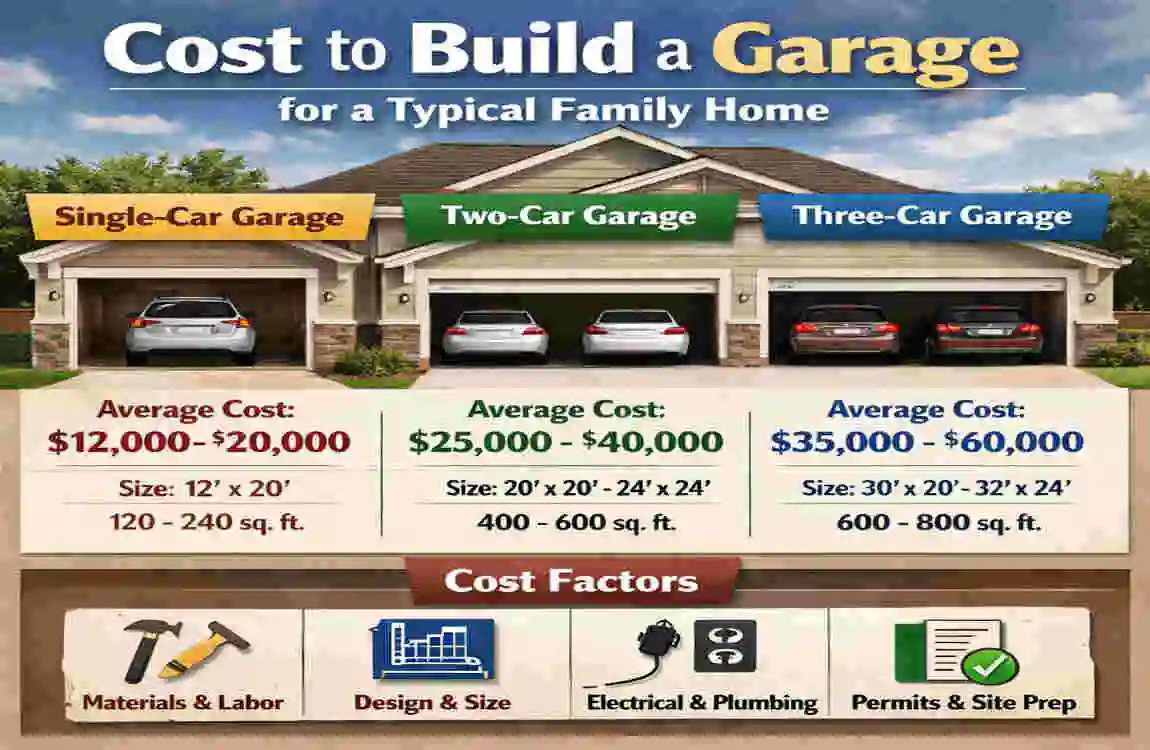
To bring all of these concepts together, let us look at a realistic, grounded example.
Imagine a family, the Smiths, living in a mid-size American suburb. They have a standard home and want to add a 2-car attached garage to escape winter snow. They want standard materials and minimal extra finishes to keep costs reasonable.
Here is what their breakdown might look like for a 450 square foot build:
- Permits, Design, & Site Prep: Before any concrete is poured, the Smiths spend about $2,500 getting the land leveled and paying the city for building permits.
- Foundation & Concrete Slab: Pouring a strong, 450 sq ft concrete slab with proper footings costs them $5,500.
- Basic Construction (Framing, Roofing, Siding): The lumber, shingles, vinyl siding, and the contractor’s labor to build the actual structure make up the bulk of the cost, coming in at $22,000.
- Garage Door and Opener: They opt for a standard, uninsulated double door with a reliable, chain-drive opener for $1,800.
- Electrical and Lighting: Running wire from the house, adding a few overhead LED lights, and installing three wall outlets costs $1,500.
- Interior Finish: They decide to leave the wood framing exposed for now to save money, costing $0.
So, how much does a house garage cost in this scenario?
Total: around $33,300.
Depending on their local market, the Smiths added a highly functional, value-adding asset to their property at a very reasonable mid-range price.
Frequently Asked Questions About How Much a House Garage Costs
Homeowners always have many questions before breaking ground. Here are some of the most common inquiries we receive.
“How much does a house garage cost on average?” While it varies, a safe ballpark figure for 2026 is between $15,000 to $25,000 for a 1-car garage, and $30,000 to $55,000 for a standard 2-car garage.
“Is it cheaper to add a garage during new construction or later?” It is almost always significantly cheaper to build the garage during new construction. When the builders are already on-site, pouring the home’s foundation and framing the main roof, adding a garage is simply an extension of existing labor and material orders. Adding it years later requires mobilization, demolition of existing siding, and complex retrofitting.
“Do garages increase home value?” Absolutely, yes. Especially in markets where off-street parking is scarce, or in regions with harsh winters, a garage is a highly sought-after feature. Most homeowners see a strong return on investment (ROI) when it comes time to sell.
“How long does it take to build a house garage?” From the day you pull the permit to the day of the final city inspection, a typical 2-car garage takes about 4 to 6 weeks to construct. However, weather delays and supply chain hiccups can extend this timeline.
“What’s the cheapest way to get a garage for my house?” The absolute cheapest route is a detached carport. If you need a fully enclosed space, building a detached prefabricated metal garage or using standard wood framing with bare-bones finishes is the most budget-friendly option.
“Can I convert my existing space into a garage?” Yes, potentially. Some homeowners choose to convert heavy-duty carports by adding walls or expanding large side sheds. However, you must ensure the existing foundation (usually just a thin patio slab) is thick enough to support the weight of a vehicle. Often, pouring a new foundation is required anyway.