If there is one thing we can all agree on, it is that the British weather loves to keep us on our toes. From howling winter gales in the Scottish Highlands to sudden, relentless summer downpours in London, your home takes a daily beating from the elements. As we move through 2026, the costs of home renovations and energy bills are climbing. Because of this, protecting your property from the top down has never been more critical.
You may be planning a major extension, building your dream eco-home from scratch, or simply replacing an old, leaky canopy. You are probably asking yourself: what type of roof in the UK actually suits my house best?
Why Roof Type Matters for UK Homes
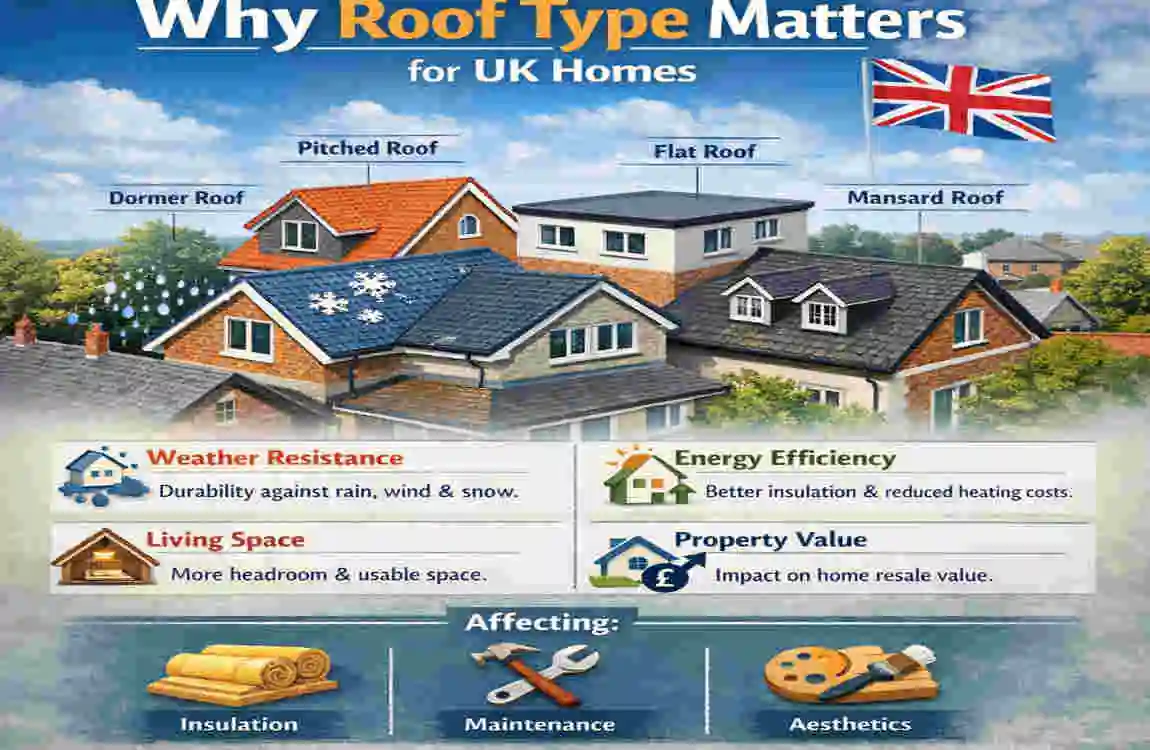
Choosing a roof is not just about picking what looks pretty on a Pinterest board. In the United Kingdom, the shape and style of your roof dictate how well your home survives the local climate.
The Battle of Drainage: Pitched vs. Flat Roofs
First, let us talk about the rain. We get a lot of it. The primary job of any British roof is to shed water quickly and efficiently. This is why pitched roofs, designed by UK architects, are so incredibly common. A steeply angled roof uses gravity to throw rainwater directly into the gutters, preventing leaks and water pooling. Flat roofs, on the other hand, require highly specialized waterproof membranes and a slight, almost invisible slope to prevent water from sitting and stagnating.
Navigating Regulations and Costs
You also have to consider the legal side of building. The UK Building Regulations, specifically Part L, focus heavily on the conservation of fuel and power. Your chosen roof type directly affects how much insulation you can fit in your loft, which, in turn, dictates your home’s energy efficiency. A poorly insulated roof lets your expensive winter heating escape straight into the sky.
Furthermore, your budget plays a massive role. Depending on the complexity of the design, a new roof can cost anywhere from £5,000 for a simple flat extension roof to £20,000 or more for a complex, multi-pitched slate roof.
Embracing Trends and Statistics
Did you know that roughly 70% of all UK homes feature a traditional pitched roof? Imagine a classic suburban street; you will see rows of triangular gable roofs stretching into the distance. This classic shape is beloved because it naturally provides a massive bonus: attic space.
However, as we embrace the trending roof styles UK homeowners are currently demanding, things are shifting. The 2026 trends are all about maximizing utility. Homeowners are demanding seamless solar panel integration, highly sustainable materials, and shapes that maximize interior headroom.
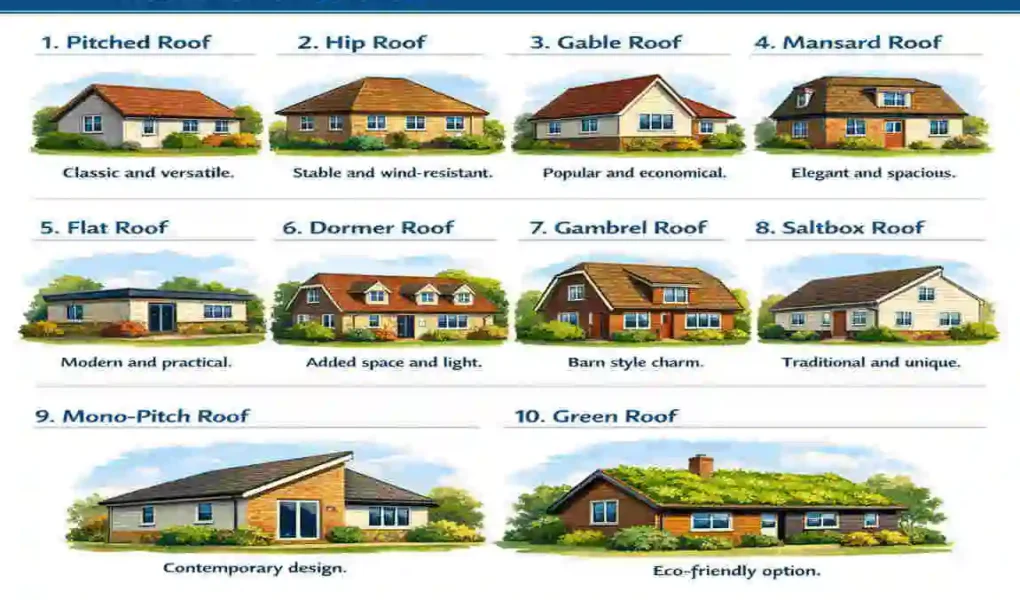
Top 10 Roof Types for UK Houses
Let us break down the absolute best structural choices for your property. We have categorized these into understandably sized segments, detailing the pros, cons, costs, and current trends for each.
Gable Roof (The Classic Standard)
When you ask a child to draw a house, they almost always draw a gable roof. It features two sloping sides that meet at a central ridge, creating a distinct triangular shape at the ends (the gables). This design is deeply woven into British architecture, adorning thousands of traditional terraced houses and detached family homes across the country.
Because the pitch is usually quite steep, gable roofs are absolute champions at shedding heavy UK rain and snow. They rely on simple, straightforward geometry, which makes them relatively easy and cost-effective for builders to construct.
Pros and Cons:
- Pros: Highly cost-effective to build; provides excellent natural attic ventilation; creates fantastic vertical space for future loft conversions; sheds water effortlessly.
- Cons: The flat, triangular gable ends act like sails in high winds. If not braced correctly, they are vulnerable to severe storm damage.
UK Suitability and 2026 Trends: The gable is perfect for almost any UK region. You can expect a standard replacement to cost between £8,000 and £12,000. In 2026, we are seeing a massive trend toward “open gable revivals,” where the triangular end is fitted with floor-to-ceiling structural glass to flood loft spaces with natural light.
Hip Roof (The Durable Choice)
If you want an upgrade in stability from the gable, you look to the hip roof. Instead of two flat ends, a hip roof has slopes on all four sides. All the sides come together at the top to form a ridge. This style is incredibly prominent on classic 1930s semi-detached houses and elegant Victorian homes.
Because there are no flat ends for the wind to catch, the hip roof is incredibly aerodynamic. The wind glides up and over the slopes, making this an outstanding choice if you live in coastal areas or the windy, exposed regions of the UK.
Pros and Cons:
- Pros: Unmatched stability in severe weather; highly resistant to wind uplift; offers a beautifully balanced, aesthetic look from the street.
- Cons: Complex to build, meaning higher labor costs; drastically reduces available attic space compared to a gable roof.
UK Suitability and 2026 Trends: This roof has a very high suitability rating for the British weather. Installation usually ranges from £10,000 to £15,000 due to the complex timber framing required. The hottest 2026 trend for hip roofs involves using ultra-lightweight composite tiles that mimic traditional slate but put far less strain on the supporting walls.
Flat Roof (The Modern Minimalist)
Do not let the name fool you. A flat roof is never perfectly flat; it always has a very low pitch (usually around 1 to 10 degrees) to allow rainwater to run off into a drainage system. For decades, flat roofs in the UK had a terrible reputation for leaking. Still, modern technology has completely flipped the script.
Today, flat roofs are the go-to choice for sleek, minimalist modern extensions, garages, and urban apartment blocks. They offer a clean, horizontal profile that looks incredibly contemporary.
Pros and Cons:
- Pros: Very cheap and fast to install; creates usable outdoor space (like a roof terrace); perfect for small rear extensions where a pitched roof would block a neighbor’s light.
- Cons: Requires rigorous maintenance; highly susceptible to water pooling and drainage issues if the drains become clogged with autumn leaves.
UK Suitability and 2026 Trends: Flat roofs are perfect for medium-weather areas and cost between £5,000 and £10,000. The absolute biggest trend right now is transforming these spaces into green flat roofs. By adding layers of insulation and a living carpet of plants, homeowners are solving drainage issues while creating eco-friendly urban havens.
Mansard Roof (The Urban Space-Maximizer)
Originating from France, the mansard roof is a masterclass in maximizing interior space. It features four sides, each with two distinct slopes. The lower slope is incredibly steep—almost vertical—while the upper slope is very shallow.
If you walk through the affluent boroughs of London, you will see mansard roofs everywhere. Because property space in UK cities is at an absolute Premium, homeowners use the mansard design to effectively add an entire extra story to their home without violating building height restrictions.
Pros and Cons:
- Pros: Creates massive amounts of usable living space; adds significant financial value to the property; allows for beautiful, ornate window integrations.
- Cons: Very expensive and complex to build; often requires lengthy battles to secure planning permission; poor weather resistance on the flat upper section.
UK Suitability and 2026 Trends: The mansard is highly suitable for city living. Because of the heavy structural work, costs easily exceed £15,000. For 2026, we are seeing homeowners blending mansard lofts with smart-home tech, turning these urban rooftops into Premium, climate-controlled home offices.
Dormer Roof (The Light-Boosting Addition)
A dormer is not entirely a roof type on its own; rather, it is a structural addition built out from an existing sloping roof. It is a small room projecting outward, complete with its own little roof and a vertical window.
When you want to convert a dark, cramped attic into a bright, airy main bedroom, the dormer is your best friend. It raises the ceiling and extends it outwards, providing essential headroom and flooding the new space with natural sunlight.
Pros and Cons:
- Pros: Dramatically increases natural light; provides standing headroom in tight lofts; adds tremendous character to the exterior of the house.
- Cons: Creates multiple seams and joints (called valleys), which are notorious for leaking if not installed by a true professional.
UK Suitability and 2026 Trends: Dormers are incredibly popular right now because they often fall under Permitted Development (PD) rights in the UK. This means you frequently do not need full planning permission to build one, saving you time and money.
Skillion / Mono-Pitch Roof (The Solar-Ready Innovator)
Imagine taking a gable roof and chopping it entirely in half. That is the skillion, or mono-pitch roof. It is a single, steeply sloping surface attached to a taller wall. Historically used for simple lean-to sheds, this shape has exploded into high-end architectural design.
Modern UK extensions frequently use mono-pitch roofs to create dramatic, high-ceilinged interior spaces. Furthermore, it is the absolute best shape for embracing green energy.
Pros and Cons:
- Pros: Incredibly easy and fast to build; allows for massive, high-level windows on the tall wall; provides the perfect, uninterrupted angle for mounting solar panels.
- Cons: Can look jarring or mismatched if attached to a very traditional, historic house; pushes all rainwater runoff to one single side of the property.
UK Suitability and 2026 Trends: This design is highly suitable for modern homes. The massive 2026 trend is designing new builds with a large, south-facing skillion roof specifically angled to maximize solar energy capture, pushing homes closer to net-zero energy ratings.
Butterfly Roof (The Futuristic Statement)
If you want your home to look like a piece of modern art, the butterfly roof is for you. It is essentially an inverted gable roof. The two sides slope inward toward the middle, meeting in a central valley, creating a shape that mimics the upward wings of a butterfly in flight.
While rare on older homes, this striking design is becoming the darling of bespoke eco-new builds across the UK.
Pros and Cons:
- Pros: Highly aerodynamic; allows for incredibly tall perimeter walls for massive windows; excellent for capturing and recycling rainwater in a central tank.
- Cons: The central valley is a massive debris trap for leaves and snow; if the central drain clogs, the roof will rapidly flood.
UK Suitability and 2026 Trends: Because it requires meticulous maintenance to keep the central valley clear, it is best suited for homeowners dedicated to upkeep. In 2026, butterfly roofs are trending heavily in sustainable architecture, specifically designed to harvest rainwater for eco-friendly home plumbing systems.
Saltbox Roof (The Asymmetrical Charm)
The saltbox roof tells a story of history and practicality. It is an asymmetrical, pitched roof featuring a short, steep slope on the front of the house and a very long, sweeping slope on the back, which often extends down to the ground floor.
Originally designed to allow homeowners to add lean-to extensions to the back of their houses without replacing the main roof, the saltbox is dripping with rustic charm. You will frequently spot this beautiful style on older, rural cottages in the English countryside.
Pros and Cons:
- Pros: The long back slope easily deflects harsh, prevailing winds; excellent at shedding heavy rain; creates unique, sloping ceilings inside.
- Cons: The interior rooms at the back of the house will have very low, slanted ceilings, which can make the house look uneven or lopsided.
UK Suitability and Trends: Perfect for exposed, rural environments. Homeowners in 2026 are modernizing this classic shape by adding massive skylights into the long back slope, blending historical charm with modern, bright interiors.
T-Shaped Roof (The Versatile Connector)
When you look at a house from above, and it forms the letter “T” or “L,” it requires a cross-hipped or T-shaped roof. This involves two separate pitched roofs meeting each other at a perpendicular angle.
This is the standard, go-to design for homeowners adding a large, multi-story extension onto the side or back of an existing traditional home. It seamlessly blends the old structure with the new.
Pros and Cons:
- Pros: Highly versatile for complex floor plans; allows you to add wings to a property easily; maintains a traditional aesthetic.
- Cons: The inward corners where the roofs meet form “valleys.” These valleys carry a massive volume of rushing water during storms and are highly prone to leaking.
UK Suitability and 2026 Trends: Very common across the UK for renovations. The current trend is to use contrasting roofing materials on the new extension wing to create a deliberate, stylish visual break between the old house and the new addition.
Green / Sedum Roof (The Eco-Trending Future)
A green roof, often called a sedum roof, turns a standard flat or slightly pitched roof into a living garden. It involves laying down a waterproof membrane, a root barrier, drainage layers, and, finally, a layer of soil planted with hardy, low-maintenance vegetation such as sedum.
As the UK pushes hard toward environmental sustainability, the green roof is transitioning from a niche eco-project into mainstream building practice.
Pros and Cons:
- Pros: Incredible natural insulation against cold and heat; boosts local biodiversity by attracting bees and birds; drastically reduces the risk of flash flooding by absorbing heavy rainfall.
- Cons: The wet soil and plants are incredibly heavy, requiring heavy-duty structural support; they require ongoing gardening maintenance.
UK Suitability and 2026 Trends: This is the ultimate roof for modern urban UK living. In fact, the 2026 trend is so strong that several forward-thinking city councils are making green roofs nearly mandatory for new commercial and large residential flat-roof extensions to combat the urban heat island effect.
Roof Types Comparison Table
To help you digest all of this information, we have put together a quick comparison table. This breaks down how the most popular styles handle UK weather, their estimated costs, and their trendiness for 2026.
Roof Type, Drainage Capability, Estimated Cost (£k), UK Weather Fit 2026 Trend Score (1-10)
Gable Excellent 8 – 12 High 9
Hip Good 10 – 15 Very High 8
Flat Fair 5 – 10 Medium 7
Mansard Good 15+ High 9
Green Excellent (Absorbs) 6 – 12 Medium 10
Trending Materials Choices
Choosing the type of roof for your home in the UK ome is only half the battle. You also have to choose what materials will cover it. The roof types used in UK houses rely heavily on materials that can withstand decades of freezing winters and wet springs.
Historically, natural Welsh slate and baked clay tiles ruled the British skyline. Slate is incredibly dense, beautiful, and boasts a lifespan that can easily exceed 50 to 100 years. However, slate is exceptionally heavy and very expensive.
As we look at the best UK roofs 2026, the industry is pivoting toward high-tech synthetics and eco-friendly alternatives. We are seeing a massive surge in composite slate tiles. These are made from recycled plastics and limestone. They look exactly like natural stone but weigh a fraction of the amount and cost significantly less, making them ideal for older homes with weaker timber frames.
For flat roofs, traditional hot-tar felt is officially a thing of the past. Homeowners are now choosing EPDM (a highly durable rubber membrane) or liquid-applied fiberglass. These materials are entirely seamless, meaning water cannot seep in.
Finally, solar tiles are the ultimate 2026 luxury. Instead of bolting ugly solar panels onto your beautiful tiles, you can now install integrated solar tiles that look like standard roofing materials but generate electricity for your home.
Maintenance & Installation Tips
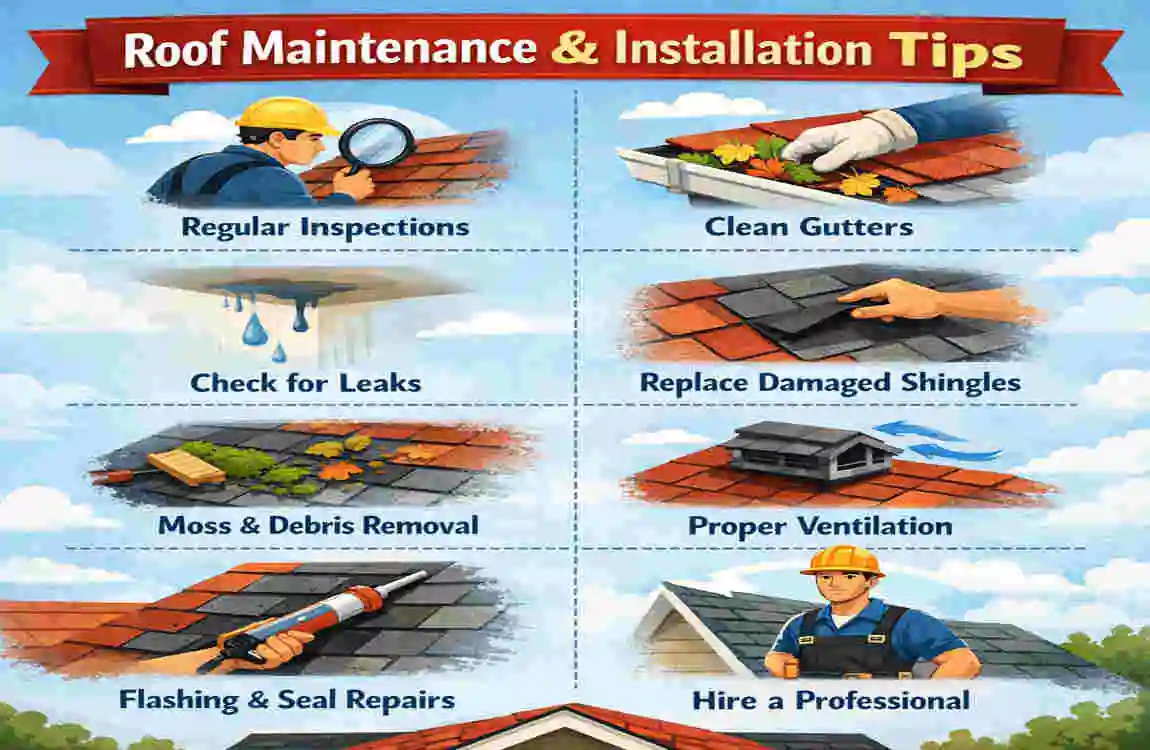
Even the most expensive roof in the world will fail if you do not look after it. You must treat your roof with the same respect you give your car’s engine.
First, commit to annual checks. Every autumn, after the leaves have fallen, you need to ensure your gutters and valleys are completely clear of debris. Trapped leaves hold moisture, which rots timber and breaks down masonry.
Second, if you spot a missing tile or cracked flashing, do not try to fix it with a tube of cheap sealant from the hardware store. Always hire certified roofers. A badly patched roof will trap moisture inside your attic, leading to dangerous black mould.
Finally, keep your eyes open for government support! The UK is highly motivated to improve home energy efficiency. There are frequently local grants available to help offset the costs of upgrading your insulation or installing green, eco-friendly roofing systems.
FAQs
What type of roof in the UK is best for heavy rain? A pitched roof, particularly a steep gable or hip roof, is the absolute best choice for heavy rain. The steep angle uses gravity to quickly force water down into the gutters, preventing any chance of water pooling and leaking.
What is the most popular roof style in the UK? The gable roof is by far the most popular style across the UK. It is cost-effective to build, excellent at shedding weather, and provides valuable attic space that homeowners love to use for storage or loft conversions.
What are the biggest 2026 roofing trends? The dominant trends for 2026 revolve entirely around sustainability. Homeowners are rapidly adopting green sedum roofs, integrated solar tiles, and using ultra-lightweight recycled composite materials to reduce their carbon footprint.
Can I change my flat roof to a pitched roof? Yes, you absolutely can change a flat roof to a pitched roof. However, this is a major structural alteration that will almost certainly require planning permission from your local council and an assessment by a structural engineer to ensure your walls can hold the extra weight.
How long should a new UK roof last? The lifespan depends heavily on the materials used. A well-installed flat rubber (EPDM) roof should last 30 to 50 years. In comparison, a traditional pitched roof covered in high-quality natural slate can easily last for over 100 years with proper maintenance.