
Imagine a living situation where you have your loved ones close by, yet you can still retreat to your own, completely private space at the end of the day. Or picture an investment property where you live in the main home while generating a steady stream of rental income from a smaller, detached unit right in your backyard. If these scenarios sound incredibly appealing to you, you are already beginning to understand the magic of a compound house.
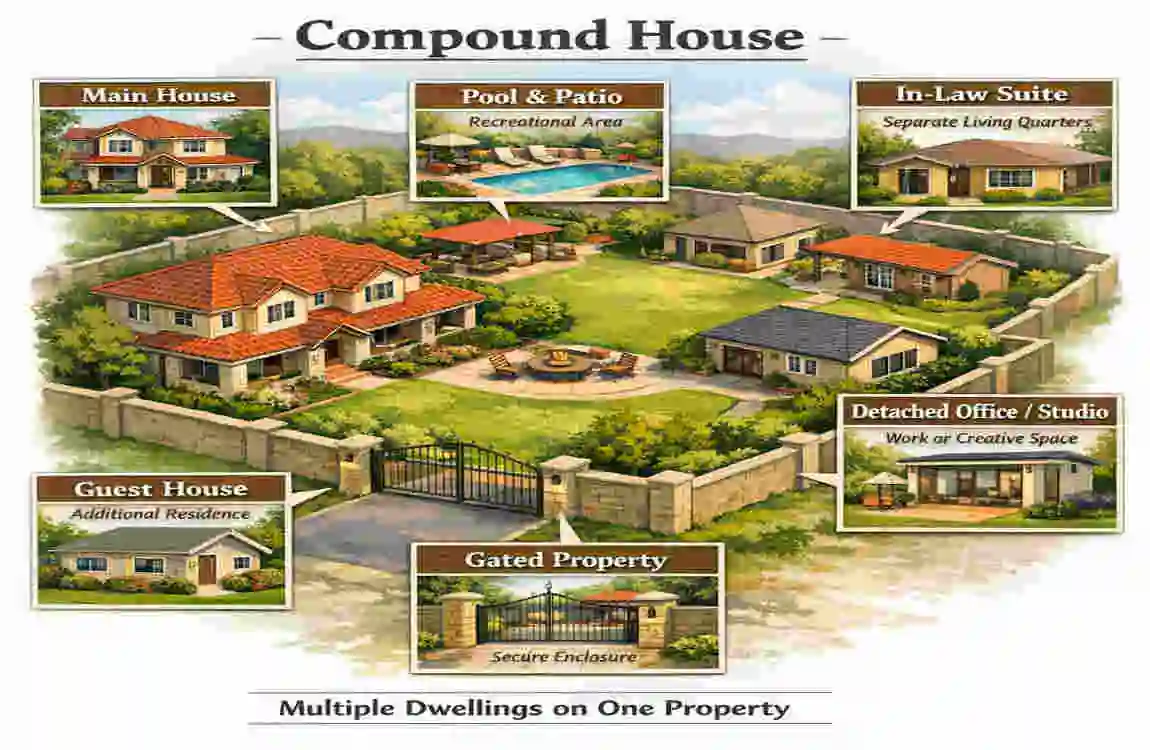
At its core, a compound house is a unique property arrangement that combines multiple independent living units or structures. These units sit under a single ownership umbrella or are gathered in a single, securely fenced area.
When people ask what compoundwhat a compound house is, they are usually looking for a flexible living solution. Simply put, it is a piece of property that holds more than just one standard, single-family home. It might include a large main house alongside a cozy guest house, a set of separate staff quarters, or even multiple standalone homes sharing a common courtyard.
Today, this concept is trending heavily in modern real estate markets. We are seeing a massive rise in demand for privacy, secure gated communities, and multi-generational family living. As housing costs rise and families look for ways to pool their resources, the idea of living on a shared family compound has moved from a luxury niche to an everyday, practical solution.
What Is a Compound House in Real Estate

To truly grasp the concept, we need to move past the simple idea of a house with a big yard. When you explore what a compound house in real estate is, you are looking at a highly intentional architectural and property design.
The core definition revolves around multiple living units situated on a single plot of land or contained within a shared, enclosed space. Unlike a standard home, a compound is designed to accommodate multiple households or distinct living purposes simultaneously. For example, you might have a primary residence where the main family lives, a fully equipped guest house for visiting relatives, and a converted carriage house serving as a home office or rental unit.
It is easy to confuse a compound house with other property types, so let us clear that up. A standalone house is just that—one single building on a plot of land. Villas are often large, luxurious, and detached, but they typically only house one family. Apartments stack multiple families into one massive building with shared hallways. A compound house sits right in the middle. It offers the detached privacy of a standalone villa, but the multi-unit functionality of an apartment complex, all spread out horizontally across a private parcel of land.
Ownership Dynamics: Who Owns What?
The ownership dynamics of a compound house are fascinating and highly flexible. In many cases, you will find a single owner holding the title to the entire compound. This owner might live in the main modern house and rent out the other structures.
Alternatively, you might see shared family ownership. In this scenario, siblings or extended family members pool their money to buy the compound together. They share the overarching title but divide the daily use of the separate units among themselves. This collaborative approach makes homeownership much more accessible in expensive markets.
Typical Features You Will Find
Compound houses come with a specific set of features that make them function smoothly. Even though the living quarters are separate, the residents often share foundational elements.
You will typically find shared perimeter walls or secure fencing that encloses the entire property. Inside, residents often enjoy common areas like a shared central courtyard, a large swimming pool, or beautifully landscaped gardens. Security is a major feature, with many compounds boasting a single secure entry gate. You will also see shared parking areas and, in many cases, combined utility connections to streamline billing.
Urban vs. Rural Settings
You might think compounds only exist in the countryside, but that is a myth. The answer to what a compound house is in real estate changes depending on where you look.
In crowded urban settings, a compound house might look like a historic home with a converted garage apartment and an attached duplex in the back. These are often tucked away in hip neighborhoods, offering a private oasis in the middle of the city.
In rural settings, a compound stretches out. You might see a sprawling farmhouse surrounded by beautifully renovated barns, caretaker sheds, and guest cabins. These rural estates offer ultimate seclusion.
You can also find stunning examples in modern luxury real estate. High-end family compounds in gated communities often feature three or four custom-built villas sharing a private lake, tennis courts, and a central security pavilion. Similarly, mixed-use developments are popping up that feature a single compound with a residential home, a separate storefront, and a creative studio.
Types of Compound Houses in Modern Real Estate
Real estate is never one-size-fits-all, and compound houses are beautifully diverse. Depending on your life stage, your family size, and your financial goals, there is a specific type of compound designed to meet your exact needs. Let us break down the most popular types you will encounter in the modern market.
Single-Family Compound Houses
This is the most common and approachable type of compound. The single-family compound features one large primary residence, paired with additional smaller structures on the same lot.
Usually, the main family lives in the primary house. The extra buildings might include a detached guest house (often called an Accessory Dwelling Unit or ADU), a dedicated home office, an art studio, or a specialized workshop. This setup perfectly addresses the need for a modern, work-from-home lifestyle. You get to “leave the house” to go to work in your backyard studio, keeping your professional and personal lives totally separate while still enjoying a zero-minute commute.
Multi-Generational Compound Houses
As family dynamics shift, the multi-generational compound house has skyrocketed in popularity. These properties are intentionally designed for extended families who want to live together without driving each other crazy.
In a multi-generational compound, you might find three equally sized homes built around a shared central garden. The grandparents take the accessible, single-story unit. The parents and young children take the larger main house. A recent college graduate might take the smaller loft over the garage. This setup beautifully addresses the need for family bonding and shared childcare, while fiercely protecting everyone’s individual privacy.
Gated Community Compound Houses
If security and a sense of community are your top priorities, the gated community compound is an excellent choice. These are mini-neighborhoods built within a larger private perimeter.
Developers build these properties with shared security gates, private roads, and exclusive amenities like clubhouses or private parks. The ownership structure here usually involves a Homeowners Association (HOA). You own your specific unit and the land immediately under it, but you share the cost and ownership of the common areas with your neighbors. This type caters directly to buyers who want luxury amenities without the burden of maintaining them alone.
Luxury Compound Houses
When ultra-wealthy buyers look for property, they often seek luxury compounds. These are high-end, sprawling estates that redefine extravagant living.
A luxury compound might feature a massive primary mansion, a fully equipped wellness center in a separate building, distinct quarters for full-time household staff, and a detached entertainment pavilion for hosting grand parties. These compounds prioritize absolute exclusivity, Premium materials, and unparalleled privacy.
Rural Compound Houses
For those who crave fresh air and wide-open spaces, rural compound houses offer a dream lifestyle. These properties usually sit on large acreage and integrate various agricultural or hobby structures into one cohesive estate.
A rural compound might include a beautifully restored historic farmhouse, a massive barn converted into a modern event space, equipment sheds, and several small cabins for guests or farm workers. This type of compound perfectly addresses the need for agricultural living, eco-tourism, or simply escaping the hustle and bustle of city life.
How Does a Compound House Work in Real Estate?
Understanding the concept is great, but how does this actually play out in the real world? Managing a property with multiple structures and potentially multiple families requires logistical planning.
Operational Mechanics: Utilities and Maintenance
The day-to-day operations of a compound house depend heavily on how the property is wired and plumbed. In some compounds, all units share a single water meter, one electric grid, and a centralized heating system. In this case, the main owner pays the bills, or the residents divide the costs evenly at the end of the month.
However, modern developers usually sub-meter compound houses. This means each distinct unit gets its own electricity and water meter. You only pay for what you use, which prevents family arguments over who left the lights on! Maintenance also requires a game plan. Residents often split the cost of landscaping the shared gardens or maintaining the main driveway, while individuals handle the repairs inside their own private units.
Zoning, Legal, and Regulatory Considerations
You cannot just buy a big lot and start building multiple houses on it. The way a compound house works legally is tied strictly to local zoning laws.
Before building or legally classifying a property as a compound, you must navigate local building codes, secure proper permits, and get zoning approvals. Many cities have zoning laws that dictate how many kitchens can exist on a single residential lot. If you want to build a guest house with a full stove and oven, you need to ensure the local municipality allows multi-unit dwellings (ADUs) in that neighborhood.
Financing and Ownership Structures
Financing a compound house can be more complex than buying a traditional home. Because you are buying multiple structures, banks will look closely at the appraisal value.
If you are buying the property to generate rental income, you might use a conventional loan or a commercial loan if there are more than 4 units. If you are buying with family members, you will likely explore joint ownership structures. You might hold the title as “Joint Tenants” or create a Family Trust or an LLC to purchase the property. This protects everyone’s financial investment and clearly outlines what happens if one family member wants to sell their share later.
The Role of Developers and Managers
Real estate developers play a massive role in creating modern compound houses. They identify large parcels of land, navigate the tricky zoning laws, and construct thoughtfully designed multi-unit estates.
Once built, many compound owners hire professional property managers. If you own a compound and rent out three units, a property manager handles tenant screening, collects rent, and schedules emergency maintenance. This turns your compound house into a truly passive income generator.
The Process of Purchasing or Renting
If you want to buy a compound house, you start by finding a real estate agent experienced in multi-family or unique properties. You will tour the property to ensure all structures are legally permitted. During the inspection, you will need separate inspections for every single building on the lot.
If you are renting a unit within a compound house, the process is similar to renting an apartment. However, your lease will include highly specific clauses about the use of shared areas, parking rules, and noise curfews to ensure harmony among the compound’s residents.
Benefits of Investing in a Compound House
Why are so many smart investors and everyday homebuyers flocking to compound houses? The answer lies in the incredible blend of financial upside and lifestyle enhancement. Investing in this type of real estate offers perks that a standard single-family home cannot match.
Financial Benefits: The Power of House Hacking
The financial benefits of a compound house are truly unmatched. If you buy a compound, you can live in the main house and rent out the guest houses or additional units. Real estate investors lovingly call this “house hacking.”
The rental income you generate from the other units can cover your entire monthly mortgage payment. Essentially, your tenants are paying for you to live in the main house for free! Furthermore, compounds offer fantastic appreciation value. As demand for multi-generational living and flexible workspaces continues to rise, properties that already have these extra structures built in are selling for a Premium. You secure a long-term investment that builds massive generational wealth.
Lifestyle Benefits: The Best of Both Worlds
Beyond the money, the lifestyle benefits of a compound house are life-changing. You gain significant space and flexibility.
If you have an aging parent who needs care but refuses to move into a nursing home, a compound house is the perfect solution. They can live independently in the ground-floor guest house, keeping their dignity and autonomy, while you remain just thirty feet away in case of an emergency. You get family-oriented living combined with the fierce protection of personal privacy. You never have to share a kitchen or a living room unless you want to.
Security Benefits: Peace of Mind
Security is a massive draw for compound house buyers. By design, these properties offer controlled access.
When you live in a compound, you usually have a sturdy perimeter fence and a main entry gate. You and your extended family or tenants can share the cost of high-end security systems, smart-camera networks, and advanced alarm monitoring. Because multiple people live on the same property, there are more “eyes on the street.” The reduced risk of break-ins and the overall feeling of safety make compound living incredibly peaceful.
Tax and Legal Advantages
Do not overlook the tax advantages! When you treat a portion of your compound house as a rental property, you open the door to significant tax write-offs.
You can deduct expenses related to maintaining the rental units, depreciate the value of those specific structures over time, and write off a portion of shared utilities. Furthermore, compound houses make inheritance planning much easier. Instead of leaving one house to three children and forcing them to sell it to split the cash, you can leave a compound house to a Family Trust, allowing all your children to continue using the distinct units for generations.
Real-World Success Story
Consider a young couple who purchased a run-down urban compound featuring a main house and two detached garage apartments. They spent their weekends renovating the apartments. Once finished, they rented out both small units to local graduate students. The combined rent from the two students completely covered the couple’s mortgage, property taxes, and home insurance. Ten years later, the property value had doubled, and they had essentially lived there for free the entire time. This is the true power of the compound house model.
Challenges and Considerations When Buying a Compound House
While the benefits are glowing, it would be irresponsible to ignore the hurdles. Owning a compound house is not always a walk in the park. Managing multiple structures and dealing with shared spaces requires patience, capital, and a lot of communication.
Legal and Ownership Issues
The biggest headaches often stem from legal and ownership conflicts. If you buy a compound with your siblings, what happens when one sibling loses their job and cannot pay their share of the property tax? Title conflicts and boundary disputes can easily tear a family apart if not documented correctly.
Additionally, zoning regulations can be a nightmare. You might buy a property hoping to rent out the back house, only to discover the local government zoning board strictly prohibits short-term rentals or multi-family living in that neighborhood.
Maintenance and Management Clashes
More buildings mean more roofs to replace, more HVAC systems to service, and more plumbing pipes to fix. Maintenance is a heavy burden.
When responsibilities are shared, disagreements are inevitable. If the shared driveway needs repaving, getting three different households to agree on a contractor and write a check at the same time can be incredibly frustrating.
Financial Risks
Compound houses come with high upfront costs. Because you are buying more square footage and multiple structures, the purchase price is naturally higher than that of a standard home. If the real estate market takes a downturn, you have a larger financial asset at risk. Furthermore, securing a loan for a non-traditional property can be challenging and might require a larger down payment.
Privacy Concerns
Yes, you have separate houses, but you still share a yard. If your tenants in the guest house throw a loud party on a Tuesday night, it will affect your peace in the main house. Balancing the use of shared spaces with your need for personal privacy requires establishing strict, clear boundaries from day one.
Navigating Challenges: Solutions at a Glance
To help you avoid common pitfalls, we have broken down the typical challenges and the best ways to solve them.
Common ChallengePractical Solution
Zoning and Legal Restrictions: Hire a local real estate attorney to verify all building permits and zoning laws before you close on the property.
Shared Maintenance Disputes: Create a legally binding written agreement that specifies exactly how shared repairs are funded (e.g., monthly contributions to a joint repair fund).
High Upfront Purchasing Costs: Partner with family members to split the down payment, or secure a tenant for the guest house immediately to offset your monthly costs.
Lack of Personal Privacy: Use strategic landscaping! Plant tall, thick hedges or build privacy fences between the distinct units to block sightlines and absorb noise.
Always insist on professional inspections for every single building on the lot. Never assume that just because the main house has a good roof, the guest house does too.
Legal and Regulatory Aspects of Compound Houses
You cannot afford to skip the legal details when dealing with a compound house. Because you are dealing with multiple dwellings, the legal framework is much more complex than a standard residential purchase.
Land Ownership and Title Search
Before you sign anything, your title company must perform a rigorous title search. You need to ensure there is clear ownership of the entire parcel. Sometimes, older compound houses were built by combining two separate lots. You need to make sure the lot lines were legally merged and that no previous owner has a lingering claim on the guest house in the back. Clear documentation is your best defense against future lawsuits.
Building Permits and Zoning Laws
As mentioned earlier, compliance with local regulations is non-negotiable. If the previous owner built the staff quarters without pulling the proper building permits from the city, you could be forced to tear the building down at your own expense. Always demand the permit history. Make sure the property is legally zoned for multi-family use if you plan to rent the units to non-family members.
Inheritance and Taxation
Handling compound houses in wills and tax planning requires a professional touch. If you leave the compound to your children, you need a clear estate plan. Will they sell it? Will they run it as a rental business? Establishing an LLC (Limited Liability Company) or a Family Trust to hold the property can save your heirs thousands of dollars in probate fees and estate taxes.
Insurance and Liability
You cannot just buy a standard homeowner’s insurance policy for a compound house. You need coverage for multiple units and shared areas. If a tenant slips and falls on the shared walkway, who is liable? You will likely need a comprehensive landlord policy, and it is highly recommended that you take out an umbrella liability policy. This provides extra protection in case someone gets injured on the shared portions of your property.
How to Choose the Right Compound House for Your Needs
With so many variables at play, how do you pick the right compound house? Making the right choice requires a deep dive into your personal goals and your financial reality.
Assess Your Lifestyle and Needs
Start by asking yourself what you truly need. Are you looking to house an aging parent? If so, you need a compound with a single-story, accessible guest house. Are you looking for maximum rental income? Then you need a property with entirely separate entrances and private parking for each unit so tenants feel independent. You must align your lifestyle goals with the property’s physical layout.
Evaluate Location, Size, and security
Location dictates everything in real estate. To evaluate the property properly, keep these specific factors in mind:
- Neighborhood Vibe: Is the area attractive to high-quality renters, or is it close to medical facilities for your aging parents?
- Lot Size: Is the yard large enough to comfortably accommodate the parking needs of two or three separate households?
- Security Features: Does the property already have secure perimeter walls, or will you have to spend thousands of dollars building a gate yourself?
- Utility Setup: Are the utilities already sub-metered, or will you have to pay a plumber to separate the water lines?
Consider Resale Value and Potential
Even if you plan to live there forever, you must consider resale value. Review the neighborhood’s future development plans. Is the city planning to build a noisy highway right behind your quiet rural compound? Also, look at rental potential. A compound near a major university or hospital will never have a shortage of willing tenants.
Tips for Negotiating and Finalizing
When you find the perfect compound, leverage the property’s complexity to your advantage during negotiations. If the inspector finds that the roof on the secondary structure is failing, ask the seller for a massive credit. Compound houses can sit on the market longer because they appeal to a niche buyer. Use this extra time to negotiate a better purchase price.
Trends in Compound House Real Estate
The real estate market never stops evolving. As we look ahead to 2025 and 2026, the compound house is undergoing some incredible transformations.
First, the rising demand for multi-generational living is explosive. Economic pressures are making it harder for young adults to buy their first homes, while nursing home costs are skyrocketing. The compound house solves both problems simultaneously, making these properties highly sought after.
Second, we are seeing a massive push for sustainability features. New compound houses are being designed with shared green energy grids. You will see main houses with massive solar panel arrays that power both the main house and the guest cottages. Shared rainwater harvesting systems and eco-friendly designs are becoming standard expectations.
Furthermore, smart-home technology integration is changing how compounds operate. We are seeing smart gates that recognize resident license plates, shared Wi-Fi mesh networks that cover an entire acre, and app-controlled security cameras that let you monitor the entire compound from your smartphone.
Finally, as population growth and urbanization push people further into the suburbs, developers are realizing that packing multiple, beautifully designed units onto a single suburban lot is the smartest way to maximize land value.
Frequently Asked Questions: What Is a Compound House in Real Estate?
Are you still curious about how these unique properties work? When you explore what is a compound house in real estate, you are bound to have a few specific questions.
To help you out, we have put together this short and easy-to-read FAQ section. Let us dive right into the most common questions buyers and investors ask!
What exactly is a compound house in simple terms?
In the simplest terms, a compound house is a single piece of property that holds multiple, separate living structures. Instead of just one main house sitting on a lot, you get a primary home alongside other buildings.
These extra buildings might be a cozy guest house, a detached home office, or living quarters for extended family. You and your family share the overall land, the perimeter fence, and often the outdoor amenities, but everyone gets their own distinct, private indoor space.
Why are compound houses so popular right now
As we move through 2026, the housing market continues to shift, making compound houses incredibly desirable. High living costs and a strong desire for family connection are driving this trend.
People want to pool their financial resources without sacrificing their personal privacy. Here is a quick look at why you might want to buy one today:
- Multi-Generational Living: You can keep aging parents or adult children close to home while giving them independence.
- Income Generation: You can easily rent out the secondary units to offset your own monthly mortgage payments.
- Remote Work Flexibility: You can use a detached unit as a permanent, quiet home office separated from your daily family chaos.
What is the difference between a compound house and a duplex?
It is very easy to confuse these two property types, but they are physically quite different. A duplex is a single building that is divided into two separate living units by a shared, interior wall.
A compound house, on the other hand, usually features entirely detached structures spread out across the property. You do not share walls with your neighbors, which drastically increases your peace and quiet.
Can I rent out the extra houses on my compound property?
Yes, you absolutely can, and many property owners do exactly that! Renting out the extra structures is a fantastic way to build your personal wealth and cover your living expenses.
However, you must always check your local zoning laws first. Your local city government dictates whether you can legally rent out secondary buildings on your specific street. You also need to ensure the extra unit has the proper legal building permits before a tenant moves in.