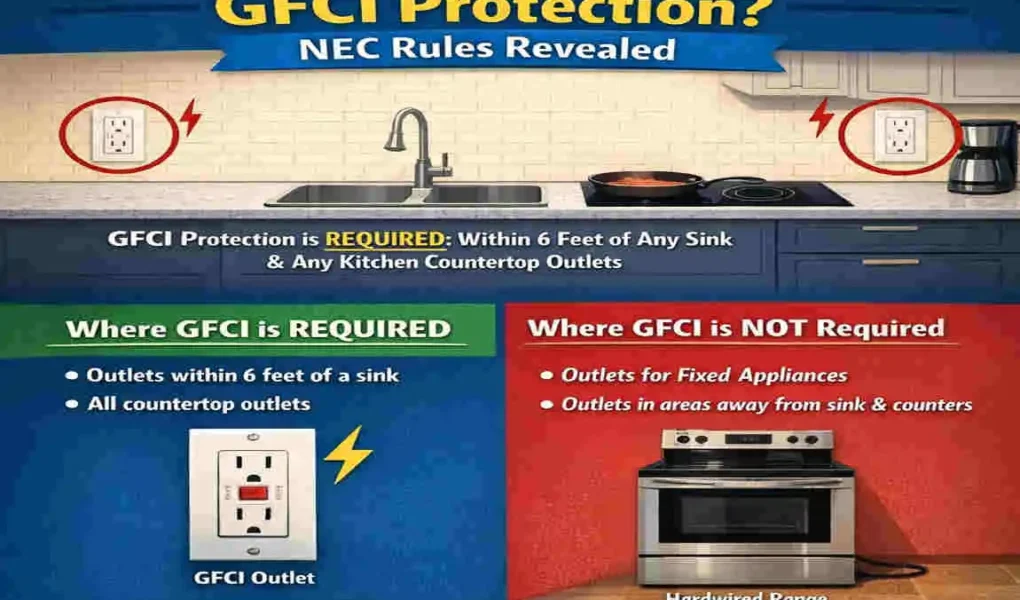
If you have ever been in the middle of making dinner and suddenly lost power to a kitchen outlet, you are not alone. Maybe the coffee maker stopped, the toaster went dead, or a reset button popped out on the wall near the backsplash. It feels annoying in the moment, but that little interruption may have prevented a dangerous electric shock.
That change matters because kitchens mix some of the biggest electrical risk factors in a home. You have water, metal surfaces, grounded appliances, people using cords with wet hands, and a lot of plug-in equipment running at once. In older code cycles, GFCI protection focused mainly on obvious danger spots, such as receptacles serving countertop surfaces or outlets near sinks. Now the thinking is much simpler: if it is in the kitchen, it probably deserves GFCI protection.
What Is GFCI Protection?
GFCI Meaning in Plain English
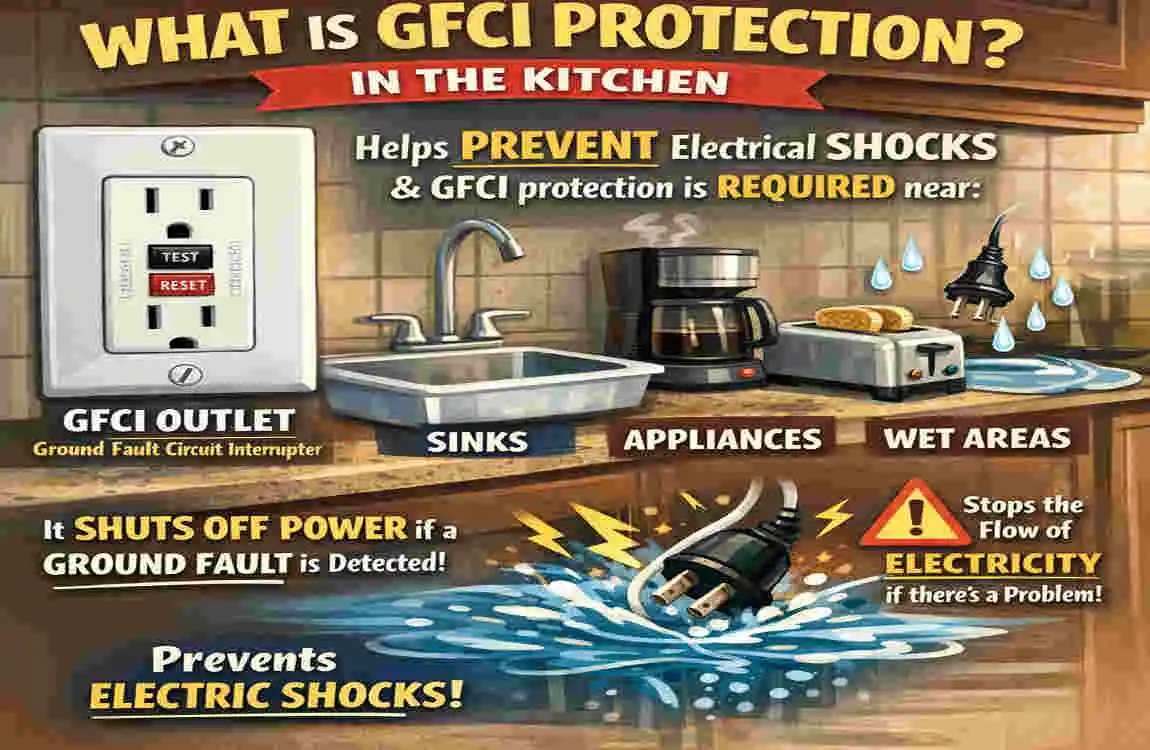
GFCI stands for Ground Fault Circuit Interrupter. That sounds technical, but the basic idea is simple. A GFCI device watches the electricity flowing out and the electricity coming back. If those two amounts stop matching, even by a very small amount, the device quickly shuts off the power.
Why would the current stop matching?
Because electricity may be leaking somewhere it should not. It could be leaking through a wet countertop, a metal appliance housing, a damaged cord, or even through a person. That is exactly the kind of situation GFCI protection is designed to stop.
A regular breaker protects wiring from overheating and fire. A GFCI protects people from shock. That is the key difference.
How a GFCI Works
Inside the device, the current on the hot and neutral wires is continuously compared. Under normal operation, what goes out on the hot wire comes back on the neutral wire. If the GFCI senses a small imbalance, usually in the range of a few milliamps, it trips very fast and cuts power.
That quick action is what makes it so valuable in kitchens. Water and electricity don’t mix. Even a small current leak can become dangerous when your hands are wet or when an appliance sits near a sink, faucet, or conductive surface.
In everyday life, you do not need to understand the electronics inside the device. You need to know this: a GFCI is watching for danger that an ordinary outlet cannot detect.
Types of GFCI Protection
There is more than one way to add GFCI protection in a kitchen. The best option depends on the layout, the number of outlets, and whether you want to protect just one receptacle or an entire circuit.
GFCI TypeBest ForTypical CostMain AdvantagePossible Drawback
Receptacle GFCI Countertops, backsplash outlets, point-of-use protection $15–$25 Easy to see, test, and reset May need several units in one kitchen
Breaker GFCI Whole-circuit protection $40–$60 Protects all receptacles on the circuit Harder for homeowners to install safely
Dead-Front GFCI Hidden protection for downstream outlets or appliance areas $20–$30 Good where outlet face is not needed No place to plug in directly
Portable GFCI Temporary tools or portable appliance use Varies Quick short-term solution Not a substitute for permanent code-compliant wiring
Why Kitchens Need It So Much
You probably already see the issue. Kitchens are busy, wet, and full of electrical demand. Small appliances move around all the time. Cords get bent. Steam builds up. Counters get wiped down. Sinks splash. Even if an outlet is not directly next to water, it still sits in a room where electrical accidents can happen fast.
That is why kitchen GFCI rules have grown stricter over time. The code gradually moved from “protect the obvious spots” to “protect the whole kitchen environment.”
Evolution of NEC Kitchen Rules
The Old Way: Limited Protection
For many years, kitchen GFCI rules were narrower than most people realize. Earlier code editions focused mainly on countertop receptacles and those near a sink. The logic was easy to follow. Those were the outlets most likely to be used with portable appliances in wet conditions.
So, if you had an outlet behind the refrigerator or one that did not serve the countertop, it often fell outside the old kitchen GFCI rule. That is why older homes sometimes have a mix of protected and unprotected receptacles in the same kitchen.
At the time, that approach made sense given how coders understood risk. But kitchens changed. Appliance use increased. Plug-in equipment became more common. Island and peninsula layouts grew more popular. More homeowners also started using dedicated receptacles for microwaves, beverage stations, and other built-in appliances.
Why the Rules Changed
The code did not change for no reason. It changed because the kitchen itself changed.
Today’s kitchen is no longer just a sink, a range, and a couple of counter outlets. It is often a multi-use room with coffee stations, air fryers, built-in microwaves, wine coolers, touch-control appliances, charging areas, and outlets on islands and cabinet sides. In that setting, limiting GFCI protection to countertop receptacles started to feel too narrow.
Code-making bodies gradually recognized that shock risk is not defined only by distance from a sink. It is defined by the broader use of electricity in a kitchen environment. That shift led to more inclusive language in later NEC editions.
The Big Shift in Modern Code
The biggest change for many homeowners is this: the kitchen itself is now treated as the protected area, not just the countertop edge or the sink zone. That means receptacles that would once have been left out may now need GFCI protection under newer code.
This is also why homeowners get confused during renovations. They may say, “My old kitchen never had a GFCI on that outlet.” That may be true. But once the work is updated under a newer code cycle, the rules can change significantly.
NEC Kitchen GFCI Timeline
NEC EditionGeneral Kitchen GFCI Scope
1987 Focused heavily on countertop receptacles and sink-related risk
1990s–2010s Expanded use and refinement of dwelling unit GFCI rules
2017/2020 Broader attention to voltage ranges and additional locations
2023 Kitchen protection expanded beyond just countertop or sink-proximate receptacles
Why Local Adoption Still Matters
Here is the part many articles skip: the NEC is a model code, and local jurisdictions decide when and how they adopt it.
That means two things can both be true at the same time:
- The latest NEC direction significantly expands kitchen GFCI protection.
- Your city, county, or state may still be enforcing an earlier code edition.
So when someone asks, “Do all kitchen outlets need to be GFCI protected?” the safest answer is:
Under the latest NEC approach, generally yes for kitchen receptacles in a dwelling unit. But your local inspector decides what is enforceable where you live.
That small detail matters a lot during permit work, remodels, and real estate transactions.
Current NEC Requirements
The Short Answer
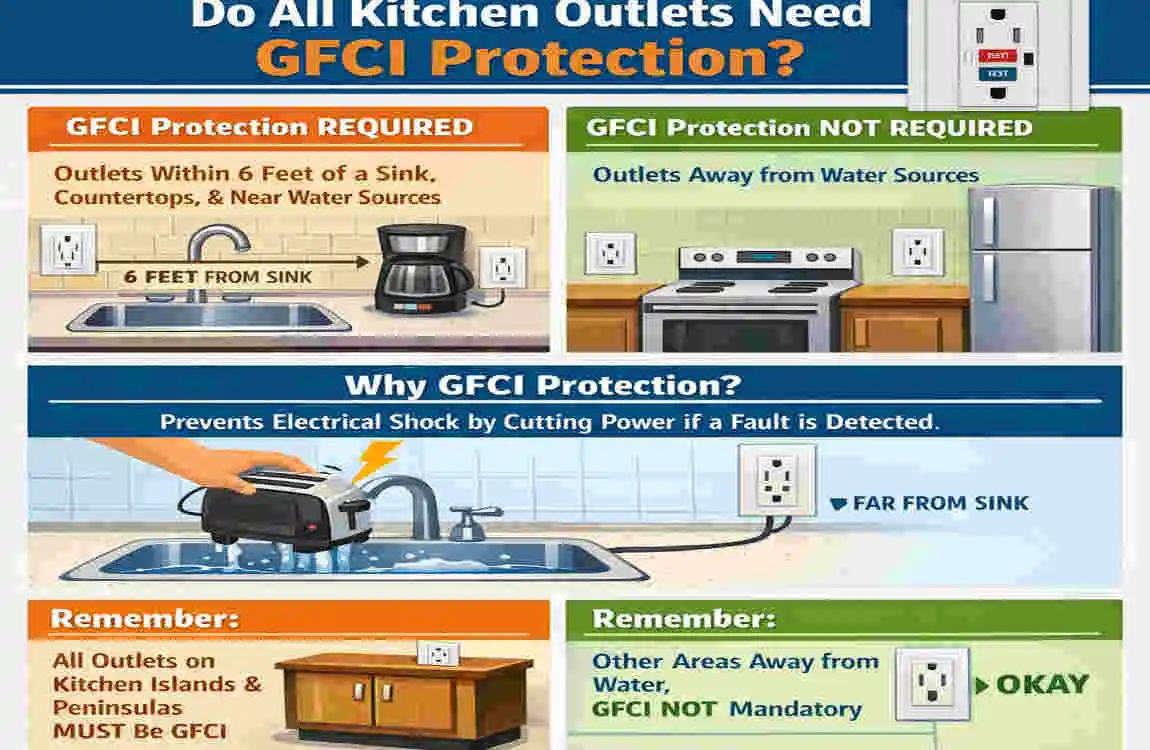
Under the latest NEC-style rules, kitchen receptacles in dwelling units generally require GFCI protection much more broadly than in the past. In older code language, protection centered on countertop service. In newer language, the kitchen itself receives broader coverage.
So if you are asking, do all kitchen outlets need to be GFCI protected, the modern, practical answer is yes: most, if not all, receptacles in a residential kitchen now fall under GFCI requirements, especially when they are 125V to 250V on single-phase branch circuits and within normal residential amperage limits.
What “All Kitchen Receptacles” Really Means
This is where wording matters.
The rule generally applies to receptacles, meaning places where you plug equipment in. It does not automatically mean every hardwired appliance connection gets handled the same way. A hardwired appliance is not a receptacle. So when you read “all kitchen outlets,” think first about plug-in receptacles.
That includes common locations such as countertop, island, and wall outlets, as well as many receptacles serving appliances in the kitchen.
Kitchen Areas Commonly Covered
In a modern residential kitchen, GFCI protection commonly applies to receptacles serving or located in these areas:
- Countertop and backsplash receptacles
- Island and peninsula receptacles
- Wall receptacles in the kitchen
- Receptacles for many plug-connected appliances
- Outlets near prep stations, beverage areas, and similar kitchen-use spaces
That is a much broader scope than older code users remember.
What About Appliances Like Refrigerators and Microwaves?
This is where many homeowners pause.
Under the broader modern view, plug-connected appliances in a kitchen are often pulled into the GFCI requirement, even if the receptacle is not above the countertop. That can include a refrigerator receptacle, a microwave receptacle, and other appliance outlets located in the kitchen.
However, you should be careful with blanket statements here for three reasons.
First, local amendments may still vary.
Second, some appliances are hardwired, not cord-and-plug connected.
Third, some electricians and homeowners still talk from older code experience, where refrigerator outlets were often treated differently.
So the smart takeaway is this: do not assume your fridge outlet or microwave outlet is exempt just because older homes had it that way.
Voltage and Amperage Scope
Modern GFCI language also expanded beyond the older, more limited 125-volt view. Newer code editions cover a broader voltage range for many residential receptacles. That matters because kitchens no longer run only basic 15-amp countertop appliances. More equipment now uses different circuit arrangements and heavier loads.
Even so, the everyday homeowner message remains simple. If the receptacle is in the kitchen, assume it has GFCI protection unless a specific exception clearly applies.
What This Means for Remodels
If you are remodeling a kitchen, you should assume GFCI protection will be part of the job plan. This is true even if the existing outlets were allowed under older rules.
A remodel often triggers at least partial compliance with currently adopted code. That can affect:
- replacement receptacles
- newly added receptacles
- altered branch circuits
- moved appliance locations
- island and peninsula additions
- cabinet and backsplash redesigns
In practice, many electricians choose a design that protects the whole kitchen circuit or uses carefully planned first-device GFCI protection. That approach reduces confusion and makes inspection easier.
A Quick Reality Check on Kitchen Circuits
You may have seen advice online saying kitchens need a very high number of circuits. In reality, kitchen wiring layout depends on the room size, the appliances included, and the adopted code. A basic NEC approach requires at least two small-appliance branch circuits for receptacle service in kitchen and related dining/pantry areas. Still, many modern kitchens use several more circuits for convenience and appliance load management.
So while the number of circuits can vary, the bigger point for you is this: GFCI protection and proper circuit planning now go hand in hand in the kitchen.
Exemptions and Exceptions
Hardwired Equipment Is a Different Conversation
One of the biggest sources of confusion is the difference between a receptacle and a hardwired appliance connection.
If a dishwasher, disposal, or other appliance is hardwired directly into the electrical system, you are no longer talking about a standard receptacle in the same way. Some hardwired equipment may still require additional protection, depending on the equipment type and code section involved, but the “all kitchen receptacles” rule applies only to receptacles.
That is why a homeowner may hear two statements that sound contradictory:
- “All kitchen outlets need GFCI now.”
- “My hardwired appliance is handled differently.”
Both can be true.
Dishwasher and Disposal Situations
Dishwashers are especially tricky because one home may have a cord-and-plug connection while another has a hardwired connection. Garbage disposals can vary too.
If the appliance is cord-and-plug connected in the kitchen area, GFCI protection is often expected under modern code. If it is hardwired, you need to review the applicable equipment and location rules more carefully.
This is one reason kitchen electrical work is not always ideal for guesswork or outdated advice from a neighbor.
Refrigerator Receptacles
Refrigerator outlets cause more debate than almost any other kitchen receptacle.
In older practice, many fridge receptacles were not GFCI protected if they did not serve the countertop and were not near the sink. Under the newer and broader kitchen approach, that older assumption is much less reliable.
Still, refrigerators remain one of the first places people ask about because of nuisance trip fears. Nobody wants to come home to spoiled food after a tripped device.
Here is the best practical advice: treat a kitchen refrigerator receptacle as likely to require GFCI protection unless your local code or inspector says otherwise.
Existing Homes and Grandfathering
Many homeowners worry that new code requires them to immediately rewire the entire kitchen. Usually, that is not how code works.
In many places, existing installations that were legal when installed can remain in place until you renovate, replace, or alter them in a way that triggers an upgrade requirement. This is often described as being “grandfathered.”
But grandfathering is not a free pass forever. A few common events can change the picture:
- major kitchen remodels
- adding new receptacles
- moving circuits
- replacing panels
- permit-required electrical work
- outlet replacement rules under adopted code
That is why you should not assume an old installation remains acceptable after new work begins.
Downstream Protection and Labeling
Not every protected kitchen outlet has to be an actual GFCI receptacle face with test and reset buttons. A standard-looking receptacle can still be GFCI-protected if it is connected downstream of an upstream GFCI device or breaker.
When that happens, proper labeling matters. You may see markings such as “GFCI Protected” or “No Equipment Ground” where applicable. Those labels help users, electricians, and inspectors understand the type of protection present.
Residential vs. Commercial Kitchens
Why the Rules Are Not the Same
A residential kitchen and a commercial kitchen may both have sinks, appliances, and cooking equipment. Still, the code does not always treat them the same way.
In a home, the kitchen is a daily-use living space where broad receptacle protection makes sense. In a commercial kitchen, the electrical layout is often more specialized. Equipment may be larger, hardwired, multi-voltage, or installed under different occupancy and equipment rules.
That is why you should be careful about using restaurant advice for a house, or vice versa.
Side-by-Side Comparison
AspectResidential KitchenCommercial Kitchen
General GFCI Scope Broad coverage for kitchen receptacles More equipment-specific and condition-specific
Main Rule Concept Kitchen area protection Use-based and equipment-based protection
Typical Homeowner Concern Countertops, islands, fridge, microwave Prep equipment, cord-connected appliances, wet zones
Inspection Focus Dwelling unit receptacle safety Occupancy type, appliance method, voltage, and equipment listing
What This Means for You
If you are working on your house, focus on dwelling unit kitchen rules, not commercial kitchen discussions. A lot of online confusion stems from people mixing the two.
Installation Guide
Before You Start
If you are comfortable replacing a basic receptacle and your local rules allow homeowner electrical work, you can install a receptacle-type GFCI in some situations. But if your kitchen wiring is old, crowded, multi-wire, aluminum, poorly labeled, or part of a larger remodel, this is a job where professional help is often worth it.
A kitchen is not the best room for trial and error. Incorrect wiring can leave downstream outlets unprotected, reverse the line and load terminals, or create nuisance-trip problems that are hard to diagnose.
Tools and Materials You May Need
A typical kitchen GFCI upgrade may involve a voltage tester, insulated screwdriver, wire stripper, needle-nose pliers, outlet tester, faceplate, labels, and the correct GFCI receptacle or breaker.
If you are considering a breaker replacement, stop and think carefully. Panel work carries more risk than swapping a wall device. Many homeowners wisely leave breaker installation to a licensed electrician.
Basic Receptacle-Style Upgrade Steps
- Turn off the power at the breaker and confirm the outlet is dead with a tester.
- Remove the existing receptacle and correctly identify the line and load conductors.
- Install the GFCI device with the incoming power on the line terminals.
- Connect downstream outlets to the load side only if you intend to protect them through that device.
- Reinstall the device and cover plate neatly and securely.
- Restore power and test using the built-in test and reset buttons.
- Label downstream receptacles, if required, to indicate they are GFCI-protected.
Installing the First Device in a Daisy Chain
Many electricians protect several kitchen receptacles by installing a GFCI device at the first outlet on the circuit and feeding the remaining receptacles from the load side. That can be cost-effective and clean.
But this only works if the first device is the correct one and the wiring is correctly identified. In an older kitchen, that is not always easy. Boxes may contain multiple cables, split circuits, or unexpected routing.
If you are not fully sure which cable is line and which is load, do not guess.
Monthly Testing Matters
GFCI protection is not a “set it and forget it” item. It should be tested regularly.
Press the test button. The outlet should trip and cut power. Then press reset to restore operation. If it does not trip, does not reset, or feels loose or damaged, replace it promptly.
A kitchen GFCI that hasn’t been tested for years isn’t providing the level of protection you think it is.
Common Mistakes to Avoid
A few errors show up again and again in DIY work:
Using the wrong line/load terminals is the most common one. Another is assuming every dead downstream outlet is protected when it may actually be on a different branch of the circuit. Homeowners also sometimes install a GFCI receptacle on an incompatible wiring setup or forget to label downstream outlets.
If you want the safest and fastest result, especially in a remodel, hire a licensed electrician and have the installation inspected.
Benefits and Risks
The Biggest Benefit: Shock Protection
The main benefit of GFCI protection is simple and important: it helps prevent serious electric shock.
In a kitchen, that matters because you are constantly handling water, metal, cords, and appliances in a high-use environment. A GFCI reacts much faster than a person can. That speed can prevent injury or make a dangerous event far less severe.
For families with kids, older adults, or busy shared kitchens, that extra margin of safety is especially valuable.
Other Benefits
GFCI protection also helps bring a kitchen up to modern safety expectations. That can matter during inspections, remodeling permits, home sales, and insurance discussions. Even when not explicitly requested by a buyer, updated kitchen electrical safety is a reassuring feature.
It also creates a more consistent electrical layout. Instead of wondering which kitchen outlets are protected and which are not, you get a much clearer and safer system.
The Main Complaint: Nuisance Trips
The downside people mention most is the nuisance trip. Some appliances, especially motors, compressors, or older equipment, may trip a GFCI even when no obvious hazard is present.
This can be frustrating with refrigerators or freezers. But nuisance trips are often manageable with better-quality devices, proper circuit design, correct wiring, and replacement of aging appliances or damaged cords.
The answer is usually not to remove the protection. The answer is to figure out why the circuit is tripping.
Cost Breakdown
What You Can Expect to Spend
Kitchen GFCI costs vary based on whether you need a single receptacle replaced or a full kitchen brought up to current expectations. Labor rates, wall conditions, circuit complexity, and permit requirements all affect the total.
ScopeEstimated Cost
Single GFCI receptacle replacement $100–$200
Several receptacles on one circuit $200–$500
GFCI breaker installation $150–$300+
Full kitchen upgrade during remodel $1,000+
Large or complex kitchen rework $1,500 and up
A basic receptacle device is not very expensive on its own. The bigger cost usually comes from labor, troubleshooting old wiring, and making the entire kitchen layout compliant during a remodel.
FAQ
Do all kitchen outlets need to be GFCI protected?
Under the latest NEC-style rules, nearly all receptacles in a residential kitchen are generally expected to have GFCI protection. Older code editions were narrower, so older homes may not reflect current expectations.
Are only countertop outlets required to be GFCI protected?
No. That was closer to the older way of thinking. Modern kitchen rules extend beyond just countertop outlets and sink-adjacent receptacles.
Does the refrigerator outlet need GFCI protection?
In many modern residential kitchen setups, yes, it likely does if it is a kitchen receptacle. But local code adoption and specific installation details still matter.
What about a microwave outlet?
If the microwave is cord-and-plug connected at a kitchen receptacle, it often falls under the broader GFCI expectation for kitchen receptacles.
Are hardwired appliances treated the same as receptacles?
No. A hardwired appliance is not the same thing as a plug-in receptacle. Different rules may apply depending on the equipment and installation method.
Do I have to update every outlet in an old kitchen right away?
Usually not. Existing installations are often allowed to remain until renovation or alteration work triggers an upgrade. But local rules can differ.
Is a regular outlet protected if it does not have test and reset buttons?
Possibly, yes. It may be protected downstream by another GFCI receptacle or by a GFCI breaker.
Can I install a kitchen GFCI myself?
If it is a simple receptacle replacement and local rules allow homeowner work. But if there is any doubt about the wiring, panel, or code requirement, call a licensed electrician.