Tax season often feels like a giant puzzle where the pieces don’t quite seem to fit. If you are a small business owner, a self-employed professional, or someone working from a dedicated home office, you have probably looked at your cleaning bills and wondered, “Can I actually write this off?” Knowing how to claim house cleaning on taxes can be a total game-changer for your bank account.
With the rising costs of living and the complexities of the IRS (or FBR if you are reading from Pakistan), finding every legal way to lower your taxable income is essential. Whether you are a professional cleaner yourself or just someone trying to keep their workspace tidy, the tax code offers several “hidden” gems that can save you a significant amount of money.
Who Can Claim House Cleaning on Taxes?
Before you start tallying up your receipts, we need to determine if you actually qualify. The IRS is very specific about who can deduct these costs. It isn’t just about having a clean house; it’s about how that cleaning relates to your ability to earn money.
Self-Employed Cleaners and Housekeepers
If you run a cleaning business, this is your bread and butter. For you, the answer to how to claim house cleaning on taxes is straightforward: almost everything you spend to perform your job is a business expense.
Since your business is cleaning, the IRS considers your supplies, travel, and equipment “ordinary and necessary” expenses. This means that if you need a vacuum to do your job, that vacuum is tax-deductible. If you need a specialized granite cleaner for a client’s kitchen, that is a deduction too. You are essentially deducting the costs of doing business to arrive at your true profit.
Home Office Deduction for Professionals
This is where it gets interesting for the rest of us. If you are a graphic designer, a writer, or a consultant who works from home, you can claim a portion of your house cleaning costs. However, there is a big “but” here.
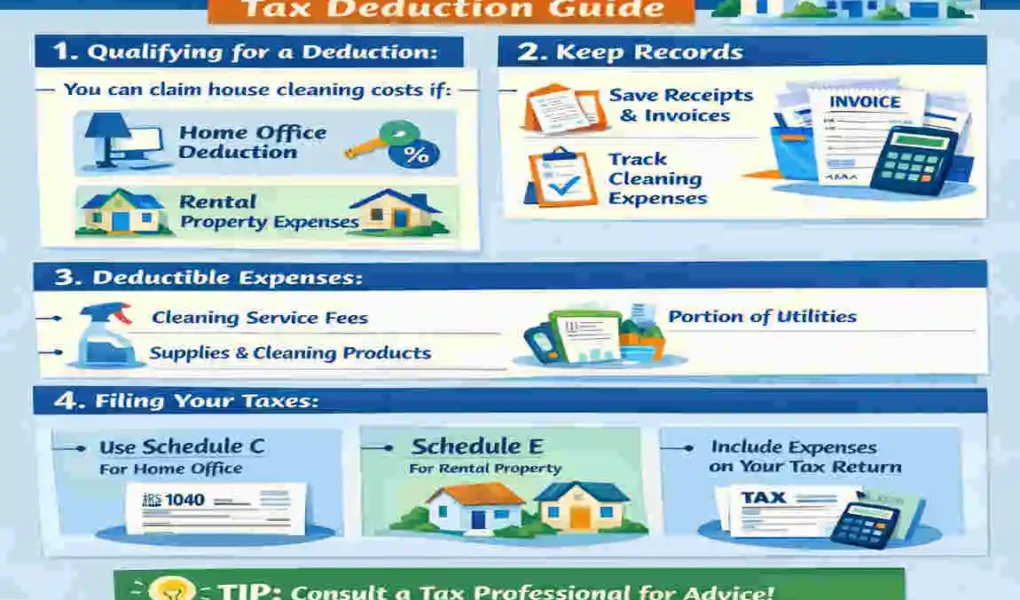
To qualify, your home office must be your principal place of business and used exclusively for work. If you work from your dining room table, you generally cannot claim house cleaning. But, if you have a spare bedroom converted into a dedicated office, you can deduct a percentage of your cleaning bills that corresponds to the square footage of that office.
Employers and Business Owners
If you own a brick-and-mortar business—like a retail shop or a law firm—and you hire a cleaning service, that is a 100% deductible business expense. Additionally, some employers offer cleaning services as a perk to their employees. While this is less common, it can sometimes be treated as a deductible business expense for the company. However, it may be considered a taxable fringe benefit for the employee.
Step-by-Step: How to Claim House Cleaning on Taxes
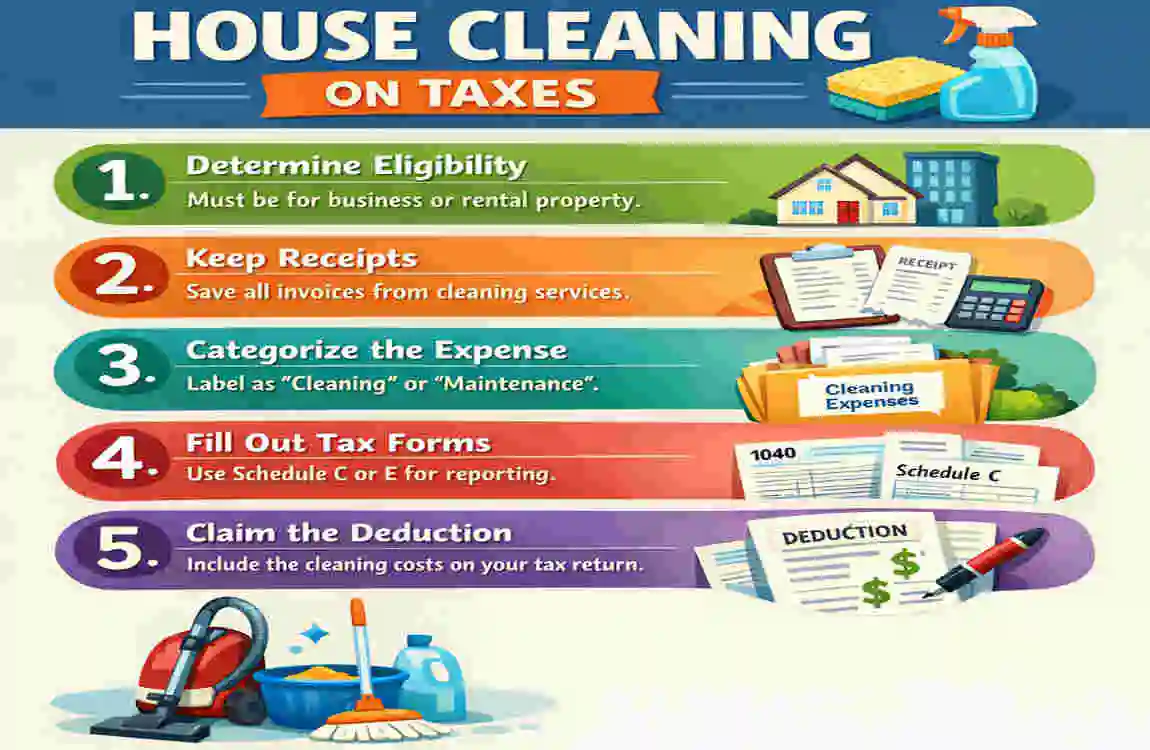
Now that we know who qualifies, let’s get into the “how.” Filing taxes can be intimidating, but if you follow these steps, you will be well-prepared for April.
Determine Your Filing Status
The first thing you need to know is which form to use. Most self-employed individuals and “solopreneurs” use Schedule C (Form 1040). This is where you report your income and your expenses. If your cleaning business is an LLC or a Corporation, your filing might be more complex, but for most people, Schedule C is the go-to.
I recommend using an app like QuickBooks or FreshBooks throughout the year. These apps allow you to categorize your cleaning expenses as you go, so you aren’t stuck with a mountain of receipts at the end of the year.
Gather Receipts and Documentation
The IRS has a saying: “If it isn’t documented, it didn’t happen.” You need to prove that you actually paid for the cleaning. This means keeping:
- Invoices from the cleaning company.
- Bank statements showing the payment.
- Receipts for cleaning supplies (if you buy them yourself).
Keep these records for at least three to seven years. If you ever get audited, these pieces of paper will be your best friends.
Calculate Deductible Expenses
Not every dollar you spend is deductible. You need to separate personal cleaning from business cleaning. If you are a professional cleaner, you can deduct 100% of the supplies you use for clients.
If you are a home office user, you have to do some math. If your home is 2,000 square feet and your office is 200 square feet, your office takes up 10% of your home. Therefore, you can deduct 10% of your total house cleaning bill.
Apply Home Office Rules
When applying the home office rules, you have two choices: the Simplified Method or the Actual Expense Method.
- The Simplified Method gives you a flat rate per square foot ($5 per sq. ft. up to 300 sq. ft.).
- The Actual Expense Method allows you to deduct a portion of your actual bills (including cleaning).
If you pay a lot for professional cleaning, the Actual Expense Method usually yields a larger tax break.
Use Standard Mileage or Actual Costs
If you are a professional cleaner traveling to clients’ homes, your vehicle is a massive tax write-off. For the 2026 tax year, the standard mileage rate is expected to be around 67 cents per mile.
You must keep a mileage log! Write down the date, the destination, and the purpose of the trip. You can’t just guess at the end of the year. The IRS is very strict about vehicle logs.
File Correctly on Schedule C
When you finally sit down to fill out your Schedule C:
- Line 22 is usually where you put “Supplies.”
- Line 9 is for “Car and truck expenses.”
- Line 13 is for “Depreciation” (if you bought an expensive vacuum or steamer).
Using the right lines ensures that the IRS’s automated systems don’t flag your return for a manual review.
House Cleaning Tax Deductions
To help you maximize your savings, I have put together a table of the most common deductions. Have you been missing out on any of these?
DeductionDescriptionEstimated SavingsForm Line
Cleaning Supplies Detergents, mops, gloves, rags $500 – $2,000/year Sch C, Line 22
Equipment/Tools: Vacuums, steamers, power washers. Up to $1M (Section 179), Sch C, Line 13
Vehicle/Mileage Gas, repairs, or 67¢ per mile $3,000+ for 10k miles Sch C, Line 9
Home Office Cleaning Proportional share of bills 10-20% of total bill Sch C, Line 30
Uniforms/Laundry Branded shirts, specialized gear $200 – $500 Sch C, Line 27a
Insurance/Licenses: Liability insurance, city permits, Full Premium cost, Sch C, Line 15
Marketing/Ads Flyers, website, Google Ads 100% of cost Sch C, Line 8
Phone/Internet Business-use percentage 50-80% of bill Sch C, Line 25
Training/Courses Certifications and safety classes Full cost of course Sch C, Line 27a
Repairs: Fixing broken vacuums or tools, as incurred, Sch C, Line 21
Let’s Look Closer at These Deductions
Cleaning Supplies
If you are a professional cleaner, every sponge you buy is a deduction. Even if you aren’t a pro, if you have a home office, a portion of the cleaning products used to keep it tidy can be deducted. Think about the paper towels, the glass cleaner, and the disinfectant wipes you use to keep your desk clean. It all adds up!
Equipment and Tools
Big-ticket items like a high-end Dyson vacuum or a commercial-grade floor polisher don’t have to be deducted all at once. Under Section 179, you can choose to “expense” the entire cost in the year you buy it, or you can “depreciate” it over several years. This is a great way to lower a high tax bill if you had a very profitable year.
Vehicle and Mileage
This is often the largest deduction for self-employed cleaners. Do you realize that every trip to the store to buy supplies is deductible? Every trip to a client’s house is deductible. If you drive 10,000 miles for business in 2026, that is a $6,700 deduction right off the top of your income.
Home Office Cleaning
If you pay a service like Merry Maids to clean your house once a week, and you have a dedicated office, don’t forget to claim that percentage! If they clean your whole house for $200, and your office is 10% of the space, that is $20 you can claim every single week. Over a year, that is over $1,000 in deductions.
Uniforms and Laundry
You can’t deduct your everyday jeans and t-shirts. However, if you have shirts with your company logo or need to wear specialized protective gear (like heavy-duty boots or masks), those are deductible. You can even deduct the cost of laundering these specific items.
Tax Law Updates for House Cleaning Claims
Tax laws are always changing to keep up with inflation and economic shifts. For 2026, there are a few key updates you should know about.
Inflation Adjustments
The biggest change is the Standard Mileage Rate. As fuel prices and vehicle maintenance costs rise, the IRS adjusts the rate to reflect reality. For 2026, the rate is set at 67 cents per mile. This is one of the easiest ways to claim house-cleaning-related travel expenses on your taxes.
Digital Tracking Requirements
The IRS is becoming more tech-savvy. They are placing a higher emphasis on digital records. If you are still using a shoebox for your receipts, 2026 is the year to stop. Using an app that links directly to your bank account makes you much less likely to be audited because the data is “clean” and timestamped.
Global Perspective: The Pakistan FBR Parallels
If you are operating in Pakistan, the Federal Board of Revenue (FBR) has similar rules under the Income Tax Ordinance. Business expenses that are “wholly and exclusively” for business are generally allowable. If you run a cleaning agency in Lahore or Karachi, your supplies, staff salaries, and office cleaning are all valid deductions against your business income. Always consult a local tax professional, as the specific forms (such as the 114(1) return) differ from the US system.
Common Mistakes When Claiming House Cleaning on Taxes
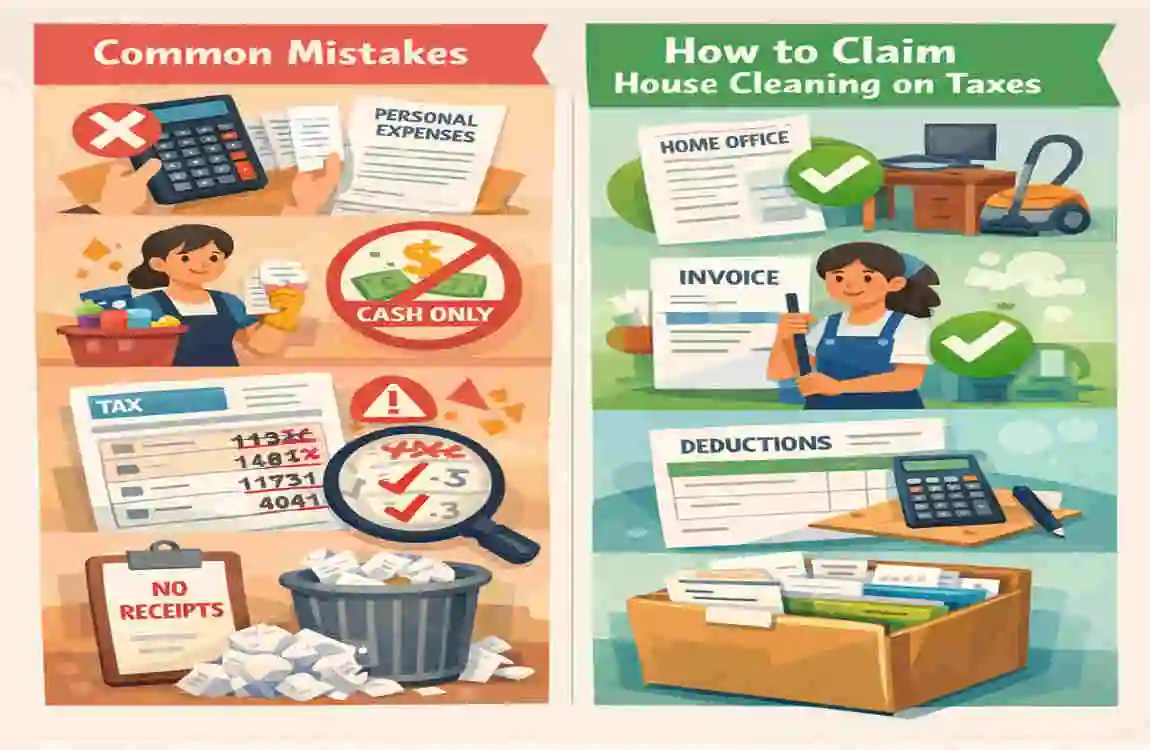
Even with the best intentions, it is easy to make a mistake that triggers an IRS red flag. Here are the pitfalls you must avoid:
Mixing Personal and Business Use
This is the number one mistake. You cannot deduct the cleaning of your kitchen and bedroom if you only work in a small office. If you try to claim 100% of your house cleaning bill, but you only have a 10% home office, the IRS will likely deny the entire claim and may even hit you with a penalty.
No Receipts or Invoices
“I paid my cleaner in cash” is not a valid excuse during an audit. If you pay in cash, you must get a signed receipt from the cleaner that includes their name, address, and Social security Number (or EIN). Without a paper trail, the deduction doesn’t exist in the eyes of the law.
Overclaiming Home Office Space
Be honest about the size of your office. If your office is a 10×10 room, it is 100 square feet. Don’t claim that your “office” includes the living room just because you occasionally take phone calls there. The IRS uses satellite imagery and property records to verify home sizes—they will know if your math doesn’t add up.
Forgetting to Depreciate Large Items
If you buy a $2,000 carpet cleaner, you might think you can write off $2,000. But if you don’t follow the depreciation rules, you could be in trouble. Make sure you decide whether you are using Section 179 to take the whole deduction now or spread it out over five years.
Tools and Apps to Track Deductions
Gone are the days of manual spreadsheets. If you want to master how to claim house cleaning on taxes, you need the right tools.
- QuickBooks Self-Employed: This is the gold standard. It automatically tracks your mileage using your phone’s GPS and lets you “swipe” transactions as business or personal.
- Expensify: Great for snapping photos of receipts. It uses OCR technology to read the receipt and categorize the expense for you.
- MileIQ: If you struggle to remember to write down your miles, this app runs in the background house and logs every drive you take. You categorize them at the end of the week.
FAQs
Can I claim house cleaning on taxes as a homeowner?
Generally, no. If you are a standard homeowner who doesn’t run a business or have a dedicated home office, house cleaning is considered a personal living expense and is not deductible.
How much is the 2026 mileage rate?
The IRS has set the standard mileage rate for 2026 at 67 cents per mile for business travel.
Is house cleaning deductible for employees?
No. Since the 2018 tax reform, W-2 employees cannot deduct unreimbursed business expenses. Only self-employed individuals and business owners can claim these costs.
What is the “Exclusive Use” rule for home offices?
This rule states that the area you claim as an office must be used only for business. If your office also doubles as a guest bedroom or a playroom, it technically doesn’t qualify for the deduction.
What is the deadline for 2026 tax filings?
For most individuals, the deadline will be 15 April 2027. If you are a business owner paying quarterly estimated taxes, those deadlines fall in April, June, September, and January.