You have just noticed a leak in your ceiling, and you decide it is finally time to replace your aging roof. You call up a local roofing contractor, they come out to inspect your property, and a few days later, they hand you a detailed estimate.
You scan the document, expecting to see terms you understand. Instead, your eyes land on a confusing line item: “20 squares of architectural shingles.”
You might immediately panic. Twenty squares? What does that even mean? Is my house only twenty square feet? Am I being overcharged for a massive commercial project?
If you have ever found yourself staring blankly at a roofing quote, you are certainly not alone. The terminology used by roofing professionals can feel like a completely different language to the average homeowner. However, understanding the basic jargon is your first and best defense against miscommunication, budgeting errors, and paying too much for your renovation.
That is exactly why understanding how big is a square in roofing shingles is essential before you sign any contracts. Once you demystify this simple industry measurement, reading your roofing bids becomes incredibly straightforward. You will know exactly how much material you are paying for, how much area it covers, and why the final price is what it is.
What Is a Roofing Square?
To understand what a roofing square is, we first need to take a quick trip back in time.
The term “square” is essentially an industry shorthand that originated in the 19th-century roofing and construction trades. Back in those days, builders and roofers needed a fast, standardized way to estimate materials without calculating thousands of individual square feet in their heads while balancing on a steep, hot roof.
They decided to group square footage into neat, manageable blocks. Thus, the “roofing square” was born to simplify estimates and streamline the ordering process for both materials and labor.
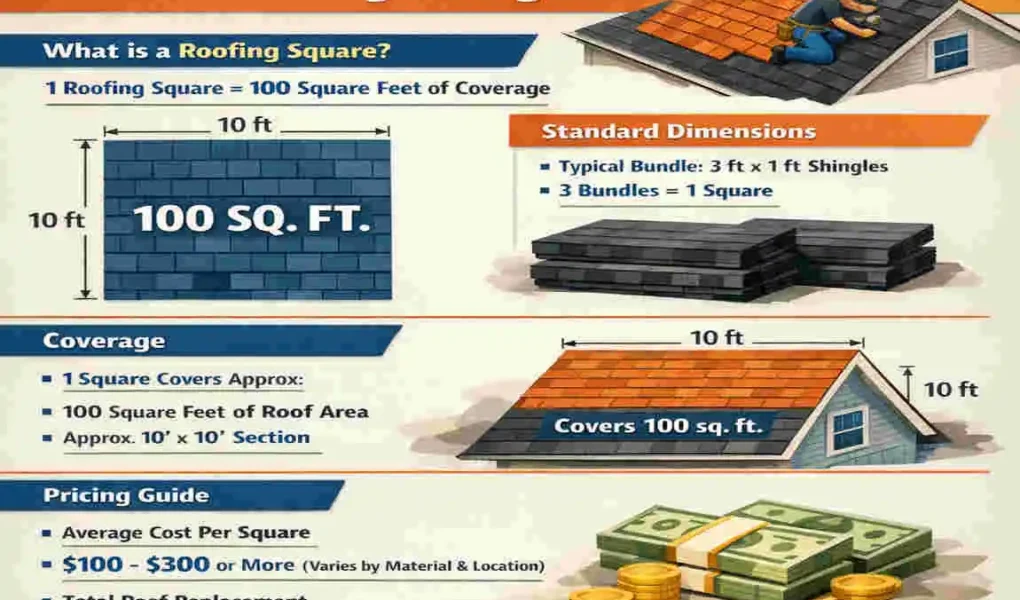
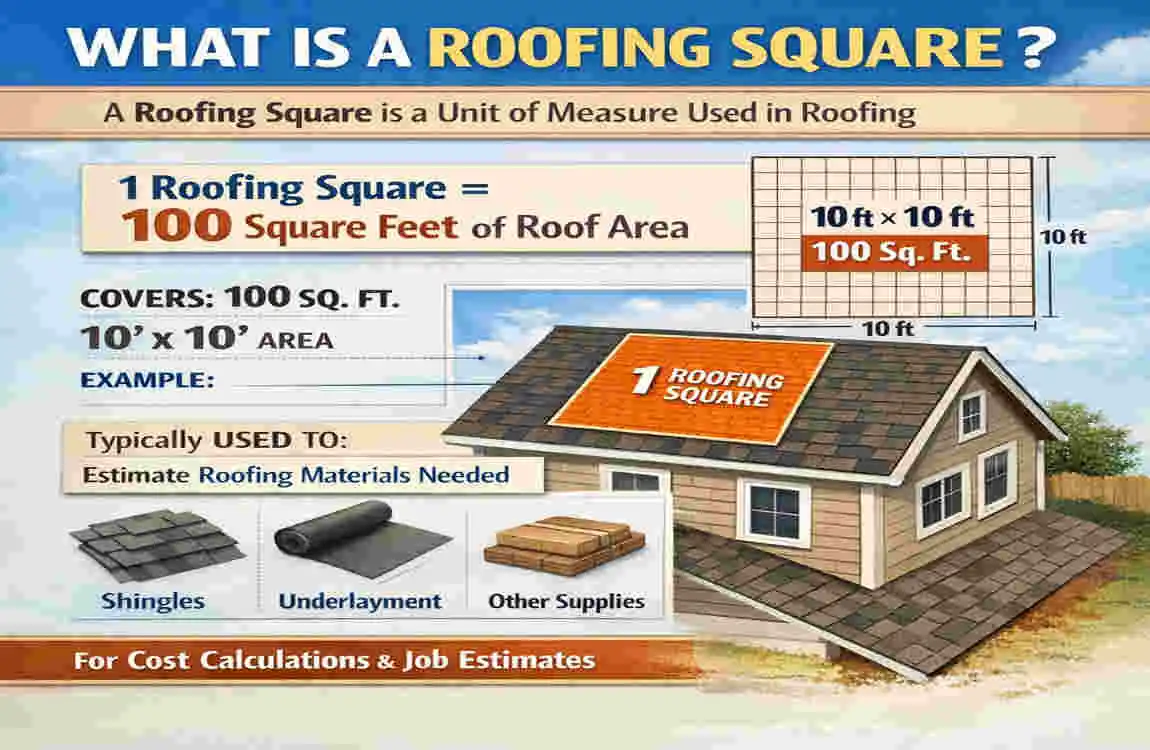
So, what is the core definition today? A roofing square is always equal to exactly 100 square feet of roof area.
This rule is a universal constant in the construction industry. It does not matter if you are installing basic asphalt shingles, premium cedar shakes, heavy slate tiles, or sleek metal panels. One square of material will always cover 100 square feet of the roof’s surface.
To give you a better mental picture, let us use some everyday comparisons. Think about the floor plan of a small guest bedroom or a standard home office. If that room is 10 feet wide and 10 feet long, the floor space is exactly 100 square feet. If you were to cover that entire floor with roofing material, you would need exactly one roofing square to do it.
Roofing Square vs. Actual Square Footage
Now, here is where many homeowners get tripped up. It is crucial to clarify that the square footage of your home’s floor plan is not the same as the square footage of your roof.
When you buy a house, the real estate listing might say it is 2,000 square feet. That number represents the livable floor space inside the walls. Your roof, however, has to extend past those walls to create overhangs and eaves, which immediately adds more surface area.
More importantly, your roof is not completely flat. It has a slope, or, as contractors call it, a “pitch.”
Because the roof is angled, it actually requires more physical material to cover the distance from the gutters to the top of the roof than it would if it were just a flat lid sitting on top of your house. Depending on how steep your roof is, the slope can easily increase the amount of roofing materials you need by 10% to 25% compared to the flat footprint of your home.
Therefore, a home with 2,000 square feet of floor space will almost always require significantly more than 20 roofing squares to be fully covered.
Dimensions of a Roofing Square
Let us get into the exact measurements and roofing square dimensions.
As we mentioned, a square equals 100 square feet of flat measurement. The easiest way to calculate this is to multiply a length of 10 feet by a width of 10 feet (10 ft × 10 ft = 100 sq ft).
But why is this measurement so strictly standardized?
The standardization of the roofing square is what keeps the entire construction industry running smoothly. Because every contractor, supplier, and manufacturer uses the same definition, your quotes are perfectly aligned.
If Contractor A quotes you for 25 squares, and Contractor B quotes you for 25 squares, you know they are both estimating the same amount of roof coverage. It also means that when a manufacturer packages its shingles at the factory, it knows exactly how many packages to bundle to make up one square. This universal language eliminates guesswork and protects consumers from being shortchanged.
Visualizing the Size
If you are a visual learner, it helps to picture the dimensions of a roofing square in the real world.
- A Two-Car Garage: A typical two-car garage is about 400 square feet. Therefore, a single roofing square (100 square feet) would cover roughly one-quarter to one-third of the roof over that garage.
- Parking Spaces: A standard commercial parking space in a grocery store lot is roughly 160 square feet. So, a roofing square is a little smaller than a standard parking space. To cover an average residential roof, you would need enough material to cover 15 to 20 parking spaces!
- Plywood Sheets: A standard sheet of construction plywood is 4 feet by 8 feet, which equals 32 square feet. It takes just over three full sheets of plywood to equal the area of one roofing square.
By visualizing these dimensions, the numbers in your contractor’s estimate will feel much more grounded in reality.
Need a professional to measure your roof’s dimensions? Check out our Free Roof Quote page to schedule an exact measurement with our expert team!
Shingle Coverage per Square
Now that we know the size of a square, let us talk about the actual physical products. When you go to a home improvement store or order from a supplier, roofing shingles are not sold in massive 100-square-foot sheets. They are heavy, cumbersome, and need to be carried up tall ladders.
Instead, they are sold in smaller, easy-to-carry packages known as “bundles.”
The standard rule of thumb across the roofing industry is that it takes 3 bundles of shingles to cover 1 roofing square.
Because one square equals 100 square feet, the shingle bundle coverage is approximately 33.3 square feet per bundle. This three-bundle rule is the golden standard for basic asphalt shingles, making the math incredibly easy for contractors to calculate.
However, there are important variations to this rule depending on the specific type and quality of the shingle you choose to install.
Asphalt Shingles Breakdown
Not all shingles are created equal. The style you select will directly impact how many shingles per square you need to purchase.
- 3-Tab Asphalt Shingles: These are the most basic, traditional flat shingles. Because they are relatively thin and lightweight, manufacturers can easily pack enough of them into a standard package. For 3-tab shingles, the rule remains perfectly steady: 3 bundles equal 100 square feet (1 square).
- Architectural Shingles: Also known as dimensional shingles, these are rapidly becoming the most popular choice for modern homes. They are manufactured with multiple layers of asphalt to create a thicker, more textured, and premium look. Because they are thicker and heavier, fewer of them can fit into a single package. For architectural shingles, you will often need 3 to 4 bundles to cover a single square, as they require more premium overlap during installation to achieve their signature multi-dimensional appearance.
Bundle Math Examples
To make sure you are totally comfortable with these numbers, let us run through a practical math example.
Imagine you have successfully measured your roof and determined that the total surface area is 1,500 square feet.
- First, divide your total square footage by 100 to find your total squares. (1,500 ÷ 100 = 15 squares).
- Next, multiply your total squares by the number of bundles needed per square. If you are using standard 3-tab shingles, you multiply by 3. (15 squares x 3 bundles = 45 bundles).
So, for a 1,500-square-foot roof, your contractor will need to order and deliver 45 individual bundles of shingles to complete the job.
Here is a handy reference table to keep your bundle math straight:
Shingle Type Bundles per Square Coverage per Bundle (sq ft)
3-Tab Asphalt 3 33.3
Architectural 3 to 4 25 to 33.3
Composite/Synthetic 3 33.3
Understanding this bundle breakdown ensures that when you see a massive pallet of shingles dropped off in your driveway, you know exactly why there are so many individual packages.
Calculating Your Roof’s Squares
Are you the kind of homeowner who likes to double-check the math? Or perhaps you are planning a brave DIY roofing project? If so, you need to know how to accurately calculate your own roof’s squares.
While calculating square footage shingles requirements is a routine task for a seasoned roofer, you can do it too by following a simple, step-by-step process.
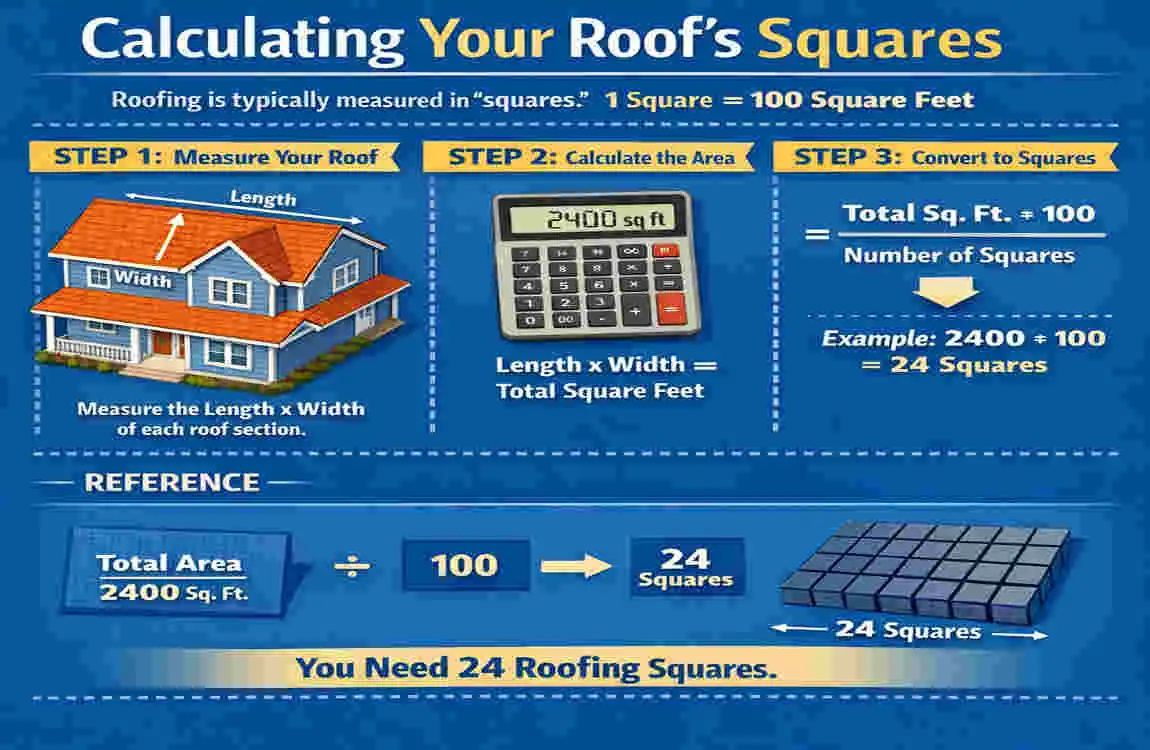
Measure the Sections Roofs are rarely a single, flat rectangle. They are usually composed of multiple geometric shapes (rectangles, triangles, and trapezoids). You need to measure the length and the width of each section of your roof.
Multiply Length by Width For each rectangular section, multiply the length by the width to get the square footage of that specific area. For example, a section that is 20 feet long and 15 feet wide equals 300 square feet. Do this for every section of the roof.
Add the Sections Together. Once you have the square footage for each section, add them together to get the total surface area of your entire roof.
Divide by 100 Take your total and divide it by 100. This gives you your baseline number of roofing squares.
Add the Waste Factor This is the most critical step that amateurs often forget! You cannot just order the exact baseline number of squares. Roofing requires cutting shingles to fit around chimneys, skylights, roof vents, and along the valleys (the internal angles where two roof planes meet). When you cut a shingle to fit an angle, the cutoff piece is usually thrown away as waste.
Because of this, industry standards dictate that you must add a 10% to 15% waste factor to your total material order. If you have a highly complex roof with lots of peaks, valleys, and dormers, you might even need to add a 20% waste factor.
Example for an Average Home
Let us put this calculation into practice for a standard, average-sized home.
Let us say your total roof surface area, after measuring all the sections, comes out to exactly 2,000 square feet.
- Divide by 100: You have 20 baseline squares.
- Add a 10% waste factor: 10% of 20 is 2. (20 + 2 = 22 total squares).
- Calculate your bundles: 22 squares x 3 bundles per square = 66 bundles.
In this scenario, a 2,000-square-foot roof translates to 22 actual squares of ordered material, totaling roughly 66 bundles of shingles.
Pricing per Square Guide
Now we arrive at the topic that matters most to your wallet: roofing square pricing.
How much is this actually going to cost?
In the roofing industry, contractors typically do not price jobs by the square foot or by the hour. Instead, they price their jobs “per square.” This per-square price is an all-inclusive figure that generally includes the cost of raw materials, the labor to tear off the old roof, the labor to install the new roof, and the cost of waste disposal.
As of 2026, the average cost to replace a roof varies wildly, generally ranging from $250 to $1,000+ per square, depending entirely on the materials you choose and the region you live in.
Let us break that combined cost down into its two main components:
- Materials: The physical products (shingles, underlayment, nails, flashing, and ridge caps) usually account for $100 to $400 per square.
- Installation & Labor: The physical labor of removing the old roof, prepping the deck, and expertly installing the new shingles costs $150 to $600 per square.
2026 Pricing by Material
The biggest factor dictating your final price tag is the specific type of roofing material you select. A basic asphalt roof will cost a fraction of what a premium slate or cedar-shake roof would.
Below is a detailed table showing the estimated 2026 pricing per square for popular materials, along with what you can expect to pay for a standard 20-square (2,000 sq ft) roof project.
Material Type Estimated Cost per Square Total for a 20-Square Roof
Basic 3-Tab Asphalt $250 – $500 $5,000 – $10,000
Architectural Shingles $400 – $800 $8,000 – $16,000
Premium (e.g., Cedar Shake) $800 – $1,000+ $16,000 – $20,000+
It is also vital to understand that your physical location plays a massive role in your quote. For example, if you are living in areas with high import costs or regional premiums—such as specific neighborhoods in Lahore or the broader Punjab region—you might see different pricing structures due to local logistics, which we will explore next.
Factors Affecting Square Size & Cost
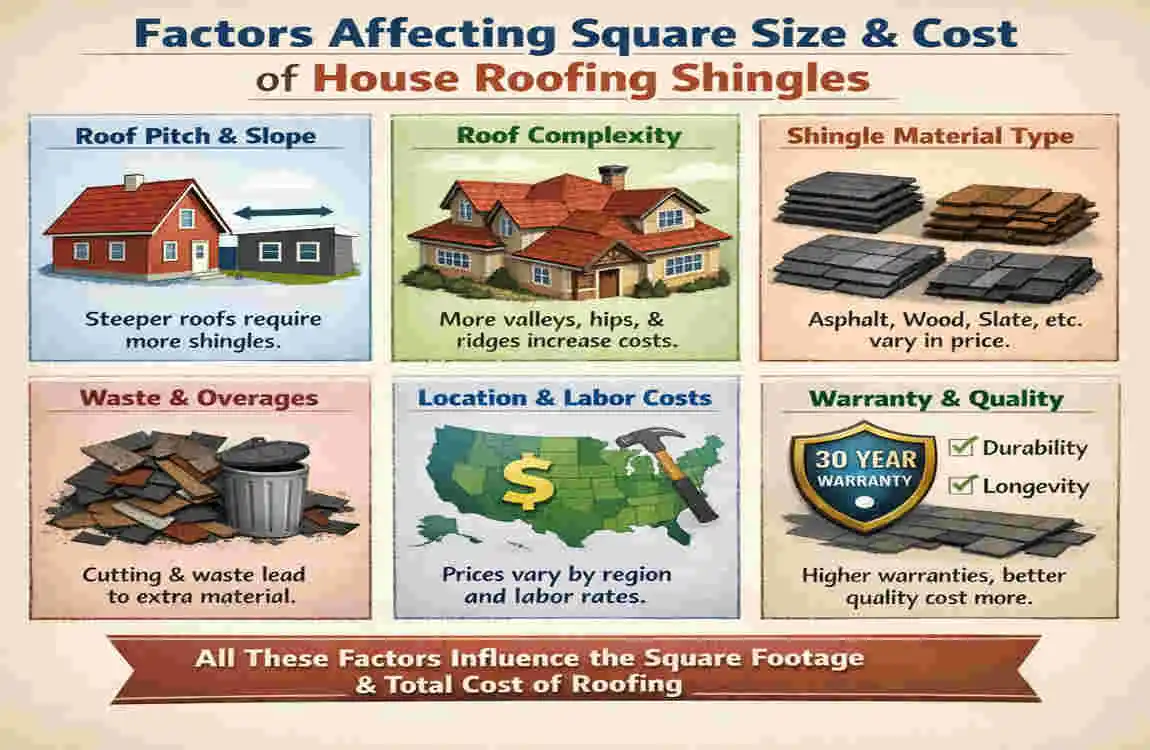
While 100 square feet is a fixed mathematical fact, the total number of squares you need, and the ultimate cost of those squares, are influenced by several dynamic variables on your specific property.
Here are the primary factors that will stretch your required materials and inflate your budget:
The Pitch Multiplier (Roof Slope) As we touched on earlier, steep roofs require more surface area to cover the same horizontal ground space. Contractors use a mathematical “pitch multiplier” to calculate exactly how much extra material is needed. Furthermore, incredibly steep roofs are dangerous to walk on. If your roof has a severe slope, the installation crew will need to use special safety harnesses, roof jacks, and scaffolding. This extra hazard slows down the work, meaning contractors will charge a higher labor rate per square to compensate for the difficulty.
Overhangs, Dormers, and Valleys A roof that is perfectly flat and rectangular is incredibly fast, easy, and cheap to shingle. But most homes have architectural character! If your roof features deep overhangs, multiple dormer windows, skylights, chimneys, and complex valleys, your costs will rise. These features require intricate flashing work, precise shingle cutting, and more time. They also push your waste factor up from the standard 10% closer to 15% or even 20%, requiring you to buy more squares of material.
Regional Tips and Supply Chain Factors Where you live heavily dictates your material costs. Let us look at a specific international example. In regions like Pakistan, local manufacturing of premium architectural asphalt shingles is limited. Therefore, these materials must often be imported. Homeowners in Lahore or the Punjab region need to factor in that import duties, shipping logistics, and local taxation can artificially inflate the base price of asphalt shingles by 20% to 30% compared to North American averages.
When reviewing your per-square quote, always ask your contractor to explain which local geographic factors might be impacting your bottom line.
Frequently Asked Questions (FAQs)
We have covered a massive amount of information. To ensure you walk away with crystal clear knowledge, let us quickly recap some of the most common questions homeowners have about roofing measurements.
How big is a square in roofing shingles? A roofing square is a standardized measurement that is equal to exactly 100 square feet of flat roof surface area (a 10-foot by 10-foot area).
How many bundles of shingles are in a square? Usually, it takes exactly 3 bundles of standard asphalt shingles to cover one square. However, if you upgrade to thicker, heavier architectural shingles, you may need up to 4 bundles to cover that same 100-square-foot area.
What is the estimated cost for a 1,000 sq ft roof? A 1,000-square-foot roof equates to 10 roofing squares. Based on 2026 national averages, a 10-square roof will typically cost between $2,500 and $5,000 for basic asphalt, and up to $10,000 for premium architectural materials (including labor).
What is the metric conversion for a roofing square? If you live in a region that utilizes the metric system, one roofing square (100 square feet) is roughly equivalent to 9.29 square meters.