A homeowner has just endured a particularly harsh monsoon season, only to find water dripping through the ceiling. The culprit? Improperly sized roofing nails that failed to secure the roof’s 5/8″ sheathing properly. This scenario, while frustrating, is all too common. If you’ve ever wondered, “What size roofing nails for 5/8 sheathing?”, you’re already taking a crucial step toward ensuring your roof is leak-proof, code-compliant, and long-lasting.
The choice of nails for 5/8″ sheathing is not just a minor technical detail. It plays a vital role in creating a roof that can withstand strong winds, heavy rains, and even the test of time. Proper nail size ensures the sheathing stays securely attached to the trusses, preventing pull-out under pressure while also avoiding over-penetration that might compromise structural integrity.
Did you know? Studies show that improper nailing causes up to 20% of roofing failures. By selecting the correct nail size, you protect your investment, save on costly repairs, and adhere to building codes—all while extending the lifespan of your roof.
| Nail Type | Size Designation | Length | Diameter | Best Use Case | Penetration Requirement |
|---|---|---|---|---|---|
| Common 8d | 8d Common | 2½ inches | 0.131 inches | Standard 5/8″ plywood/OSB sheathing | At least 1 inch into rafters |
| Cooler 8d | 8d Cooler | 2⅜–2½ inches | ~0.113–0.131 inches | Residential roofs, reduced splitting | Full sheathing thickness + ¾–1 inch into framing |
| 10d (heavier duty) | 10d Common | 3 inches | 0.148 inches | Thicker sheathing or commercial use | When 8d insufficient for load |
Why Nail Size Matters for 5/8″ Sheathing
When it comes to roofing projects, attention to detail is paramount. The thickness of the sheathing and the type of nails you use can make or break your roof’s durability. Understanding why nail size matters is the foundation for making the right choices.
The Basics of 5/8″ Sheathing
Roof sheathing, also known as decking, is typically made of plywood or oriented strand board (OSB). For residential roofing, 5/8″ sheathing (19/32″ actual thickness) is commonly used, especially for rafters spaced at 24 inches, as per the International Residential Code (IRC) R803.2. This thickness provides adequate strength to handle loads, such as heavy roofing materials and environmental stresses, including snow or wind.
Risks of Using Incorrect Nail Sizes
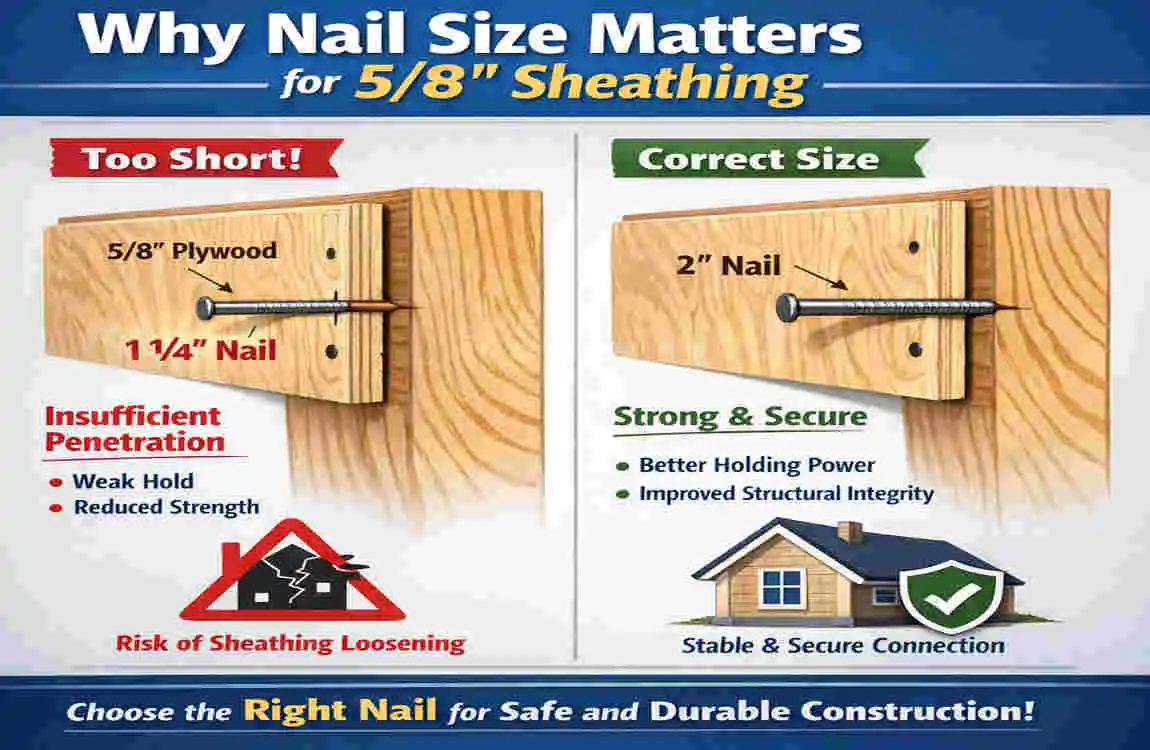
Using nails that are too short can result in pull-out failures, particularly during strong winds or storms. On the other hand, oversized nails can split the wood, weakening the sheathing over time. Both scenarios compromise the structural integrity of your roof.
Nail Penetration Requirements
To ensure proper attachment, building codes like the IRC and International Building Code (IBC) require that nails penetrate at least 1-1.5 inches into the trusses or rafters beneath the sheathing. This ensures a strong grip and prevents the nails from loosening over time.
Here’s a quick reference table for nail requirements for 5/8″ sheathing:
Factor Requirement for 5/8″ Sheathing
Minimum Nail Length 2.5″ (8d common nails)
Nail Diameter 0.131″ (thicker than 0.113″)
Shank Type Ring shank for better grip
Penetration Depth 1-1.5″ into truss
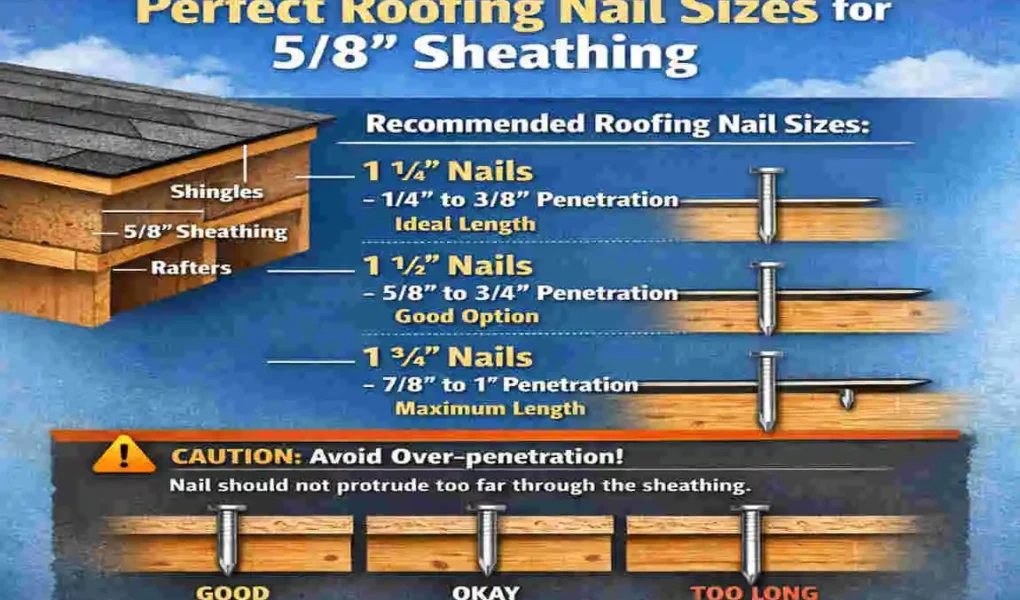
Recommended Roofing Nail Sizes for 5/8″ Sheathing
Choosing the right nail size isn’t just about meeting code requirements; it’s also about optimizing your roof’s performance. Here’s everything you need to know about selecting the right nails.
Core Recommendation: 8d Nails
For 5/8″ sheathing, the gold standard is 8d nails, which are 2.5 inches long with a 0.131-inch diameter. These nails are thick enough to grip the sheathing securely and long enough to penetrate deeply into the trusses.
Alternatives for High-Wind Zones
In regions prone to hurricanes, storms, or strong winds—like Karachi—you may need to upgrade to longer nails, such as 2-3/8″ or 3″ ring-shank nails. These nails provide a firmer hold due to their unique grip pattern.
Nail Types and Their Benefits
- Common Smooth Shank Nails: These are the most basic and affordable option, but their holding power is comparatively low.
- Ring Shank Nails: These nails offer 40% better holding strength due to their ridged design, making them ideal for areas with high wind loads.
- Spiral Shank Nails: A hybrid grip pattern provides excellent holding power and is often used for specialty applications.
Nail Size Formula
To calculate the ideal nail length, use this formula:
Nail Length = Sheathing Thickness (0.625″) + Truss Penetration (1.5″) + Overdrive Allowance (0.125″)
This yields a total minimum length of 2.5 inches, making 8d nails the perfect fit.
Nail Types and Materials Explained
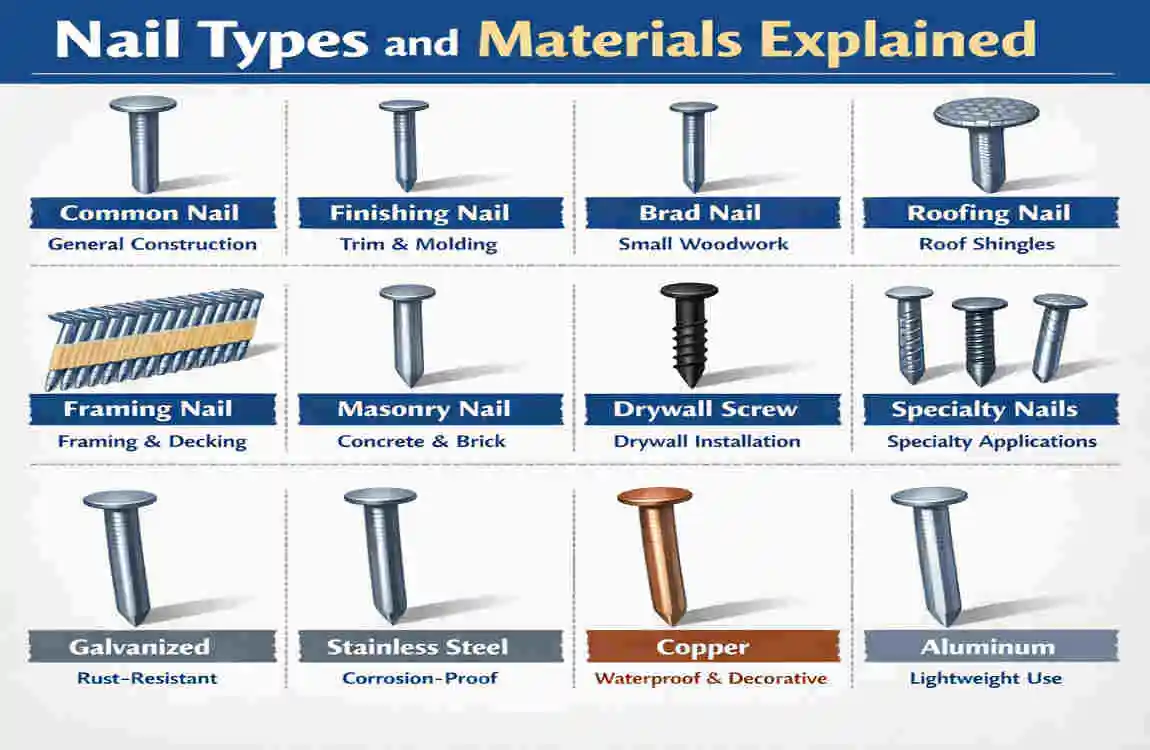
When selecting roofing nails, it’s essential to consider the material and coating in addition to size. Different materials offer varying levels of corrosion resistance and durability.
Popular Roofing Nail Materials
- Galvanized Nails: These nails are coated to resist rust, making them ideal for humid areas like Lahore.
- Stainless Steel Nails: The Premium choice for coastal regions with high salt content in the air.
- Electroplated Nails: A budget-friendly option, though less durable than hot-dipped galvanized nails.
Here’s a comparison table of nail types:
Nail Type Best For Drawbacks Cost (PKR/1000)
Galvanized Ring Shank Standard 5/8″ roofs Moderate corrosion 1500-2000
10d Spiral Shank High-wind zones Can split thinner wood 2500
Cap Nails Underlayment Bulkier and harder to install 3000
Building Codes and Standards for Roofing Nails
Meeting building codes is not just a legal requirement—it’s also a proven way to ensure your roof’s reliability. Let’s break down the key standards.
International Standards
The IRC and IBC specify the following for 5/8″ sheathing:
- Nail Size: 8d (2.5 inches)
- Spacing: 6 inches along edges, 12 inches in the field
- Penetration: Minimum 1 inch into trusses
Local Standards in Pakistan
While Pakistan’s building bylaws align with many global standards, certain areas, like high-wind zones, may require nails longer than 2.5 inches. Always consult local regulations to ensure compliance.
Step-by-Step Installation Guide
Proper installation is just as important as choosing the right nails. Follow these steps to nail your roofing project like a pro:
- Preparation: Start by inspecting the rafter spacing (typically 16-24 inches).
- Spacing: Use 6-inch spacing along edges and 12-inch spacing in the field.
- Tools: Use a pneumatic nailer loaded with 16-gauge nails.
- Technique: Drive nails at a slight 45-degree angle to ensure a secure grip.
- Avoid Common Mistakes:
- Overdriving nails can damage the sheathing.
- Using framing nails instead of roofing nails.
Cost Comparison and Buying Guide
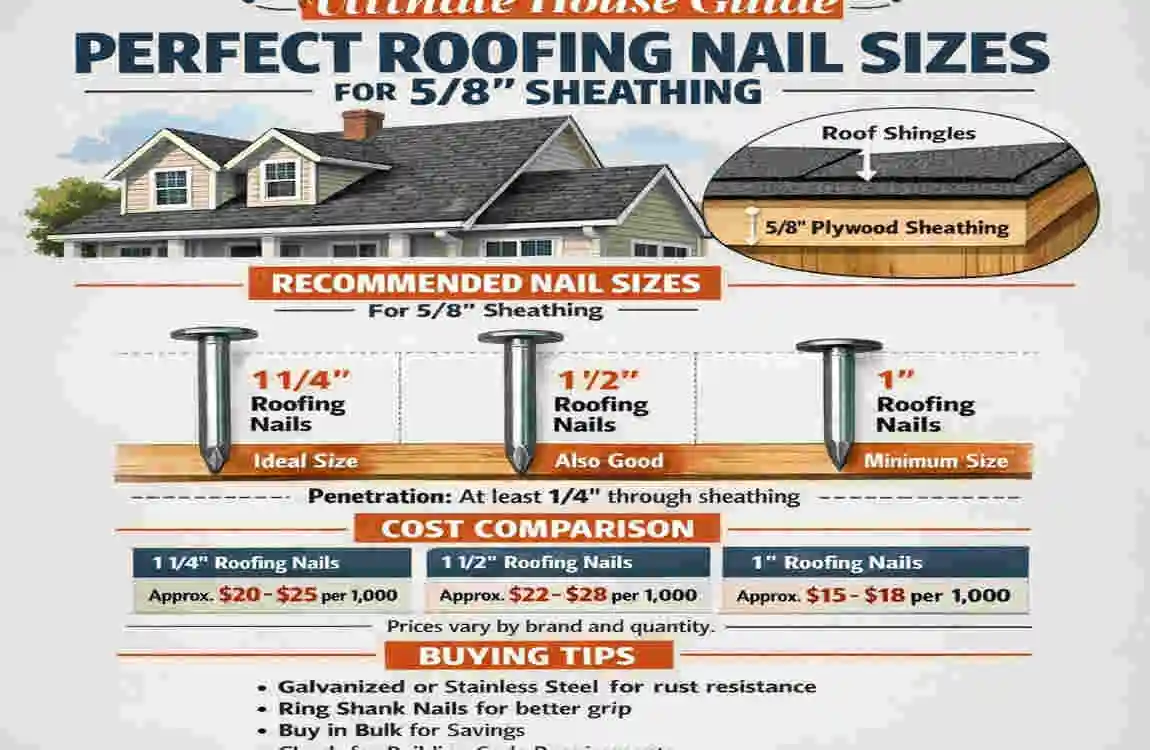
Here’s a quick breakdown of nail costs in Pakistan:
Nail Size Pack Price (PKR)Coverage (sq ft)
8d (2.5″) 1800 1000
3″ Upgrade 2500 1000
FAQs: What Size Roofing Nails for 5/8″ Sheathing?
Q: What size roofing nails should I use for 5/8″ sheathing?
The standard recommendation is to use 8d nails, which are 2.5 inches long with a diameter of about 0.131 inches. These nails provide the right length to penetrate the 5/8″ sheathing and at least 1 inch into the supporting rafters or trusses, ensuring a strong hold .
Q: Are ring shank nails better than smooth shank nails for 5/8″ sheathing?
Yes. Ring shank nails offer about 40% better holding power compared to smooth shank nails. They grip the wood fibers more securely, which is especially important in areas with high wind or heavy weather exposure .
Q: Can I use shorter nails for 5/8″ plywood or OSB sheathing?
No. Nails shorter than 2.5 inches risk insufficient penetration into the framing, which can lead to pull-out failures. The nail must go through the sheathing and at least 1 inch into the rafter or truss for proper fastening .
Q: What about nail spacing for 5/8″ sheathing?
Building codes typically require nails to be spaced 6 inches apart along panel edges and 12 inches apart in the field (center area) of the sheathing. This spacing helps distribute loads evenly and prevents sheathing movement .
Q: Can I use screws instead of nails for 5/8″ sheathing?
Yes, in some cases, 2-inch deck screws can be used as an alternative, especially for retrofit or repair work. However, nails remain the preferred fastener for new roof sheathing due to their flexibility and shear strength .
Q: What if I live in a high-wind area?
For high-wind zones, it’s recommended to use 3-inch ring shank nails to provide extra holding power and resistance to uplift forces.
Q: Does the type of sheathing (plywood vs. OSB) affect nail size?
Both plywood and OSB sheathing at 5/8″ thickness generally require the same nail size (8d, 2.5 inches). However, OSB may benefit more from ring shank nails due to its layered structure