Moving into your very first one-bedroom house is an incredibly exciting milestone. You finally have a space to call your own, a place to relax, and a blank canvas to decorate exactly how you want. But right after you sign the lease or close on the house, a massive question usually pops into your head. You start wondering exactly how much to furnish a one-bedroom house without completely breaking the bank.
If you are staring at empty rooms and feeling a little overwhelmed, you are definitely not alone. Furnishing an entire home from scratch can feel like a massive mountain to climb. The good news is that you have complete control over how much you spend. Whether you are a college student stretching every dollar, a young professional looking for cozy comfort, or someone ready to invest in your forever home, there is a realistic budget plan for you.
In the year 2026, the average cost to fully furnish a one-bedroom house typically lands somewhere between $3,000 and $8,000. However, averages only tell part of the story. You can absolutely furnish your space for a bare-bones minimum of $1,000, or you can easily spend upwards of $10,000 if you want luxury, custom-made pieces.
Why Budgeting Matters for Furnishing a One-Bedroom House
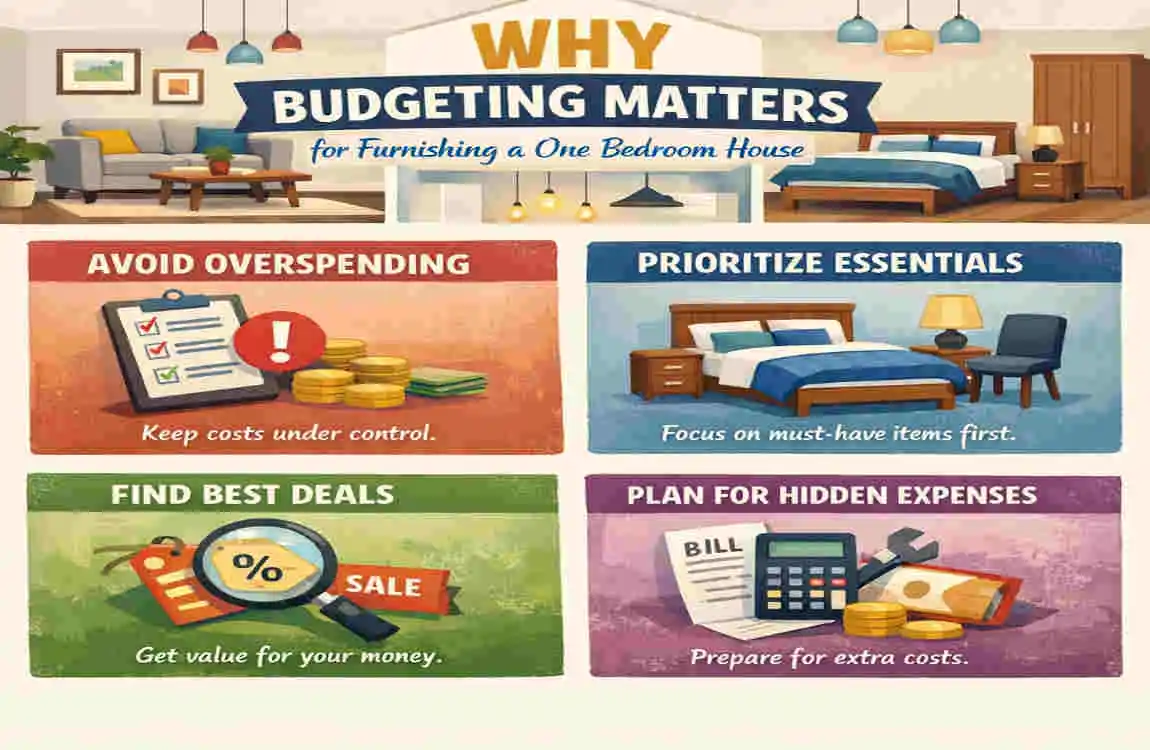
Before you rush out to buy that beautiful velvet sofa you saw in a store window, you need to set a firm budget. Figuring out how much to furnish a one-bedroom house depends on several different factors. Understanding these factors will help you make smart, stress-free decisions.
First, think about your square footage. Most one-bedroom houses range from 400 to 800 square feet. A smaller space means you need fewer items, which keeps costs down. However, smaller spaces often require clever, space-saving furniture, which can sometimes carry a Premium price tag.
Second, you need to decide if you want brand-new furniture or if you are happy with used items. Buying secondhand is the ultimate cheat code for saving money, while buying new offers warranties and modern designs.
Finally, your personal style plays a huge role. A minimalist design with clean lines and few items will naturally cost less than a highly decorative, luxurious aesthetic.
We also have to factor in the current market. In 2026, we have seen a slight inflation bump on furniture prices, roughly a 5% to 10% rise on average. This makes planning ahead more important than ever. Having a budget prevents you from making impulse buys that you might regret later. It allows you to prioritize the pieces that truly matter to you and personalize your space at your own pace.
Cost Influencers: New vs. Used Furniture
Here is a quick look at how your choices drastically change the overall cost.
Furniture Strategy, Estimated Average Cost, Best For
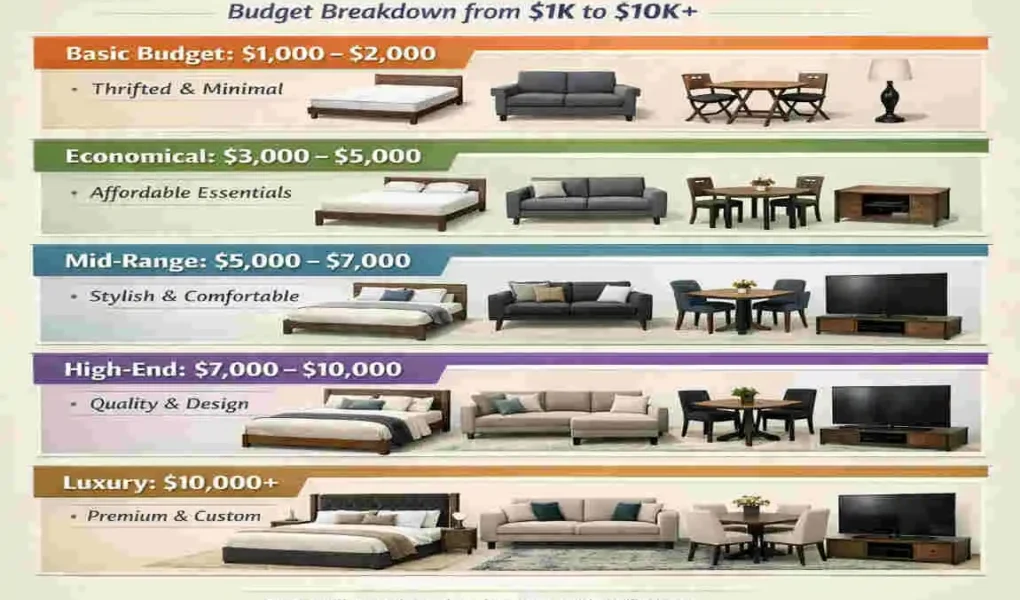
100% Brand New $5,000 – $8,000 Long-term use, warranties, specific styles
Mixed (New & Used) $2,500 – $4,500 Budget-conscious buyers who want clean mattresses
100% Used/Thrifted $1,000 – $2,000 Extreme savers, DIY lovers, temporary living
Luxury/Custom $10,000+ Forever homes, Premium materials, high-end design
Room-by-Room Essentials: What You Actually Need
When you are trying to figure out how much to furnish a one-bedroom house, you must separate your “needs” from your “wants.” It is easy to get distracted by beautiful artwork and fancy lamps, but you cannot sleep on a lamp.
You need to prioritize the core functional pieces first. These must-haves take up about 70% of your total budget. Let us break down exactly what you need for each room to make your house functional and comfortable.
Living Room Must-Haves
The living room is the heart of your home. It is where you will relax after work, watch movies, and entertain your guests. Because it gets so much traffic, you want to invest in comfortable, durable pieces.
- The Sofa or Sofa Bed: This is your biggest living room expense. A standard new sofa will run you anywhere from $200 to $1,500. If you have frequent guests but no guest room, spending a little extra on a high-quality sleeper sofa is a very smart move.
- A Coffee Table: You need a place to set your drinks, books, and remote controls. Depending on the material, expect to spend $50 to $400.
- Media Center or TV Stand: Even if you mount your TV on the wall, a stand provides necessary storage for cords, gaming consoles, and routers. These usually cost between $100 and $600.
- An Area Rug: A rug ties the room together and makes a house feel like a home. A good-sized rug will cost between $100 and $400.
Pro tip for your living room: Always look for multi-functional pieces when furnishing small spaces. A coffee table that lifts up into a desk, or an ottoman that opens up for blanket storage, gives you way more value for your money.
Bedroom Priorities
Your bedroom is your private sanctuary. When budgeting for this room, you should prioritize your physical comfort above all else. You spend a third of your life in bed, so this is not the place to cut corners on quality.
- Bed Frame and Mattress: This is the most critical purchase in your entire house. A sturdy frame and a comfortable mattress will cost between $300 and $2,000 combined. If you have to choose where to spend your money, spend it on the mattress.
- Nightstands and Dressers: You need a place for your clothes and a spot next to your bed for your phone and a lamp. A dresser and a pair of nightstands will run you roughly $100 to $800.
- Quality Bedding: Pillows, sheets, and a warm comforter are essential for a good night’s sleep. Budget about $50 to $300 for a complete bedding set.
Kitchen & Bath Basics
Most one-bedroom houses come with major appliances like a fridge and stove, so you usually need to focus on dining furniture and daily-use items.
- Dining Table and Chairs: Even if your house is small, a dedicated eating space is wonderful for your mental health. A small two-to-four-seat dining set typically costs $100 to $700.
- Kitchen Storage and Shelving: If your cabinets are small, a standalone pantry shelf or a rolling kitchen island provides much-needed space. Budget $50 to $300 for extra storage solutions.
- Bathroom Essentials: You will need a shower curtain, a bath mat, a trash can, and a good set of towels. These basics will easily cost between $50 and $200.
Budget Breakdown: How Much to Furnish a One-Bedroom House by Tier
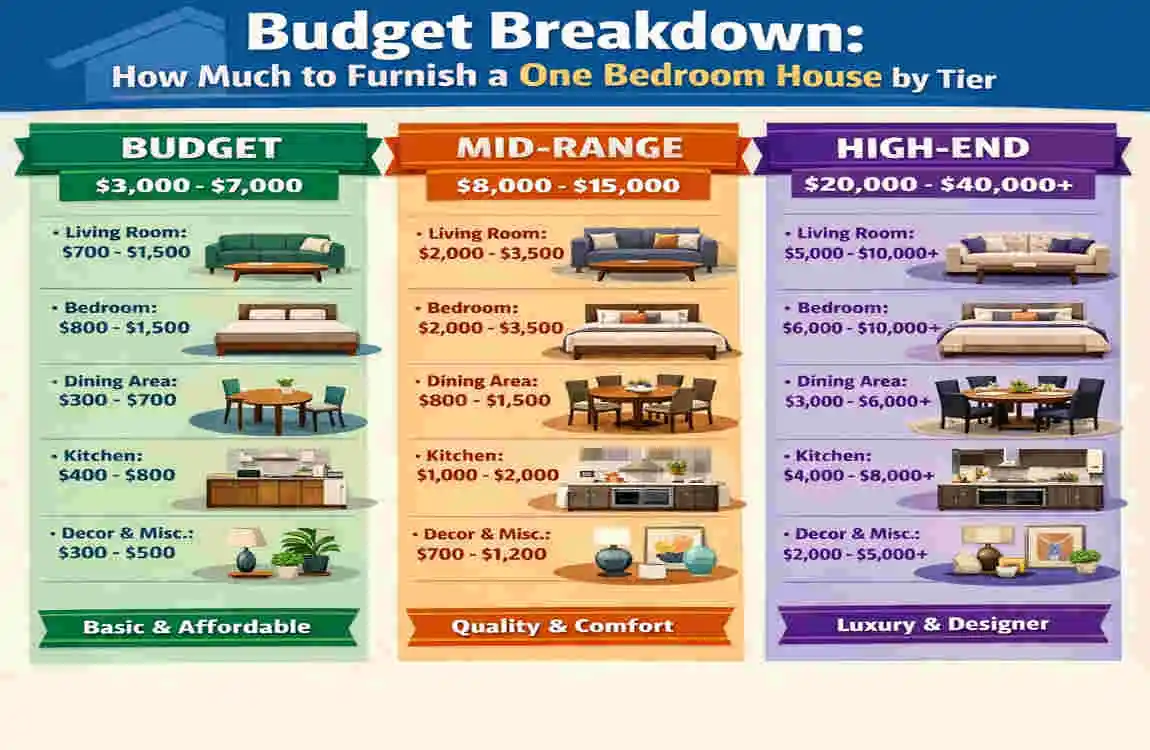
Now we are getting to the most important part of the guide. We are going to break down the exact numbers.
Everyone’s financial situation is different, so we have created three distinct budget tiers. We will look at real 2026 pricing examples to give you a clear picture of what your money can buy. Keep in mind that “one bedroom house furnishing cost” variations heavily depend on where you live and how patient you are while shopping.
The $1K Bare Minimum: DIY & Thrift Essentials
If you are a student, a brand new renter, or simply someone who wants to save as much money as humanly possible, this tier is for you. Furnishing a house for $1,000 means you must focus entirely on function over form.
At this price point, you are not buying a matched bedroom set from a fancy catalog. You are hunting for deals. You will rely heavily on the secondhand market, upcycling, and hand-me-downs from family and friends. It takes a little more time and effort, but the financial savings are massive.
How to make the $1,000 budget work:
Essential Item, Estimated Cost, Recommended Sourcing Strategy
Sofa or Futon $200 Facebook Marketplace or local yard sales
Bed Frame & Mattress $300 Mattress in a box (Amazon) + Used Frame
Dining Table + 2 Chairs $150 Local Thrift Stores or Goodwill
Dresser / Storage $100 Craigslist or neighborhood apps
Coffee Table & TV Stand $100 Flea markets, or DIY pallet builds
Basic Kitchen/Bath Supplies $150 Dollar stores or discount retailers
Total Estimated Spend ~$1,000
Tips for this budget:
- Use your network: Tell everyone you know that you are moving. People are often desperate to get rid of old furniture and will gladly give it to you for free if you come pick it up.
- Look globally, shop locally: For example, if you are living in a bustling city, skip the retail stores. You can furnish a house for well under $1,000 by navigating local markets. If you are in Pakistan, exploring the incredible Lahore furniture markets will yield amazing, affordable finds that you cannot get at big box stores.
- Embrace the mismatched look: Do not worry if your wood tones do not perfectly match. An eclectic, bohemian vibe is incredibly stylish and very forgiving on a tight budget.
The $3K–$5K Mid-Range: Balanced Comfort
This is the most common budget tier for young professionals and couples moving into their first home together. At the $3,000 to $5,000 range, you hit the perfect “sweet spot.” You can afford to balance lasting comfort with beautiful style.
With this budget, you do not have to spend your weekends hunting through dusty thrift stores unless you want to. You can buy primarily new items, or create a hybrid space where you splurge on a brand-new mattress and sofa, but buy a secondhand dining table to save cash.
How to make the $3K–$5K budget work:
Essential Item Low End ($3K Budget)High End ($5K Budget)
Living Room Sofa $400 $800
TV Stand & Coffee Table $250 $500
Living Room Rug & Decor $150 $350
New Mattress & Bed Frame $600 $1,000
Nightstands & Dresser $350 $700
Dining Table & 4 Chairs $300 $600
Kitchen/Bath Essentials $250 $400
Lighting, Curtains, Art $300 $550
Total Estimated Spend $2,600 (Leaves buffer room) $4,900
Tips for this budget:
- Shop the mid-tier brands: This budget aligns perfectly with popular flat-pack stores like IKEA, online retailers like Wayfair, and the home sections of Target or Amazon Basics.
- Leave room for decor: At this tier, you should dedicate about 10% of your total budget strictly to decorative items. Throw pillows, wall art, plants, and nice curtains take a house from feeling like a sterile waiting room to a warm, inviting home.
- Pace yourself: You do not have to spend all $5,000 on day one. Buy your bed, sofa, and dining table first. Live in the space for a few weeks to see what kind of lighting or rugs the rooms actually need.
The $10K+ Luxury: Style & Quality
If you have established your career, bought your forever home, or have a high appreciation for interior design, the luxury tier is where you want to be. When your budget exceeds $10,000, your focus shifts away from basic function and moves entirely toward durability, aesthetics, and custom craftsmanship.
In this tier, you are not buying furniture that you expect to throw away when you move in two years. You are investing in solid wood, genuine leather, custom upholstery, and designer names. The initial cost is high, but the return on investment is fantastic because these pieces will easily last you 10 to 20 years.
How to make the $10K+ budget work:
Premium Item, Estimated Cost, The Luxury Advantage
Custom Sectional Sofa $2,500+ Stain-resistant, performance fabrics, deep seating
Solid Wood TV Console $1,200+ No particle board, soft-close hinges, timeless design
Premium King Mattress $1,800+ Cooling tech, memory foam, 10-year warranties
Upholstered Bed Frame $1,000+ Statement headboards, sturdy construction
Solid Wood Dining Set $1,500+ Scratch-resistant, highly durable, heirloom quality
Designer Rugs & Lighting $1,500+ Hand-tufted wool rugs, smart-home integrated lighting
High-End Decor & Art $1,000+ Original artwork, Premium window treatments
Total Estimated Spend $10,500+
Tips for this budget:
- Hire a professional: If you are spending this much money, consider allocating a small portion of your budget to a virtual interior designer. They can help ensure your expensive pieces flow perfectly together.
- Focus on the materials: Always check the specifications. Look for kiln-dried hardwood frames on sofas, full-grain leathers, and dovetail joints on dressers. Avoid anything labeled “veneer” or “MDF” at this price point.
- Think long-term: Choose classic, neutral colors for your most expensive, large pieces (like a grey or beige sofa). You can easily add trendy, bright colors later through cheaper items like pillows and blankets.
Smart Savings Hacks: Cut Costs Without Sacrificing Style
No matter which budget tier you fall into, nobody likes spending more money than they have to. If you are constantly searching for the “cheapest way to furnish a one-bedroom house,” you need to get creative.
Here are the best, proven strategies in 2026 to slash your furnishing costs without making your house look cheap.
- Master the Art of Secondhand Apps: The digital thrift store is your best friend. Apps like OfferUp, Facebook Marketplace, and Craigslist offer amazing deals. You can easily find gently used furniture for 20% to 50% off the retail price. Always set up alerts for specific items you want so you can message the seller immediately.
- Embrace DIY Projects: You can save a massive amount of money with a little elbow grease. Buying a scratched, ugly wooden dresser for $20 and spending $30 on sandpaper and a fresh can of paint gives you a beautiful, customized piece for $50. You just saved hundreds of dollars.
- Shop Strategically During Major Sales: Never buy expensive furniture in the middle of a random Tuesday if a holiday is coming up. Retailers offer their biggest discounts during holiday weekends. Plan your major purchases around Memorial Day, Labor Day, or the massive Black Friday 2026 sales events.
- Look for Bundle Deals: Many online retailers will give you a steep discount if you buy a complete “room set.” Buying a bed frame, dresser, and two nightstands together is almost always cheaper than buying them separately.
- Explore Rent-to-Own Options: If you desperately want pieces from the $10K luxury tier but do not have the cash upfront, rent-to-own or buy-now-pay-later services (like Affirm or Klarna) allow you to spread the cost out over 12 to 24 months. Just be incredibly careful with interest rates!
- Visit Estate Sales: On the final day of an estate sale, organizers are desperate to clear out the house. You can negotiate incredible prices on high-quality, vintage, solid wood furniture.
- Check Open-Box Deals: Online retailers and local appliance stores often have an “open-box” or “scratch and dent” section. These are items that were returned by customers or have minor cosmetic damage on the back. They work perfectly but are heavily discounted.
- Repurpose What You Already Own: Before you buy a new TV stand, ask yourself if that old, low bookshelf you already own could do the job.
- Join Local “Buy Nothing” Groups: Search Facebook for your local “Buy Nothing” project group. Neighbors constantly give away free furniture, home goods, and kitchen appliances simply because they do not want to deal with moving them.
- Take Your Time: The biggest budget killer is rushing. You do not need to furnish your entire house in a single weekend. Sleep on an air mattress for a week if it means finding the perfect bed frame on sale the following week.
Hidden Costs to Watch Out For
When you are calculating how much to furnish a one-bedroom house, it is incredibly easy to forget about the hidden fees. The price tag on the sofa is never the final price you pay.
First, you have to account for delivery fees. Unless you have a large truck and a strong back, you will pay between $100 and $300 to have bulky furniture delivered to your door.
Second, consider assembly costs. If you buy flat-pack furniture and despise putting things together, hiring someone from a service like TaskRabbit will easily cost you $50 to $200, depending on the job.
Finally, never forget about state and local taxes. An 8% to 10% sales tax on a $5,000 furniture haul adds up very quickly. Because of these hidden fees, you should always add a 15% to 20% financial buffer to your overall budget to avoid any nasty surprises.
Shopping Guide: Where & What to Buy in 2026

Knowing how much money you want to spend is only half the battle. You also need to know exactly where to spend it. The furniture landscape in 2026 offers a huge variety of choices. Here is a quick guide to help you navigate the best retailers based on your specific budget.
- For the Budget Shopper: If you are staying close to the $1K to $2K range, your best friends are going to be flat-pack champions like IKEA, the home aisles of Walmart, and discount stores like HomeGoods. You get modern styles for incredibly low prices, though the durability is usually meant for the short term.
- For the Mid-Range Buyer: If you are playing in the $3K to $5K space, online giants like Wayfair, Amazon, and Target offer excellent hybrid pieces. You will find better fabrics and sturdier builds. Just make sure you read the customer reviews very carefully before clicking the buy button!
- For the Luxury Investor: If you have the $10K+ budget, skip the flat-pack stores entirely. Look at Premium brands like Article, West Elm, Pottery Barn, or Crate & Barrel. You are paying for gorgeous designs, Premium customer service, and white-glove delivery right into your living room.
- For the Local Treasure Hunter: Never underestimate the power of local markets. As mentioned earlier, if you are reading this from Pakistan, the sprawling Lahore furniture markets offer incredible craftsmanship at prices that easily fit into a $1K or $2K tier. Local carpenters can often build you exactly what you want for less than what a big box store charges.
The Sustainability Angle
In 2026, we also have to talk about eco-friendly shopping. Fast furniture (cheap furniture meant to be thrown away quickly) is terrible for the environment.
If you have a little extra room in your budget, consider looking for sustainable furniture. Pieces made from reclaimed wood, bamboo, or recycled plastics might add $500 to your total budget, but they are built incredibly well. Investing in eco-friendly furniture means your pieces last significantly longer, which actually saves you money in the long run and helps protect the planet.
FAQs: Answering “How Much to Furnish a One-Bedroom House”
What is the absolute cheapest way to furnish a one-bedroom house?
The absolute cheapest way is to set a $1,000 limit and buy absolutely nothing brand new. You must rely 100% on free hand-me-downs from family, extreme thrift store hunting, and heavily negotiating on apps like Facebook Marketplace.
Is there a cost difference between a one-bedroom apartment and a house?
Yes, there is a slight difference. The interior costs are almost exactly the same. However, a house usually comes with a patio, a small yard, or a front porch. You should add roughly $300 to $500 to your budget to buy basic outdoor furniture, a grill, or lawn care items that apartment dwellers do not need.
How long does it actually take to furnish a house fully?
If you have a large budget and buy everything from one store, you can order it all in a single afternoon. However, accounting for delivery times, out-of-stock items, and the time it takes to build things, you should realistically expect the process to take 2 to 4 weeks before your house feels fully “finished.”
Should I pay for furniture delivery or rent a truck?
If you are buying one large item (like a sofa), paying the $100 delivery fee is usually cheaper and easier than renting a truck. However, if you are doing a massive run to IKEA and buying a whole room’s worth of furniture, renting a U-Haul van for $40 for the day is a much smarter, cheaper move.
What is the one item I should never buy used?
You should never buy a used mattress. Even if it looks incredibly clean, used mattresses can harbor dust mites, allergens, and, in the worst-case scenario, bed bugs. Your health and hygiene are worth the extra money. Always buy your mattress brand new, even if you buy the cheapest model available.