You are sitting in your living room, looking around at the toys scattered across the floor, the cramped dining table, and the general chaos of daily life. You have a growing family, and you are feeling the pinch of rising housing costs. If you live in a bustling city like or anywhere else facing an affordability crisis, you are likely asking yourself a very important question. Can a family of 4 live in a 2-bedroom house comfortably?
It is a completely normal question to ask. Housing prices are climbing, and the dream of a sprawling four-bedroom house with a massive yard is slipping out of reach for many. the average rent for a decent two-bedroom house or apartment can hover around PKR 40,000 a month or more, making larger homes a heavy financial burden.
But you are not alone in this situation. Did you know that nearly 40% of families globally, and a significant portion of urban families , live in two-bedroom homes or even smaller spaces? Recent urban housing surveys confirm that small-space living is not just a temporary fix; it is a long-term reality for millions of happy families.
Is It Feasible? Understanding Space Needs for a Family of 4
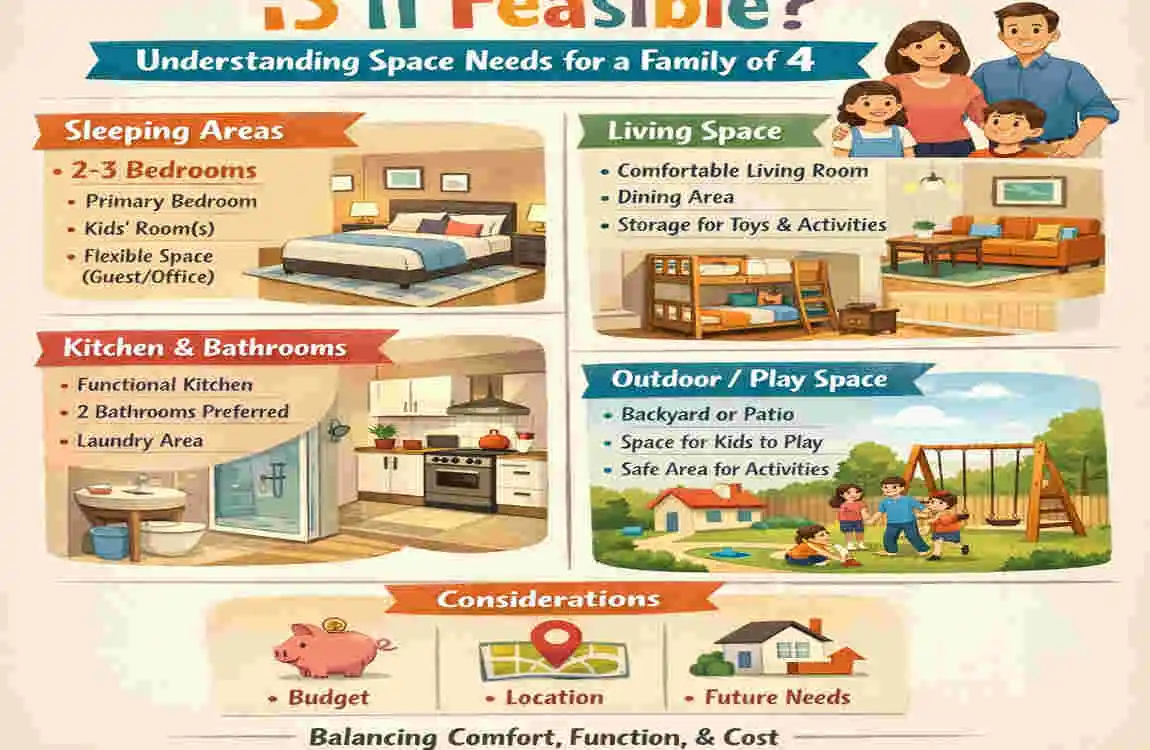
Let us address the core question right away. Is it actually feasible to fit two adults and two children into a two-bedroom space without driving each other crazy? To answer this, we need to look at how much space a family genuinely needs compared to how much space they want.
Breaking Down the Square Footage
When you look at average family space requirements, housing experts generally suggest that a family of four needs anywhere from 600 to 1,000 square feet to live comfortably. Now, compare that to a typical two-bedroom house or apartment. Most two-bedroom homes range between 800 and 1,200 square feet.
Mathematically speaking, you have more than enough room to meet your basic needs. The problem usually is not the lack of square footage; it is how families utilize that square footage. A poorly arranged 1,200-square-foot home will feel much smaller than a smartly organized 800-square-foot apartment.
The Age Factor: Toddlers vs. Teens
Your family’s specific needs will change depending on the ages of your children. If you have two toddlers, sharing a bedroom is usually a breeze. They take up less physical space, their clothes are tiny, and they often enjoy the comfort of having a sibling nearby.
However, if you have two teenagers, the dynamic changes entirely; teenagers crave privacy. They need quiet spaces to study, and their physical belongings take up much more room. You will need to get highly creative with room dividers and schedules to keep the peace.
Factoring in Remote Work and Pets
Do you work from home? If so, living in a two-bedroom house requires strict boundaries. You cannot easily hide a home office in a spare room when you do not have a spare room! You will need to carve out a dedicated workspace in the living room or your main bedroom.
Pets also add another layer to the space equation. A large dog bounding around a small living room will make the house feel instantly cramped. If you have pets, you must factor their beds, toys, and feeding stations into your floor plan.
Real-Life Inspiration
You do not have to look far to find real-life examples of families thriving in tight quarters. Take the bustling urban centers , for instance. Countless families and Karachi live happily in two-bedroom apartments. They prioritize experiences over possessions and utilize their local parks and community centers as extensions of their living space.
Legal and Practical Considerations: Can You Even Do It?
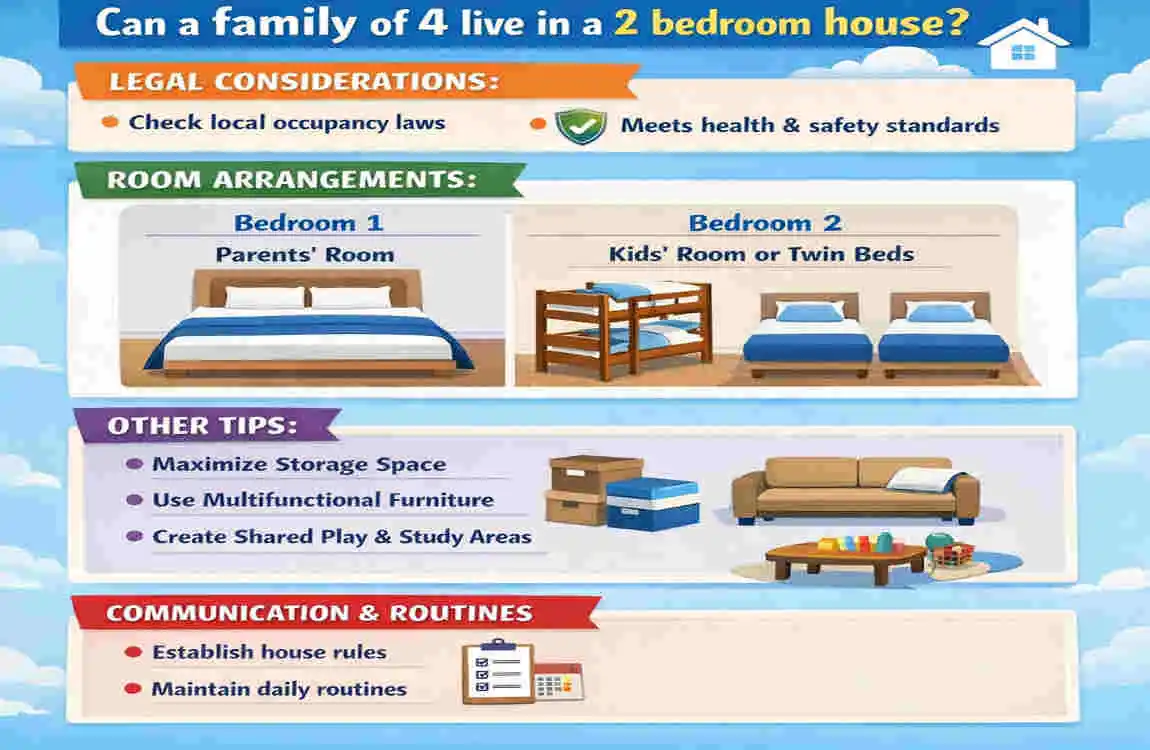
Before you commit to small-space living, you need to clear up a few technical details. You might be wondering if it is even legally permissible to house four people in a two-bedroom property. It is important to cover these regulations to build trust and ensure you are making a safe choice for your family.
Understanding Zoning and Occupancy Rules
In the vast majority of residential areas, it is perfectly legal for a family of four to live in a two-bedroom home. Most local housing authorities use a standard occupancy rule of “two plus one.” This means two people per bedroom, plus one extra person living in a common area like the living room.
Under these standard guidelines, a two-bedroom house can legally accommodate up to five people. If you live in , authorities like the generally do not restrict a family of four from occupying a two-bedroom space. As long as you are a single-family unit, you are usually in the clear.
School Districts and Family Size Norms
While there is no legal ban on a family of four in a two-bedroom house, you might face some unwritten social norms. Occasionally, specific school districts or strict homeowner associations take an interest in your square footage, though this is rare.
The bigger practical consideration is how your address impacts your daily life. Often, buying or renting a smaller home allows you to afford a house in a much better school district. Many parents gladly trade a larger house in a poor district for a smaller home in an excellent educational zone.
Insurance and Safety Codes
Safety must always come first. When you pack more people into a smaller space, you need to pay close attention to fire codes. Every bedroom must have two ways out—usually a door and an egress window.
An egress window is simply a window large enough for a person to climb out of during an emergency. Make sure your two-bedroom home meets these basic safety standards. Interestingly, compact living often makes it easier to maintain smoke detectors and quickly evacuate during an emergency, which is a hidden practical benefit!
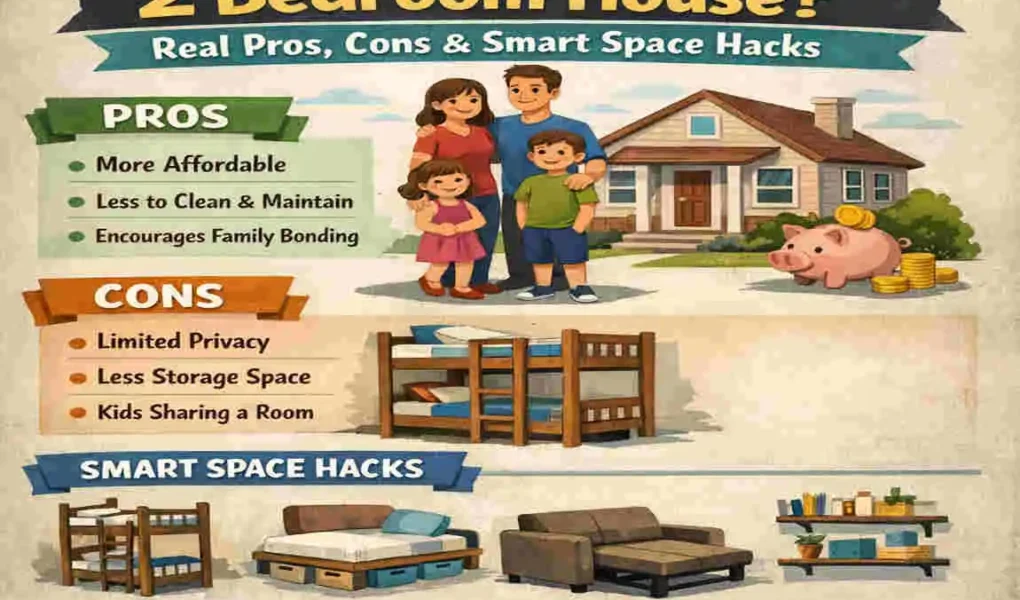
Pros of Living in a 2 Bedroom House for a Family of 4
Now, let us get to the good stuff. Living in a smaller home is not just a sacrifice; it comes with some incredibly powerful benefits. When you choose a two-bedroom house for a family of four, you unlock advantages that owners of large homes often envy. Let us highlight these positives.
Massive Financial Savings
This is the most obvious and impactful benefit. When you downsize or choose not to upsize, you save a tremendous amount of money.
- Lower Rent or Mortgage: You could easily save PKR 20,000 to PKR 50,000 or more every single month on rent alone. Over a year, that is a massive amount of cash staying in your pocket.
- Reduced Utility Bills: It costs significantly less money to heat and cool a small house. Your electricity and gas bills will plummet.
- Fewer Furnishings: You do not have to buy extra beds, couches, and rugs to fill up empty guest rooms. You can take all these financial savings and put them towards your children’s education, family vacations, or an emergency fund.
Stronger Family Bonds
Small homes force you to interact. You cannot retreat to opposite ends of a sprawling mansion when you live in a two-bedroom house. This forced togetherness actually builds stronger routines and better communication.
According to behavioral studies on housing, families in smaller homes often report closer relationships. You watch movies together, you cook together, and you learn how to resolve conflicts quickly because you cannot simply walk away and hide. Sharing a bedroom also teaches children valuable lessons about compromise, sharing, and respecting another person’s space.
Easier and Faster Maintenance
Think about how much time you spend cleaning. Now cut that time in half. That is the reality of living in a two-bedroom house.
- Less Cleaning: With fewer rooms, you have less floor to sweep, fewer windows to wash, and fewer bathrooms to scrub.
- Urban Convenience: Smaller homes and apartments are often located closer to city centers. In a city like , living in a smaller, centrally located apartment means you are just steps away from the best schools, markets, and hospitals.
An Eco-Friendly Lifestyle
If you care about the environment, moving into a smaller home is one of the best things you can do. A smaller physical footprint naturally translates to a smaller carbon footprint. You use less energy, consume fewer building materials, and generally buy fewer physical items because you do not have the space to store them.
A Real-Life Success Story
Consider the story of a young of four living in a 900-square-foot two-bedroom apartment. Initially, they worried they would suffocate in the tight space. Instead, they found that their weekends were no longer consumed by endless house chores. Because their rent was low, they could afford to eat out more often and take their kids to local museums and parks. Their small home became a cozy basecamp for a much larger, richer life outside their four walls.
Cons and Challenges of a 2 Bedroom House for 4 People
Of course, we must be realistic. It is not all sunshine and cozy family movie nights. Cramming four people into two bedrooms comes with distinct challenges. You need to know what you are up against so you can prepare properly.
Let us look at a quick breakdown of the main challenges, how they impact your family, and a teaser of how to fix them.
Challenge Impact on Family of 4Mitigation Teaser
Limited Privacy: Kids sharing rooms can lead to fights as they grow. Parents lack a quiet space. Use room dividers and create distinct zones (see hacks below).
No Dedicated Home Office Remote work clashes with family life. Hard to take professional calls. Invest in multi-use furniture and folding desks.
The Storage Crunch Toys, outgrown clothes, and kitchen items easily overflow and cause clutter. Go vertical! Utilize wall-mounted and under-bed solutions.
Guest Overnights Having grandparents or friends stay over causes awkward sleeping arrangements. Buy high-quality pull-out couches or Murphy beds.
Lower Resale Value Two-bedroom homes are often seen merely as “starter homes” by buyers. Master the art of staging to show off the home’s potential.
The Emotional Toll of Small Spaces
We cannot ignore the emotional side of this equation. When the weather is bad—like during the heavy monsoon season when you are trapped indoors—cabin fever can set in quickly. When everyone is stuck inside a two-bedroom house for days on end, tempers can flare.
The morning bathroom rush is another notorious stress point. When four people need to get ready for school and work using only one or two bathrooms, tensions run high. In fact, surveys suggest that roughly 25% of families living in small homes report feeling occasional stress directly related to their lack of space.
You will need a lot of patience, and you must deliberately teach your children how to give each other grace when someone is feeling overwhelmed by the proximity.
Smart Space Hacks: Making a 2 Bedroom House Work for Your Family
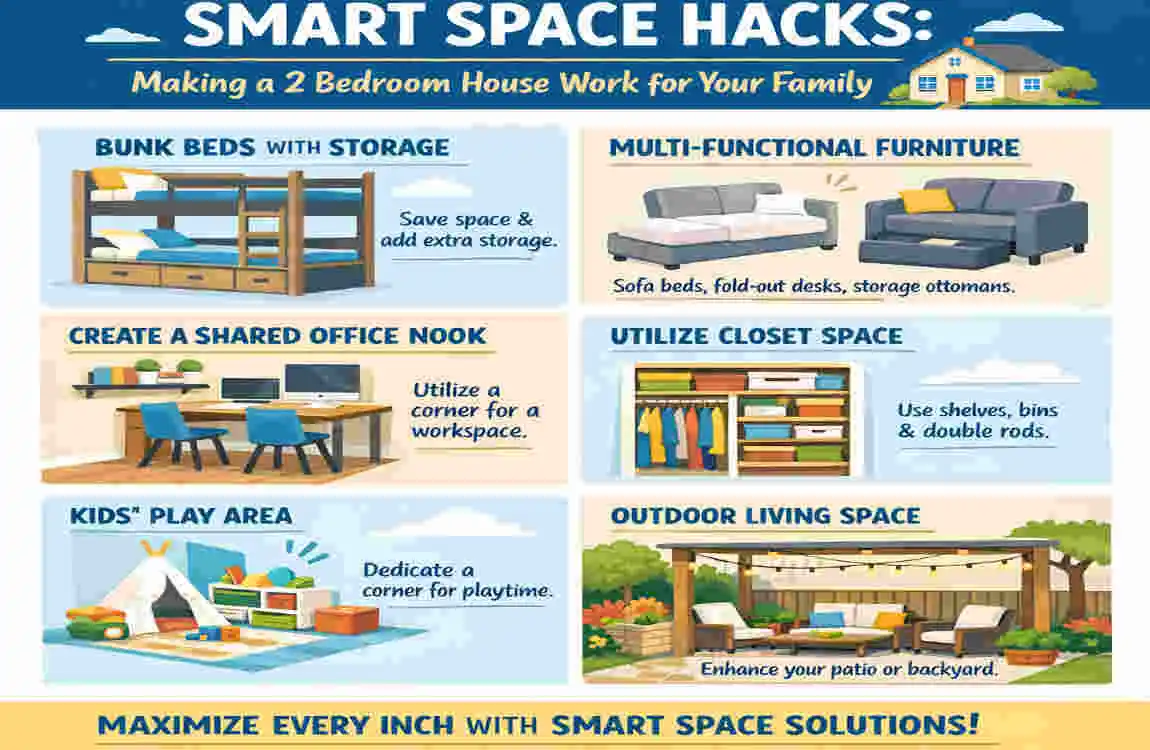
This is the most important section of our guide. Knowing the pros and cons is great, but how do you actually make it work on a practical level? If you want to master the art of asking “Can a family of 4 live in a 2-bedroom house?” you must become an expert in spatial efficiency.
Here are step-by-step, genius space hacks to help you maximize every single inch of your home.
Maximize the Bedrooms
The bedrooms are where you will feel the squeeze the most, especially the room your kids share. You must think beyond traditional twin beds.
- Embrace Bunk Beds: Bunk beds are the ultimate space-savers. But do not just buy standard bunks. Look for bunk beds that feature built-in storage, stairs, or drawers underneath the bottom bunk.
- Loft Beds for Older Kids: If your kids are older, consider loft beds. A loft bed elevates the mattress high off the floor, leaving a massive empty space underneath. You can place a study desk, a reading chair, or dressers directly underneath the bed. It doubles the usable floor space in the room!
- Declutter Ruthlessly: You cannot afford to keep clothes that no longer fit. Adopt a strict “one in, one out” rule for toys and garments to keep the bedroom closets manageable.
Transform Your Living Areas
Your living room needs to be the hardest-working room in your house. It must serve as a lounge, an entertainment center, a playroom, and sometimes a guest room or home office.
- Invest in a Murphy Bed: If you frequently have guests, or if you decide to give the kids their own separate rooms and take the living room for yourselves, a Murphy bed is a game-changer. It pulls down from the wall at night and folds away seamlessly during the day.
- Sectional Sofas with Hidden Storage: Never buy a sofa that sits there! Buy a sectional couch where the chaise lounges lift up to reveal deep storage compartments. You can hide winter blankets, extra pillows, and board games inside.
- Create Visual Zones: Use area rugs and folding screens to break up the living room. Put a small rug under a desk in the corner to signal “this is the office zone,” and a larger rug under the sofa to define the “family zone.”
Kitchen and Bath Wins
Small kitchens and tiny bathrooms cause massive daily frustration. You need to optimize these utility spaces so you can cook and get ready without bumping elbows.
- Over-the-Door Organizers: The back of your doors is prime real estate. Hang a multi-pocket organizer on the back of the bathroom door to hold hairbrushes, lotions, and toiletries. Do the same on the kitchen pantry door for spices and snacks.
- Stackable Appliances: If your two-bedroom house has laundry hookups, do not buy a side-by-side washer and dryer. Buy a stackable unit. This frees up an entire vertical half of your laundry closet for extra shelving.
- Tension Rod Tricks: Place a simple tension rod underneath your kitchen sink. You can hang all your spray bottles and cleaning supplies from the rod, leaving the bottom of the cabinet totally free for sponges and trash bags.
Vertical and Multi-Use Magic
When you run out of floor space, you must look up. The walls are your best friend in a two-bedroom house.
- Wall-Mounted Shelves: Take your shelving all the way up to the ceiling. Put the items you rarely use on the highest shelves and the daily essentials lower down. This draws the eye upward and makes the room feel taller.
- Foldable Furniture: Buy a dining table that features drop leaves. You can keep it small against the wall for daily meals, and fold the leaves out only when you need the extra table space for homework or guests.
- The Mighty Storage Ottoman: Replace your traditional coffee table with a large, padded storage ottoman. It serves as a footrest, extra seating for guests, and a giant toy box all in one.
Outdoor Extensions
Do not forget the space outside your walls! If you can push some of your living to the outdoors, your interior will feel much larger.
- Balcony Gardens: If you have an apartment balcony, treat it like an extra room. Add a weather-resistant rug, a small bistro table, and some potted plants. It becomes a peaceful retreat for your morning tea.
- Use Community Spaces: If you live in an apartment complex, utilize the shared community spaces. Take the kids to the building’s shared courtyard or rooftop to burn off energy so they do not tear up the living room.
Small Budget, Big Impact
You do not need a fortune to implement these hacks. Here is a quick breakdown of high-impact changes you can make on a tight budget.
Smart Hacks Under PKR 10,000:
- Vacuum Storage Bags (PKR 1,500): Shrink down bulky winter coats and blankets to slide under beds easily.
- Over-the-Door Hooks (PKR 1,000): Instantly add hanging space for towels and backpacks.
- Floating Wall Shelves (PKR 4,000): Move books and decor off your tables and onto the walls.
- Under-Bed Storage Boxes (PKR 3,500): Utilize the dead space under your beds for out-of-season clothing.
Real Family Stories: Successes and Lessons from 2 Bedroom Living
Sometimes, you need to hear from people who are actually in the trenches. Here are three anonymized stories from real families who answered “yes” when asked if a family of four can live in a two-bedroom house.
The Urban Couple: “We moved from a spacious village home to a two-bedroom apartment in when our twins were born. At first, the lack of space terrified us. But we learned to love it. We installed a giant pegboard in the kitchen to hold all our pots and pans, which freed up our cabinets. The kids share a room, and honestly, they sleep better together. We save enough on rent to send them to a top-tier school.”
The Transition from a 3-Bedroom: “After my husband lost his job, we had to downsize from a three-bedroom house to a two-bedroom. I thought it would be a nightmare. But we bought a loft bed for our teenager, put a desk underneath, and hung a heavy curtain across the room to give our younger child their own side. It forced us to declutter ten years of junk. I actually prefer cleaning this smaller house now!”
The Key Takeaway: What do these stories have in common? Adaptability. Your success in a small home depends entirely on your willingness to adapt, declutter, and find creative solutions.
When to Upgrade: Signs It’s Time for More Space

While a family of four can absolutely live in a two-bedroom house, there may come a time when you truly outgrow the space. You need to recognize the red flags that indicate it is time to move on.
Watch out for these signs:
- Teenagers Demanding Extreme Privacy: When kids hit their late teens, sharing a tiny room can genuinely impact their mental health and study habits.
- Constant, Unresolvable Arguments: If the lack of space is causing daily friction that compromises your marriage or family harmony, it is time to look for a bigger place.
- Health and Accessibility Issues: If a family member develops mobility issues, a cramped two-bedroom home might become unsafe.
Always compare the costs. Moving to a three-bedroom house in a city like might increase your rent to PKR 60,000 or more. Consider whether extending the life of your two-bedroom home with a few smart hacks is worth the financial savings before you make the leap.
FAQs
Can a family of 4 live in a 2-bedroom house legally? Yes, in almost all residential areas, it is completely legal. Standard occupancy laws usually allow for two people per bedroom plus one additional person in the main living space, making a family of four perfectly compliant.
What are the best space hacks for a 2-bedroom house, family of 4? The most effective hacks include using bunk beds or loft beds in the kids’ room, investing in furniture with hidden storage (like storage ottomans), utilizing wall-mounted shelves to clear floor space, and hanging over-the-door organizers in bathrooms.
What are the pros and cons of small homes for families? Pros include significant financial savings on rent and utilities, less time spent cleaning, and closer family relationships. Cons include a lack of privacy for older children, difficulty working from home, and limited storage space for belongings.
How much space does a family of 4 need? Housing experts generally suggest that a family of four can live comfortably in 600 to 1,000 square feet. Since most two-bedroom homes range from 800 to 1,200 square feet, they provide adequate space if organized efficiently.