It is a beautiful Saturday evening. You have just poured yourself a glass of iced tea, and you are heading out to your screened porch to watch the sunset. You step out, expecting relaxation, but instead, you look down. The paint on the wooden floor is peeling, a warped board trips you up, and the corner smells a little musty from last week’s rainstorm. Suddenly, your relaxing oasis feels more like a maintenance project waiting to happen.
Does this sound familiar? If so, you are not alone. A screened porch is a unique space—it is not quite indoors, but it isn’t fully outdoors either. This “in-between” status makes choosing the right flooring tricky. You need something that feels like a living room but acts like a patio. You want to transform your screened porch into a year-round oasis without worrying about rain, bugs, or fading.
If you are wondering what the best flooring for screened porch renovations is, the answer lies in balancing factors like weather resistance, slip resistance, and style. According to recent home improvement surveys, nearly 80% of porch owners regret installing non-durable flooring within the first five years. Why? Because they treated the space like an indoor room, ignoring the humidity and temperature swings.
Key Factors to Consider When Choosing Screened Porch Flooring
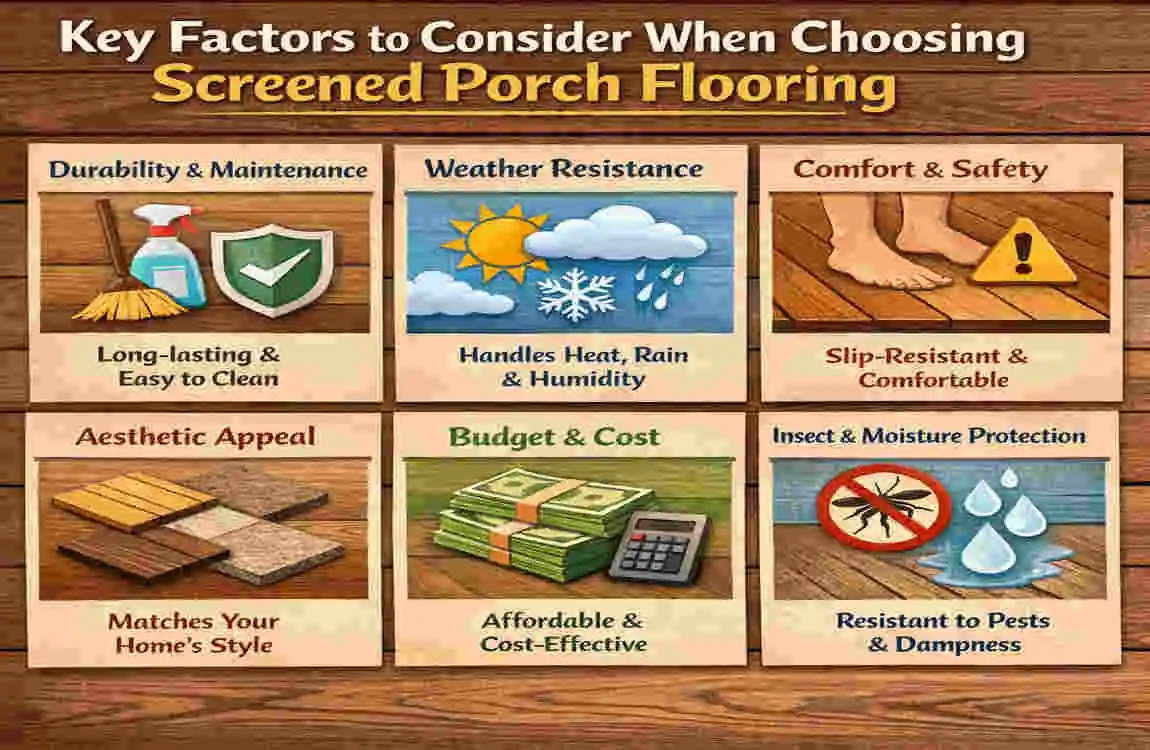
Before we jump into the specific products, we need to understand the “why” behind the choices. Not all flooring is created equal, and putting a standard indoor carpet or hardwood in a screened porch is a recipe for disaster. Because your porch is exposed to the elements (even with screens), durability is your top priority.
Here are the four pillars to consider when choosing the best flooring for your home’s screened porch.
Weather and Moisture Resistance
This is the single most important factor. Even if your porch has a roof, wind-blown rain, morning dew, and general humidity will get in. If you live in a humid climate, moisture is your enemy. You need materials that are either waterproof or highly mold-resistant.
- Think about this: If water sits on the floor, will it warp the boards? Will it cause rot underneath?
- The Goal: Prioritize materials with low water absorption rates.
Durability and Traction
Screened porches often see high traffic. You have people walking in with shoes, kids running around, and pets scratching the floor. Plus, there is the issue of safety. When floors get wet from a summer storm, they can become ice rinks.
- The Standard: Look for flooring with a texture or “tooth.” In tile terms, you often want an R11 rating or higher, which indicates good grip in wet areas.
- The Wear and Tear: Can the floor handle heavy patio furniture being dragged across it?
Maintenance and Longevity
Be honest with yourself: Do you want to spend your weekends sanding and sealing a floor, or do you want to enjoy it? Some materials look beautiful but require annual labor. Others are “install and ignore.”
- The Investment: While some options are cheaper upfront, they might only last 5–10 years. Others might cost more but last 20+ years with zero effort.
- Cleaning: How easy is it to sweep off pollen or wash away mud?
Budget, Aesthetics, and Installation
Finally, there is the look and the cost. Screened porch flooring ranges drastically in price, from as low as $2 per square foot to over $15 per square foot.
- DIY vs. Pro: Can you snap it together yourself over a weekend, or do you need to hire a professional mason?
- Style: Does the floor match your home’s architectural style?
Here is a quick breakdown of how these factors play out:
Factor High Priority For…What to Avoid
Moisture Humid/Rainy Climates Standard Hardwood, Indoor Carpet
Traction Families with Kids/Seniors Polished Marble, Smooth Glossy Tile
Maintenance Busy Professionals Natural Softwoods (Pine)
Budget First-time Homeowners Natural Stone, High-end Composite
These factors determine what the best flooring for a screened porch is in rainy or sunny regions. Now, let’s get into the top candidates.
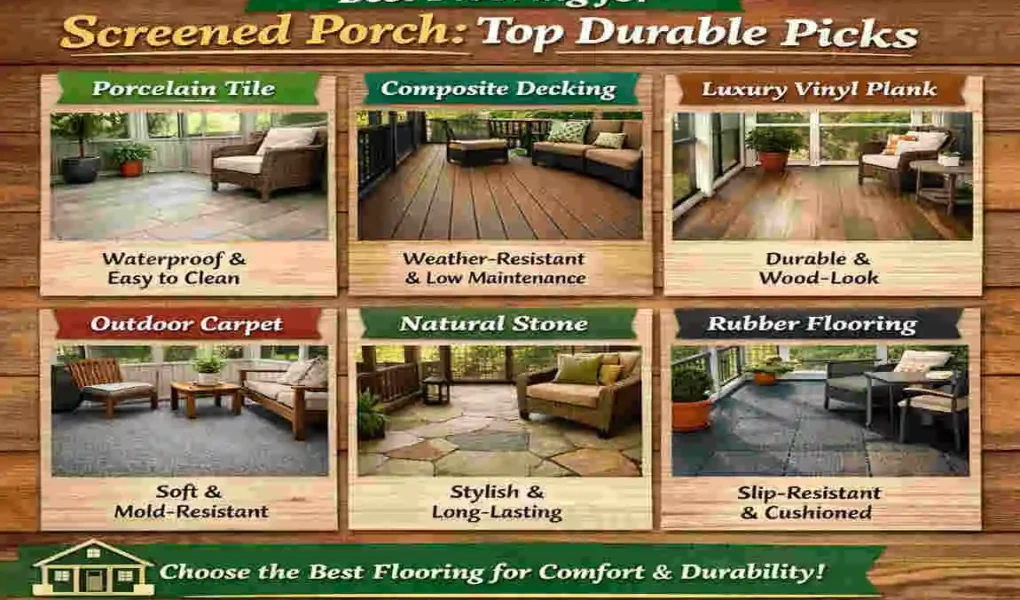
Top 7 Best Flooring Options for Screened Porches
We have ranked these options based on a mix of durability, popularity, and value. Here are the top 7 picks for 2026.
Composite Decking
If you are looking for the gold standard in modern porch flooring, composite decking is often the winner. This material is a blend of wood fibers and plastic (often recycled), capped with a tough outer shell. Brands like Trex or Timber Tech have made this a household name.
Why It Is a Top Pick: It is virtually indestructible against the weather. Unlike traditional wood, it won’t rot, warp, or splinter. It is designed specifically to handle the transition from indoors to outdoors, making it ideal for the fluctuating humidity of a screened porch.
Pros:
- Waterproof: It stands up to rain splatter and high humidity effortlessly.
- Fade-Resistant: The color you buy today is the color it will be in 10 years.
- Warranty: Most manufacturers offer 25 to 50-year warranties.
Cons:
- Cost: It is an investment. Expect to pay between $4 and $12 per square foot.
- Heat: Darker colors can get hot underfoot in direct sunlight (though less so under a roof).
Best For: Homeowners in humid climates. If you live in an area with hot, sticky summers, this material won’t swell or buckle like wood.
Porcelain or Ceramic Tile
When people ask what the best flooring is for a screened porch with pets or high traffic, porcelain tile is a fantastic answer. Note that we are talking about outdoor-rated tile, not the slippery, glossy stuff used in bathrooms.
Why It Is a Top Pick: Porcelain is fired at extremely high temperatures, making it denser and less porous than standard ceramic. It doesn’t absorb water, so it won’t crack when the temperature drops below freezing. It also offers a high-end, finished look that feels like an extension of your interior living space.
Pros:
- Durability: It is incredibly hard to scratch or stain.
- Cooling: It stays cool to the touch, which is lovely on hot days.
- Design Variety: You can buy tiles that look exactly like wood planks, stone, or concrete.
- Cost: Moderate pricing at $3 to $10 per square foot.
Cons:
- Grout: The tiles are durable, but the grout lines need to be sealed to prevent staining or mildew.
- Hardness: It is unforgiving if you drop a glass (or fall).
Best For: Those wanting a seamless transition from an indoor kitchen or living room to the porch.
Concrete Pavers or Stamped Concrete
Sometimes, the best floor is the one that is already there—or a dressed-up version of it. If your porch is built on a slab, concrete is the ultimate low-maintenance king.
Why It Is a Top Pick: It is practically indestructible. You don’t have to worry about scratching, rotting, or fading. With modern stamping techniques, concrete can be textured and colored to look like expensive stone or brick pavers.
Pros:
- Budget King: Extremely affordable, often running $2 to $8 per square foot.
- Easy Cleaning: You can literally hose it down.
- Cool Factor: Maintains a steady temperature.
Cons:
- Cracking: Over time, concrete can develop hairline cracks if the ground shifts.
- Hardness: Like tile, it is very hard underfoot, which can be tiring for prolonged standing.
Best For: Ground-level screened porches and budget-conscious renovations.
Pressure-Treated Wood or Redwood
For the purists, nothing beats the look and feel of real wood. Pressure-treated (PT) pine is the standard, while Redwood or Cedar offers a natural resistance to decay.
Why It Is a Top Pick: It offers a classic, warm aesthetic that fits traditional home styles perfectly. It is also structurally sound and allows for gaps that let water drain away if you have a slatted floor design.
Pros:
- Cost: Very affordable, generally $3 to $7 per square foot.
- Aesthetics: Authentic wood grain and warmth.
- Customizable: You can stain or paint it any color you like.
Cons:
- Maintenance: This is the high-maintenance option. You must seal or stain it every 1-2 years to prevent rot.
- Splinters: Over time, wood can splinter, which isn’t great for bare feet.
Best For: DIYers who don’t mind annual maintenance and love a rustic look.
Vinyl Plank or Luxury Vinyl Tile (LVP)
You might have this in your kitchen, but did you know some versions work for porches? Luxury Vinyl Plank has taken the flooring world by storm.
Why It Is a Top Pick: It mimics the look of wood or stone almost perfectly but is made of waterproof synthetic materials. It is softer than tile but tougher than laminate.
Pros:
- Price: Very reasonable at $2 to $6 per square foot.
- Installation: Most feature a “click-lock” system, making them a great weekend DIY project.
- Waterproof: High-quality LVP is 100% waterproof.
Cons:
- Temperature Sensitivity: Vinyl expands and contracts with temperature changes. If your porch isn’t climate-controlled, you must leave ample expansion gaps to prevent the floor from buckling.
- Heavy Furniture: Heavy legs can leave dents in softer vinyl.
Best For: Three-season rooms that are well-enclosed, preventing direct UV exposure.
Rubber Flooring or Mats
This might sound like a gym choice, but modern rubber flooring comes in attractive pavers and designs that look like stone or brick.
Why It Is a Top Pick: It is the safest floor you can buy. It is soft, slip-resistant, and forgiving.
Pros:
- Safety: Ultimate slip resistance.
- Comfort: Soft underfoot—great for kids playing.
- Durability: Water rolls right off it. Prices range from $3 to $8 per square foot.
Cons:
- Smell: New rubber can have a “tire” smell for the first few weeks.
- Aesthetics: It definitely looks more casual and less “high-end.”
Best For: Play areas, porches near pools, or homes with elderly residents concerned about slips.
Engineered Bamboo or Luxury Laminate
If you want an eco-friendly vibe, engineered bamboo is a strong contender. However, you have to be careful with the selection here.
Why It Is a Top Pick: It is incredibly hard (harder than oak) and sustainable. Engineered versions are glued in layers to resist warping.
Pros:
- Eco-Friendly: A renewable resource.
- Look: distinct, modern, and clean.
- Cost: Mid-range at $4 to $9 per square foot.
Cons:
- Moisture Sensitivity: While better than solid wood, it can still swell if soaked. It is best for porches that have glass windows or very wide overhangs.
- Warping: Not ideal for extreme humidity changes.
Best For: Enclosed porches or “sunrooms” that are well-protected from driving rain.
Comparison Snapshot: Composite decking often ranks as the best flooring for a screened porch overall because it balances durability with looks, but as you can see, the “best” depends on your specific needs.
Pros, Cons, and Cost Comparison Table
To help you visualize the differences, here is a quick reference table. Use this to pick the best flooring for a screened porch based on your specific needs.
Flooring Type Durability (1-10)Cost/sq ft (Est.)Maintenance Level Slip Resistance Best For…
Composite Decking 10 $4 – $12 Low High Humid climates & longevity
Porcelain Tile 9 $3 – $10 Medium High (Textured) Pet owners & design lovers
Concrete/Pavers 10 $2 – $8 Low , Medium Budget & ground-level
Pressure-Treated Wood 7 $3 – $7 High Medium Traditionalists & DIYers
Luxury Vinyl (LVP) 8 $2 – $6 Low Medium 3-Season rooms
Rubber Flooring 9 $3 – $8 Very Low Very High Safety & Play areas
Engineered Bamboo 6 $4 – $9 Medium Low Dry, enclosed spaces
Installation Tips and Common Mistakes for Screened Porch Flooring
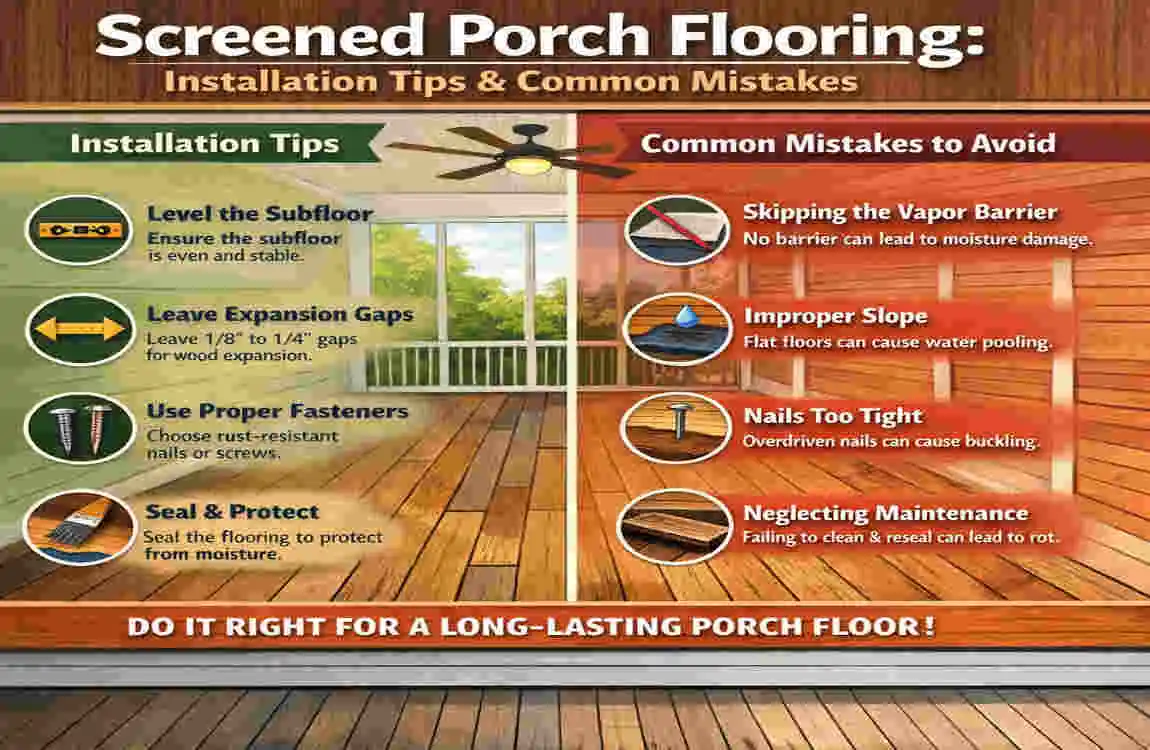
Even the most expensive flooring will fail if it is installed incorrectly. The unique environment of a screened porch requires specific attention to detail. Here is how to ensure your project is a success.
Prep the Subfloor
This is the step most people rush, and it is the step that causes the most problems later. Your subfloor must be clean, level, and dry.
- If you are laying tile over concrete, any crack in the concrete will eventually transfer to the tile unless you use an isolation membrane.
- If you are laying vinyl or wood over an existing deck, ensure the boards are secure and flat.
Manage Moisture from Below
Moisture doesn’t just come from rain; it rises from the ground.
- Vapor Barriers: If you are installing a floating floor (like LVP or laminate), always use the recommended underlayment or vapor barrier. This stops ground moisture from warping the planks from the bottom up.
Mind the Gaps
Materials expand in summer and shrink in winter. This is physics, and you cannot fight it.
- Expansion Gaps: When installing composite, wood, or vinyl, you must leave a small gap (usually 1/4 inch) around the perimeter of the room. If you fit the flooring tight against the wall, it will buckle when the July heat hits.
Pro vs. DIY
Know your limits.
- DIY Friendly: Vinyl plank, rubber tiles, and painting concrete.
- Hire a Pro: Porcelain tile (requires precise cutting and grouting), composite decking (requires structural framing knowledge), and stamped concrete.
Keyword Check: Proper install ensures your answer to what is the best flooring for a screened porch lasts decades, not just seasons.
Real Homeowner Reviews and Expert Recommendations
It is one thing to look at specs; it is another to hear from people who live on these floors.
The Consensus on Composite: According to consumer reports and forum discussions, homeowners who chose composite decking (like Trex) report a 95% satisfaction rate specifically for screened porches. One homeowner noted, “We used to paint our wooden porch every spring. We switched to composite three years ago and haven’t touched it since. It just sprays clean.”
The Climate Factor: Experts suggest tailoring your choice to your geography.
- In Humid Zones (e.g., Florida, Southeast Asia), porcelain tile is highly recommended because it is impervious to mold that thrives in humidity.
- In Freeze/Thaw Zones (e.g., Midwest, Canada): Flexible flooring, such as rubber or a floating composite, is preferred because it can withstand shifting temperatures without cracking.
The Regret: The biggest regret reported by homeowners? Installing smooth, indoor tile. “It gets slippery when the mist comes through the screens,” says one DIYer. “We had to put rugs everywhere to stop the kids from slipping.” Always check the slip rating!
Frequently Asked Questions (FAQ)
What is the best flooring for a screened porch in a wet climate? For constantly wet or humid climates, Composite Decking or Porcelain Tile are the best options. They are waterproof and mold- and mildew-resistant, unlike natural wood, which can rot over time.
Is wood good for screened porches? Pressure-treated wood or Cedar is a good option if you are on a budget and want a traditional look. However, it requires annual sealing and staining to protect it from moisture and UV rays.
How much does screened porch flooring cost? The cost varies widely. Budget options like Concrete or Vinyl can cost $2–$6 per sq ft. Mid-range options like Wood run $3–$7 per sq ft, while premium Composite or Tile can range from $4–$12+ per sq ft installed.
Can I DIY screened porch flooring? Yes! Luxury Vinyl Plank (LVP) and Interlocking Rubber Tiles are very DIY-friendly and snap together. However, tile and poured concrete usually require professional skills for the best results.
Can I use indoor laminate on a screened porch? Generally, no. Standard indoor laminate swells quickly when exposed to moisture or humidity. Only use laminate if it is specifically rated “waterproof,” and the manufacturer approves it for non-climate-controlled spaces.