
Have you ever found yourself standing in the middle of a home improvement store, looking at a wall of PVC pipes, and wondering, “Is house plumbing a good career in today’s job market?”
It is a valid question. We live in a world that pushes four-year university degrees as the only path to success, often overlooking the skilled trades. But as student loan debt climbs and office jobs face threats from automation, the hands-on trades are having a major comeback.
Here is the reality: plumbing is the circulatory system of our homes. Without it, modern life grinds to a halt. As our nation’s infrastructure ages and the housing market evolves, the need for skilled professionals to install, maintain, and repair these systems is skyrocketing.
Why Plumbing Demand is Booming
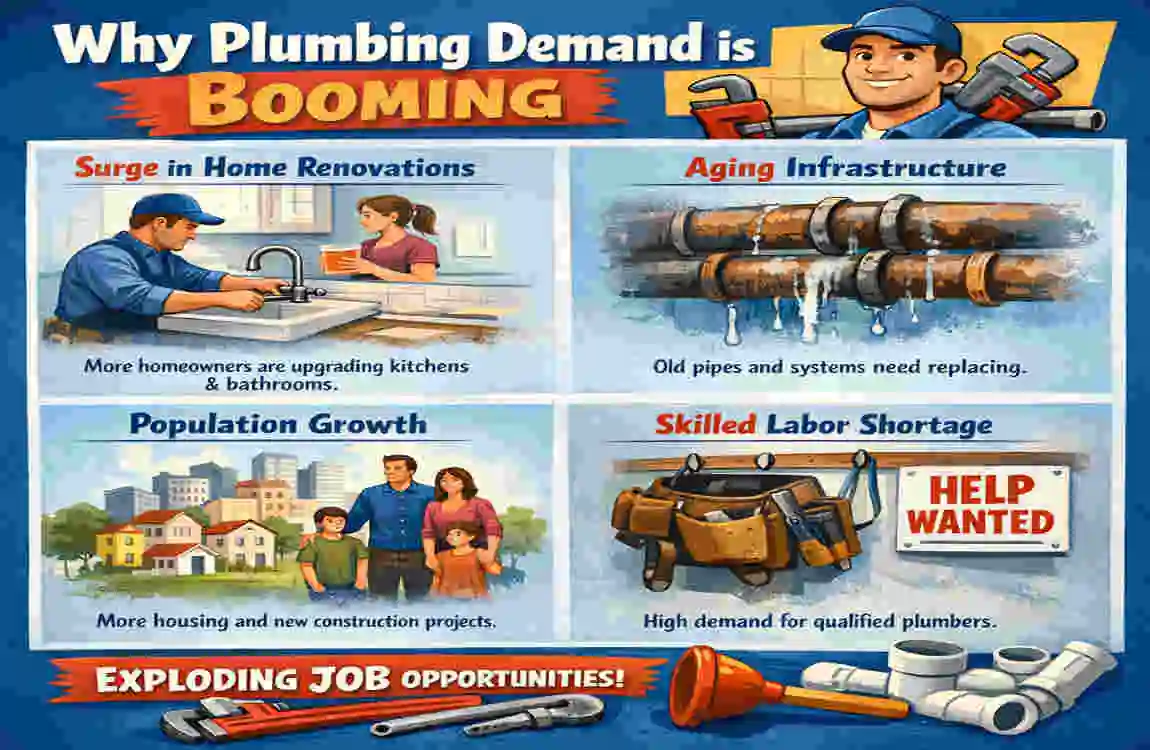
You might be asking, “Why is everyone talking about the trades right now?” The answer lies in a perfect storm of economic and social factors that have made house plumbing one of the most stable career choices available.
The “Silver Tsunami” and the Skills Gap
First, let’s talk about the workforce itself. For decades, fewer young people have entered the trades, favoring college degrees instead. Meanwhile, the existing workforce of expert plumbers is retiring. This is often called the “Silver Tsunami.”
What does this mean for you? It means there is a massive shortage of skilled tradespeople. When supply is low and demand is high, job security goes up, and so do wages. Employers are desperate for reliable workers who are willing to learn.
Aging Infrastructure and Housing Shortages
Look around your neighborhood. You likely see two things: old houses and new construction sites.
- Aging Homes: A huge percentage of homes in the U.S. were built decades ago. Their iron pipes are rusting, their clay sewer lines are cracking, and their fixtures are outdated. These homes need constant maintenance and repiping.
- New Construction: There is a persistent housing shortage in many parts of the world. Every time a new apartment complex or subdivision goes up, plumbers are needed to lay the groundwork, install rough-in plumbing, and set the final fixtures.
The Renovation and DIY Reality
Thanks to HGTV shows and social media, homeowners are obsessed with renovations. They want spa-like bathrooms and gourmet kitchens. While a homeowner might be able to paint a wall, moving a toilet or installing a pot filler requires a licensed pro. This “renovation boom” provides a steady stream of work for residential plumbers.
Green Technology and Efficiency
Finally, we have the eco-friendly movement. Homeowners and governments are pushing for water conservation. This means upgrading to low-flow toilets, installing tankless water heaters, and setting up greywater recycling systems. Plumbers are at the forefront of this green revolution, making the career not just stable but impactful for the environment.
With job growth projections sitting steadily at 4-5% annually, entering this field isn’t a gamble; it’s a calculated investment in your future.
Plumber Salary Breakdown
Let’s get to the part everyone wants to know about: the money. Is the paycheck worth the hard work? The short answer is yes. In fact, many plumbers out-earn their college-educated peers, especially when you factor in the lack of student debt.
The U.S. median pay for plumbers is hovering comfortably over $60,000, but that number doesn’t tell the whole story. Let’s break down the earning potential at different stages of your career.
Entry-Level Earnings: Paid to Learn
This is one of the biggest advantages of the trade. Unlike college, where you pay to learn, as a plumbing apprentice, you get paid to learn.
Entry-level apprentices usually start between $40,000 and $50,000 per year. You are working a full-time job while receiving on-the-job training. Your “tuition” is your sweat equity. By the time you finish your apprenticeship, you have a career, zero debt, and four years of income already in your pocket.
Mid-Career Pay: The Journeyman
Once you pass your exams and become a licensed Journeyman plumber, your income jumps significantly. Journeymen typically average between $60,000 and $80,000 annually.
However, location plays a massive role here. If you are working in a major metropolitan hub like New York, Chicago, or San Francisco, your base pay will be much higher to match the cost of living. In rural areas, the pay might be lower, but your money will go further.
Top Earners and Overtime
If you stick with it and become a Master Plumber, the sky is the limit. Master plumbers often earn $ 100,000 or more per year.
How do they hit these numbers?
- Overtime and Emergency Calls: Burst pipes don’t care if it’s Christmas Eve. Emergency rates can be double or triple the standard hourly wage.
- Specialization: Plumbers who specialize in complex systems, such as medical gas piping or green energy systems, command higher rates.
- Business Ownership: Many master plumbers eventually open their own businesses. Once you are running the show, your income is determined by how well you manage your team and your clients.
Salary Overview Table
To give you a clearer picture, here is a breakdown of what you can expect:
Experience Level Avg. Annual Salary, Hourly Rate, Factors Influencing Pay
Apprentice $40,000 – $50,000 $20 – $25 Location, Union vs. Non-Union status
Journeyman $60,000 – $80,000 $30 – $40 Years of experience, overtime hours, state licensing
Master Plumber $90,000 – $120,000+ $45+ Advanced certifications, business ownership, niche skills
Essential Skills for Plumbing Success
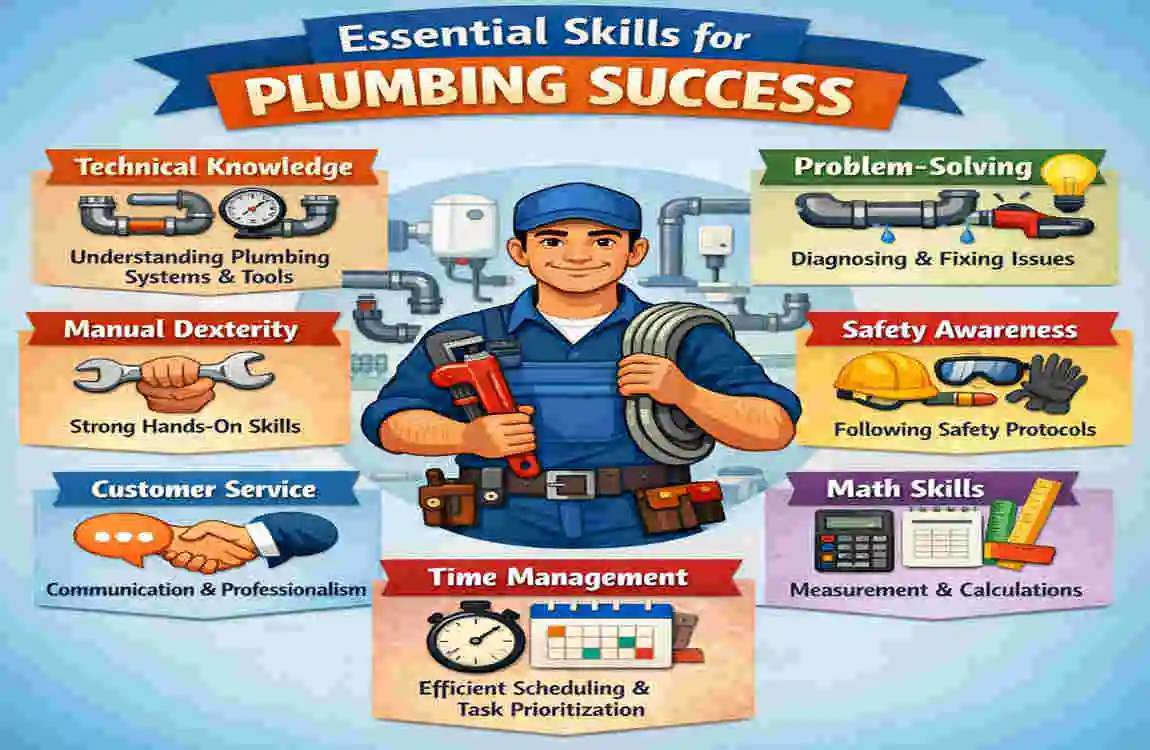
You might think plumbing is just about turning a wrench, but it is actually a highly intellectual and technical career. To answer “Is house plumbing a good career?” you have to ask if you have the right mix of skills to enjoy it.
Technical Skills: The Hands-On Work
These are the hard skills you will learn during your apprenticeship.
- Pipe Fitting and Cutting: You need to know how to measure, cut, and connect materials such as copper, PEX, and PVC.
- Leak Detection: Sometimes water appears in the living room, but the leak is in the attic. You need to be a detective to find the source.
- Blueprint Reading: On new construction jobs, you must be able to read complex architectural drawings to know exactly where pipes need to go before the walls are closed up.
- Soldering: the art of joining metal pipes with melted metal filler. It requires a steady hand and attention to safety.
Soft Skills: The People Side
This is often overlooked. As a residential plumber, you are entering people’s homes, often when they are having a very bad day (like a flooded basement).
- Customer Service: You need to be polite and respectful, and able to explain complex technical issues to the homeowner in simple terms.
- Problem-Solving: Every house is a puzzle. You will constantly encounter weird angles, outdated systems, and “what was the previous guy thinking?” moments. You need to think on your feet.
- Physical Stamina: You will be crawling into crawlspaces, climbing ladders, and carrying heavy cast-iron fixtures. Being in decent physical shape is a requirement.
Emerging Skills: The Future
The trade is evolving. To stay competitive, you should look into:
- Smart Home Integration: Installing Wi-Fi-enabled leak detectors and smart water shut-off valves.
- Water Conservation Tech: Understanding flow rates and efficiency standards.
The Top 10 Skills Checklist
If you want to excel, focus on developing these ten attributes:
- Critical Thinking: diagnosing the root cause, not just the symptom.
- Mathematics: Calculating water pressure, angles, and volume.
- Dexterity: Working with small parts in tight spaces.
- Communication: Writing clear invoices and talking to clients.
- Patience: Sometimes a rusty bolt takes 20 minutes to turn.
- Attention to Detail: One loose fitting can cause thousands in damage.
- Safety Awareness: Dealing with gas lines and high pressure requires caution.
- Tool Knowledge: Mastering everything from pipe wrenches to hydro-jets.
- Reliability: Showing up on time is half the battle.
- Adaptability: Every day is different; you have to roll with the punches.
Pros and Cons of a Plumbing Career
No job is perfect. To give you an honest answer about whether house plumbing is a good career, we need to look at both the highlights and the challenges.
The Pros: Why People Love It
Incredible Job Security We have said it before, but it bears repeating: Plumbing is recession-proof. Even when the economy crashes, people still need working toilets and running water. You will rarely struggle to find work if you are good at what you do.
Flexible Hours and Independence Once you have your license, you have options. You can work for a large company for stability, join a union for benefits, or start your own van-based business for total freedom. You can choose to work weekends for extra cash or stick to a Monday-Friday schedule.
Immediate Satisfaction There is a unique psychological reward in the trades. You show up, there is a problem, you fix it with your hands, and you leave with the problem solved. It provides a sense of accomplishment that sending emails or filling out spreadsheets cannot match.
No Massive Student Debt. While your friends are paying off loans well into their 30s, you will have been earning a full salary since you were 18 or 19. The financial head start is undeniable.
The Cons: The Reality Check
It Can Be Physically Demanding. Plumbing takes a toll on the body. You spend a lot of time on your knees, crouching under sinks, or digging trenches. Back aches and sore joints are common complaints. Pro tip: Invest in the best knee pads money can buy—your future self will thank you.
The “Yuck” Factor Let’s be real. You will deal with sewage, clogged drains, and mold. It can be smelly and gross. However, most plumbers get used to this very quickly, and the “smell of money” makes it easier to handle.
Irregular Schedules If you go into service plumbing (repair work), you might be on an “on-call” rotation. This means your phone might ring at 2 AM for a burst pipe. While the pay is great for these calls, it can disrupt your sleep and social life.
Injury Risks Working with power tools, blowtorches, and heavy pipes comes with risks. Cuts, burns, and slips are possible if you don’t strictly follow safety protocols.
Real-World Perspective
Imagine this: It is Tuesday. You spend the morning installing a high-end shower system in a renovated master bath (clean, precise work). In the afternoon, you snake a drain at a rental property (quick, dirty work). By 4 PM, you are done. You are tired, but you made $350 today and don’t have to take any work home. For many, that balance is perfect.
How to Start in House Plumbing
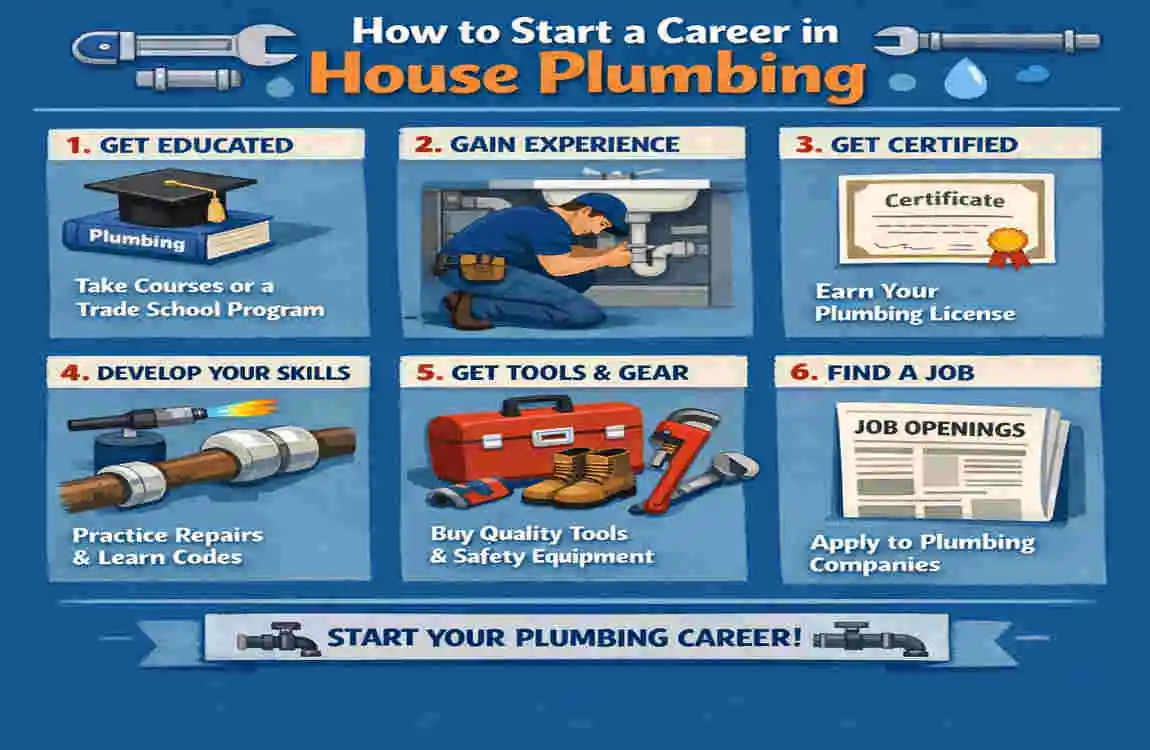
If you are reading this and thinking, “Okay, I’m sold. How do I start?” here is your roadmap.
Education Paths
You generally need a high school diploma or a GED to get started. Basic competence in math (fractions and geometry) and in science (water flow physics) is helpful.
You have two main choices after high school:
- Vocational/Trade School: You can attend a technical college for a certificate in plumbing technology. This usually takes about a year and teaches you the theory and safety basics. It can make you a more attractive candidate for apprenticeships.
- Direct Apprenticeship: You can jump straight into a union or non-union apprenticeship without trade school. You will learn everything on the job.
Secure an Apprenticeship
This is the most critical step. An apprenticeship is a mix of classroom instruction and paid on-the-job training. It typically lasts 4 to 5 years.
- Union: Look for your local United Association (UA) chapter. They have structured programs with great benefits.
- Non-Union: Contact local plumbing companies directly. Ask if they are hiring helpers or apprentices.
Licensing and Certifications
Plumbing is a regulated trade because mistakes can threaten public health (think contamination of drinking water).
- Journeyman License: After completing your apprenticeship hours (usually around 8,000 hours of work), you are eligible to take the state Journeyman exam. This test covers code requirements, venting, and sizing.
- EPA Regulations: You may need certification regarding water conservation rules or handling specific materials, depending on your state.
Build Your Portfolio and Tools
As you work, you will slowly buy your own hand tools. You should also keep track of the projects you work on. If you ever want to switch companies or start your own business, having a reputation for quality work is your best asset.
Job Outlook and Future Trends
The future of plumbing looks incredibly bright, but it is also changing. If you want to know “Is house plumbing a good career” for the next 20 years, you have to look at the trends.
The Rise of the Smart Home
Plumbing is getting “smarter.” Homeowners want Wi-Fi-enabled showers that pre-heat the water to a specific temperature before they get out of bed. They want app-based monitoring systems that shut off the main water valve if a leak is detected while they are on vacation. Plumbers who understand technology and electronics will have a massive advantage.
Sustainability Mandates
As climate change impacts water availability, strict regulations regarding water usage are coming. Plumbers will install greywater systems (using bathwater to flush toilets) and rainwater harvesting systems. This positions plumbers as key players in the green economy.
Automation Myths
Do not worry about robots taking your job. While robots might eventually be able to lay simple pipes in a factory, a robot cannot drive to a 100-year-old house, squeeze into a cobweb-filled crawlspace, diagnose a weird noise, and replace a corroded pipe at a bizarre angle. The adaptability required for residential plumbing makes it unlikely to be automated for the foreseeable future.
Frequently Asked Questions
What is the plumber’s salary by state projected for 2026?
While rates fluctuate, states with high costs of living and strong unions (like Illinois, New York, Massachusetts, and California) are projected to see Journeyman salaries averaging over $90,000. Southern and Midwestern states may see averages closer to $65,000-$75,000, though the cost of living there is significantly lower.
Is plumbing hard on your body?
Yes, it can be. It involves lifting heavy pipes, working overhead, and kneeling for long periods. However, using proper lifting techniques, wearing protective gear (especially knee pads), and staying fit can significantly reduce wear and tear on your body.
How long does it take to become a Master Plumber?
It takes about 7 to 10 years total. This includes your 4-5 year apprenticeship to become a Journeyman, followed by another 2-5 years of work experience as a Journeyman before you are eligible to take the Master Plumber exam.
Can women become plumbers?
Absolutely. While the trades have historically been male-dominated, more women are entering the trades every year. Many companies are actively seeking female plumbers to diversify their teams, and many female homeowners report feeling more comfortable with female technicians.
Do I need to be good at math to be a plumber?
You don’t need to be a calculus genius, but you do need strong practical math skills. You will be using algebra and geometry daily to calculate pipe lengths, angles, water pressure, and volume.