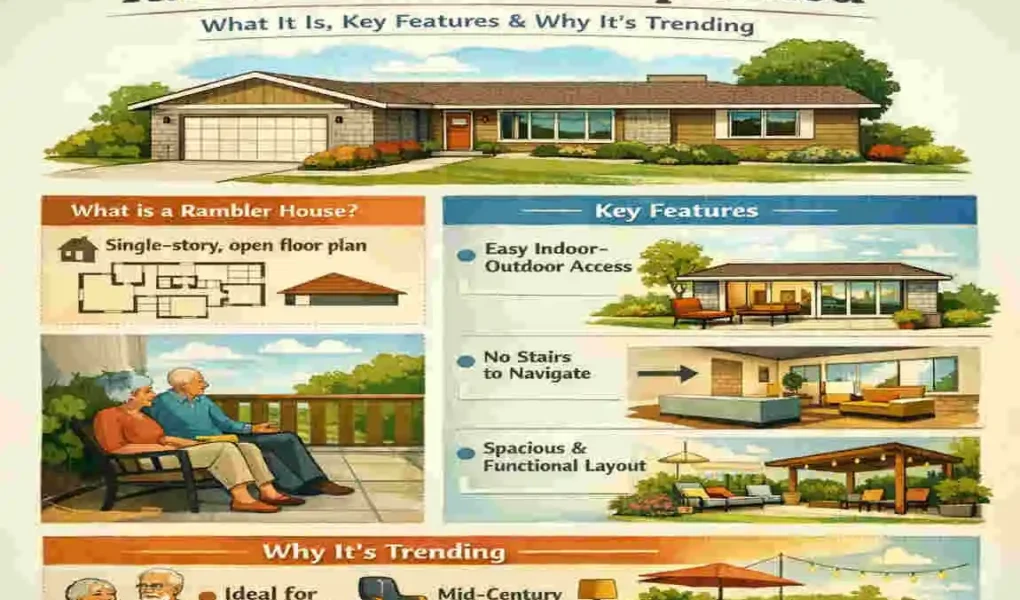
Ever wondered what a rambler house is and why it is absolutely dominating real estate trends in 2026? If you have been scrolling through property listings or driving through established suburban neighborhoods lately, you have probably noticed a resurgence of these low-profile gems. They aren’t just a relic of the past; they are the future of accessible, stylish living.
We are seeing a massive shift in the housing market this year. Industry stats suggest a 20% increase in searches for single-story homes, driven by everyone from first-time millennial buyers to retirees looking to downsize. But why the sudden obsession? It comes down to a desire for simplicity and connection to the outdoors.
What Is a Rambler House?
Core Definition and Characteristics
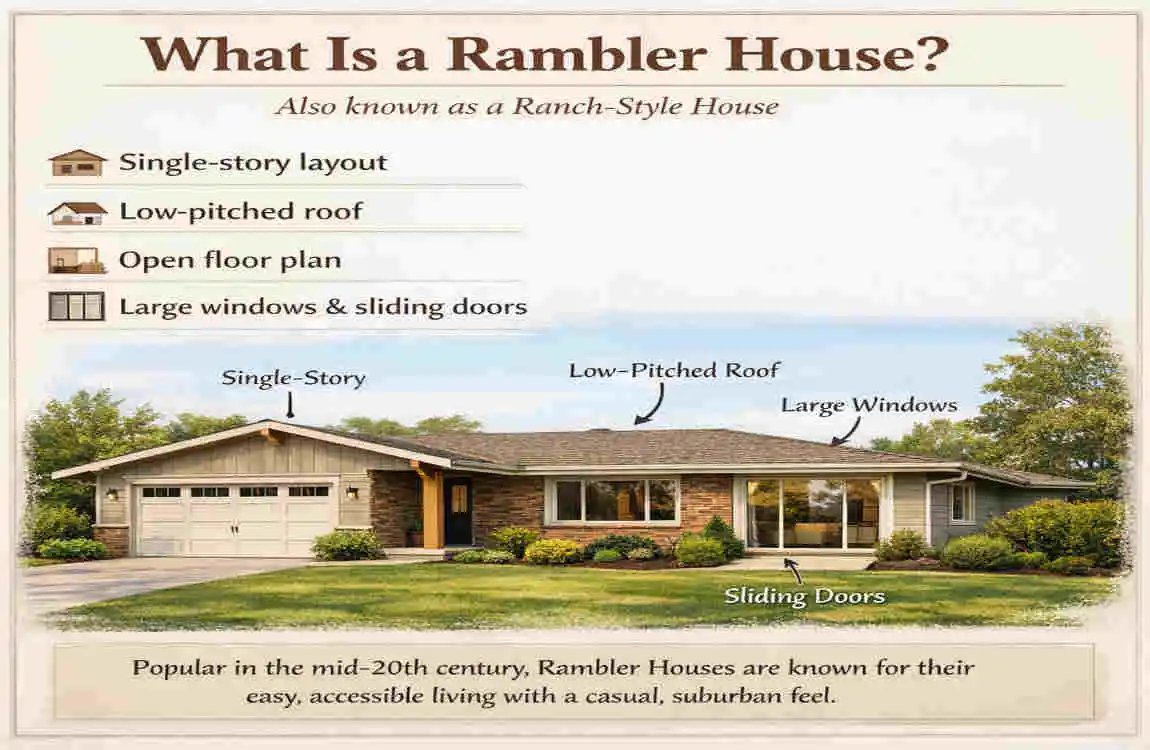
At its most basic level, a rambler house is a single-story dwelling that emphasizes horizontal lines rather than vertical height. Unlike the towering Victorians or the boxy Colonials, the rambler hugs the earth. This style originated in the mid-20th century in the United States, with deep roots in 1920s California architecture.
The design philosophy here is “form follows function.” The goal was to create a living space that was easy to navigate and integrated seamlessly with the surrounding landscape. While the style peaked in popularity between the 1940s and 1970s, modern architects are reviving the form with contemporary twists.
Visually, you can spot a rambler a mile away. Look for a low-pitched roof with wide eaves that extend out, protecting the home from the elements and creating natural shade. The floor plans usually follow an L-shape, a U-shape, or a simple rectangular footprint.
Distinguishing the Rambler from the Ranch: You might hear the terms “rambler” and “ranch” used interchangeably. While they are essentially the same family, some architectural purists make a slight distinction. A “ranch” is the broader category, while a “rambler” often implies a more sprawling, wandering layout that “rambles” across the property line. Unlike a split-level home, which creates vertical separation, the true rambler keeps life on one level.
Common Misconceptions
There is a myth floating around that ramblers are just “old, dated suburban boxes.” This couldn’t be further from the truth. While the original boom produced some cookie-cutter neighborhoods, the modern rambler-style house is often synonymous with luxury.
When people ask, “What is a rambler house style?” they often expect a cramped 1950s starter home. In reality, today’s ramblers are being renovated into open-concept masterpieces. They are ground-level, nature-connected designs that prioritize airflow and light. They are not “cheap” alternatives; they are specific lifestyle choices for those who value accessibility and land over stairs and height.
History of Rambler Houses
Origins and Evolution
To understand the Rambler, we have to look back at the American West. The style traces its lineage back to Spanish Colonial architecture found in the Southwest. These early homes featured spacious ground floors and were designed to maximize airflow in hot climates—a principle that remains central to rambler design today.
However, the real explosion happened post-World War II. Soldiers were returning home, families were growing, and the automobile was reshaping American life. People were moving out of cramped city apartments into the suburbs, where land was cheap. The rambler was the perfect solution: it was affordable to build, quick to construct, and perfect for the new “casual” American lifestyle.
Key Eras of the Rambler:
- 1920s-1930s: The experimental phase in California, blending Spanish styles with Craftsman ideals.
- 1940s-1970s: The “Boom Years.” Developers like Cliff May popularized the “California Ranch,” making it the dominant style of the American middle class.
- 2020s-Present: The Revival. Driven by an aging population needing “aging-in-place” solutions and younger generations seeking mid-century modern aesthetics.
One cannot discuss the history of this home style without mentioning iconic examples, such as Ronald Reagan’s Rancho del Cielo. His “Western White House” epitomized the rugged, relaxed, and horizontal appeal of the rambler, cementing it as a symbol of American independence.
Regional Variations
As the style spread across the country, it adapted to local climates.
- The California Rambler: Typically L-shaped or U-shaped to create a private courtyard or patio. These homes heavily emphasize indoor-outdoor living with sliding glass doors.
- The Pacific Northwest Rambler: You will often find these with attached garages and larger, grassy lawns to accommodate the rainy climate, keeping the car close to the kitchen.
- The Midwest Rambler: often simpler, rectangular designs built on concrete slabs or basements, focused on efficiency and warmth during cold winters.
Key Features of Rambler Houses
Architectural Elements
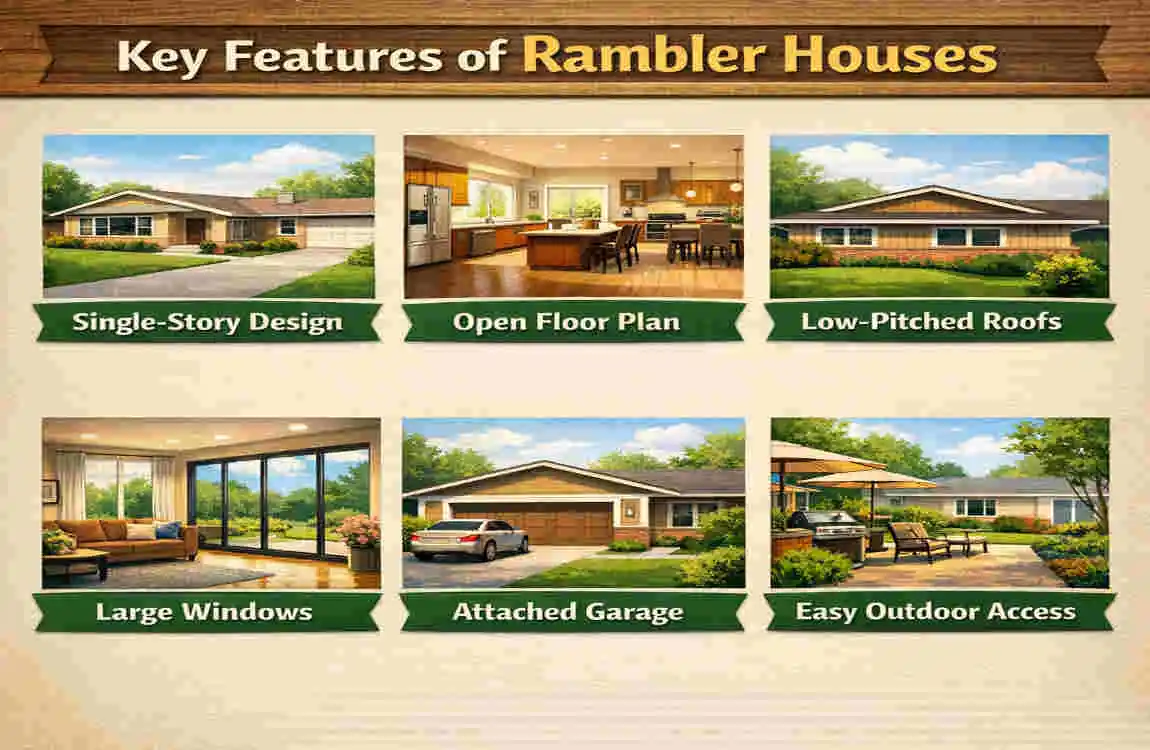
If you are walking through an open house, there are specific cues that scream “rambler.” The most obvious is the low profile. These houses do not try to dominate the skyline; they try to blend into it. The roofline and the window layout emphasize the horizontal lines.
Another hallmark is the open floor plan. Even in older 1950s models, ramblers were among the first homes to ditch formal dining room walls in favor of a flow between the living, dining, and kitchen areas. This was a radical departure from the compartmentalized rooms of the Victorian era.
Structurally, you will often see vaulted ceilings in the main living areas, following the roof’s pitch. Because they are single-story, builders often use concrete slab foundations, which provide stability and help regulate temperature, keeping the home cooler in summer.
Interior Highlights
Stepping inside, the focus is on space and light.
- Spacious Kitchens: The kitchen is the heart of the rambler, often positioned to look out over the backyard or flow directly into the family room.
- Natural Light: Because the house is wide, there are more opportunities for windows. You will frequently find large picture windows in the living room and smaller, high windows in bedrooms to maintain privacy while letting in light.
- Defined Zones: Despite the open flow, ramblers are famous for having a “living wing” (kitchen, den, dining) and a “sleeping wing” (bedrooms and baths), usually separated by a central corridor.
Exterior Design
The exterior of a rambler is understated. You won’t find ornate Victorian gingerbread trim here. Instead, expect wide façades and a mix of materials, such as brick, wood siding, or stucco.
The roof is the most critical feature. It is almost always low-pitched with deep overhangs (eaves). These eaves serve a dual purpose: they protect the siding from rain and shade the windows from the high noon sun, which was an early form of passive energy efficiency.
Comparison: Traditional vs. Modern Rambler
Feature Traditional Rambler (1950s)Modern Rambler (2026)
Roof : Low-pitched, asphalt shingles , or low-pitched, often sustainable solar tiles or metal
Windows : Large single-pane picture windows , Floor-to-ceiling energy-efficient thermal glass
Layout : Linear or L-shaped, some walls completely open, L/U-shaped, “Great Room” concept
Garage , carport, or single-car garage . Attached double/triple garage, often converted to flex space
Flooring : Wall-to-wall carpet or linoleum , polished concrete, hardwood, or luxury vinyl plank
Benefits and Drawbacks
Top Advantages
Why are people flocking back to these designs?
- Accessibility: This is the number one selling point. With no stairs to climb, ramblers are the safest option for toddlers, older people, or anyone with mobility issues. It is the ultimate “forever home” design.
- Safety: In the event of a fire or emergency, escaping from a ground-floor window is significantly easier and safer than escaping from a second-story bedroom.
- Maintenance: Cleaning gutters, painting siding, or checking the roof is much easier when your home is only 10 to 15 feet tall. You often don’t even need a professional extension ladder.
- Indoor-Outdoor Flow: With the right renovation, almost every room in a rambler can have direct access to the yard.
- Energy Efficiency: Generally, heating and cooling a single level is more consistent than balancing temperatures across multiple floors, where heat rises.
Potential Downsides
Of course, no home design is perfect.
- Larger Lot Requirement: Because the house spreads out horizontally rather than vertically, you need more land to build a 2,500 sq ft rambler than you would for a two-story colonial of the same size. This can make them expensive in dense urban areas.
- Privacy: Being on the ground level means passersby might be able to see into your bedroom windows more easily than into second-story rooms.
- Construction Costs: Believe it or not, the foundation and roofing are the most expensive parts of a build. A rambler has a larger foundation and roof than a two-story stacked house, which can drive up initial building costs per square foot.
Mitigation Tips: If you are worried about energy costs in an older rambler, look into modern insulation upgrades. Since the attic space is usually vast and accessible, adding new insulation is a straightforward DIY project that creates massive savings.
Why Rambler Houses Are Trending in 2026
Current Popularity Drivers
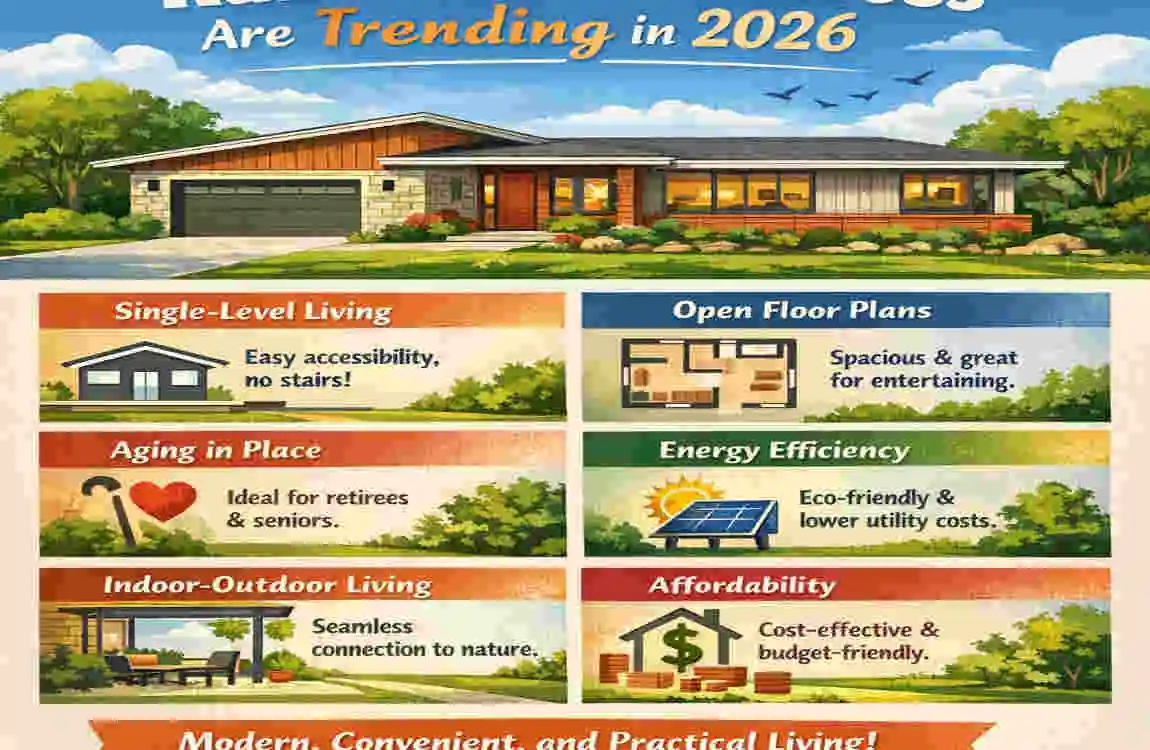
We are living in a unique moment for real estate. The remote work boom that started in 2020 has permanently altered what we need from a house. We no longer want formal separation; we want open spaces where we can keep an eye on the kids while working from a kitchen island.
Furthermore, demographics are shifting. As a large share of the population enters retirement age, approximately 40% of buyers explicitly prefer single-story homes. They are looking to downsize their maintenance without downsizing their quality of life.
Sustainability is another factor. The low profile of a rambler makes it ideal for solar panel installation, as the roof area is large and easily oriented towards the sun.
Celebrity and Market Examples
The aesthetic is also getting a pop-culture boost. We are seeing modern celebrities purchasing mid-century ramblers in places like Palm Springs and renovating them into chic, retro-modern hideaways. The style has shifted from “outdated” to “vintage cool.”
Real estate data backs this up. In suburban markets—and even in international markets with growing expatriate communities like the outskirts of Lahore or sprawling Australian suburbs—the search volume for “what is a rambler house” is up 35% year-over-year.
Rambler House Plans and Design Ideas
Popular Floor Plans
If you are looking to build or renovate, there are a few standard layouts that work best.
- The Classic “L”: This places the garage and living areas on one axis and the bedrooms on the other. It naturally creates a sheltered backyard patio, perfect for a pool or garden.
- The Split Bedroom: A modern twist where the main suite is on one side of the house and the other bedrooms are on the opposite side, separated by the main living area. This offers maximum privacy for parents.
- The 3-Bed, 2-Bath Sweet Spot: Most rambler plans generally fall into the 2,000 to 3,000 sq ft range, offering manageable luxury.
Customization Tips
If you own a rambler, you have a blank canvas.
- Raise the Ceiling: If the roof pitch allows, knocking out the flat ceiling to expose the rafters can make a small rambler feel like a cathedral.
- Add Skylights: Since there is no second floor above you, you can add skylights to hallways or bathrooms to flood the interior with natural light.
- SEO Tip for Builders: If you are designing these, focus on “Rambler house floor plans with airflow.” Ventilation is a key selling feature for health-conscious buyers in 2026.
Cost and Building a Rambler House
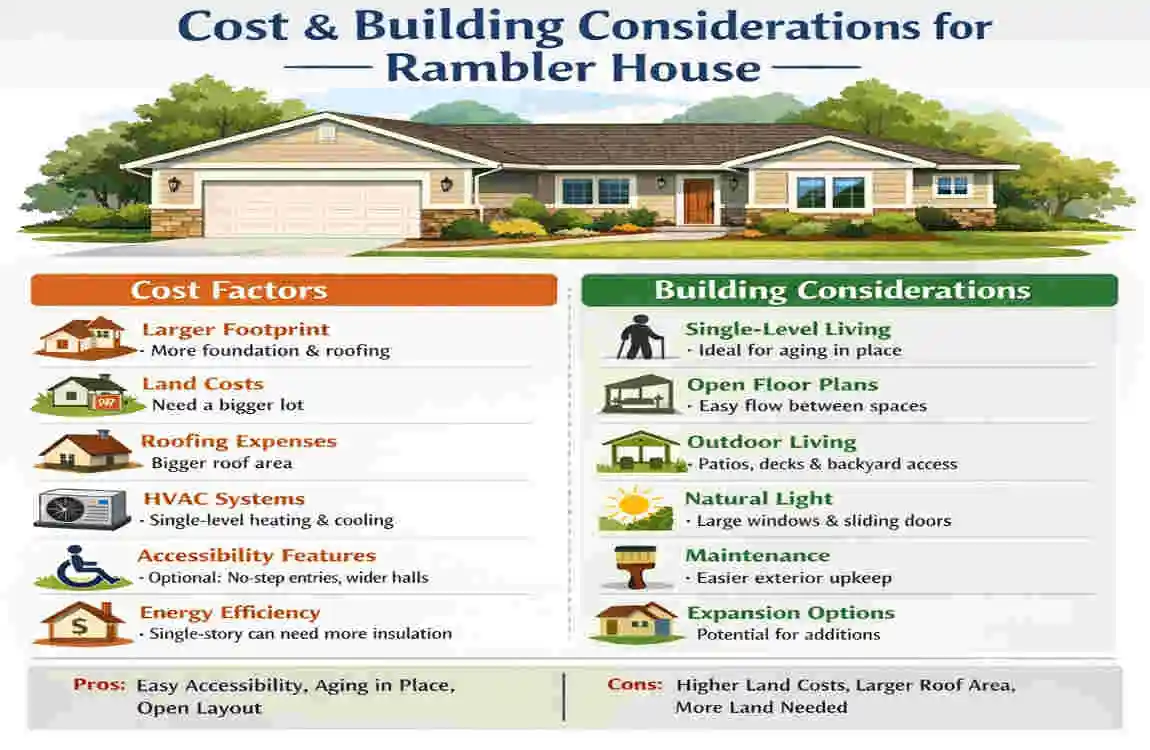
Let’s talk numbers. Building a custom rambler in 2026 generally costs between $200 and $400 per square foot, depending heavily on your location and finishes.
While the foundation and roofing costs are higher (as mentioned earlier), you save money on staircases, structural reinforcements for second floors, and scaffolding costs during construction. Furthermore, the resale value is incredibly strong. Because the buyer pool includes families, singles, and seniors, ramblers often see a 15% higher rate of value appreciation than multi-story homes in the same neighborhood.
Factors influencing cost include:
- Location: Building in established suburbs requires finding a wide lot, which carries a Premium.
- Materials: Opting for the classic brick exterior will cost more than vinyl siding but pays off in longevity.
FAQs
Q: What is a rambler house exactly? A: A rambler house is a single-story, ranch-style home designed with a low profile, open layout, and a focus on easy indoor-outdoor living. It is defined by its horizontal footprint and lack of stairs.
Q: What is the difference between a rambler and a ranch? A: Ideally, they are the same. However, “Rambler” is often used to describe homes that are more sprawling or L-shaped, whereas “Ranch” can apply to smaller, simple rectangular starter homes.
Q: Are rambler houses good for families? A: Absolutely. The open floor plans make it easy for parents to supervise children, and the lack of stairs removes a major safety hazard for babies and toddlers.
Q: Can you add a second story to a rambler? A: Technically, yes, this is called a “pop-top.” However, it often requires significant foundation reinforcement and alters the home’s aesthetic character. Many architects recommend building out (expanding the footprint) rather than up, if the lot allows.