Picture this: You are standing in your Florida backyard, looking at that old, dusty storage shed. Right now, it is just holding rusty lawnmowers and forgotten boxes of holiday decorations. But what if you could wave a magic wand and transform that wooden box into a beautiful, income-generating guest house?
With Florida’s booming housing market, a rising demand for affordable living spaces, and new laws sweeping the state in 2026, you do not need magic to make this happen. You just need a solid plan. Florida homeowners are increasingly converting their backyard sheds into cozy guest houses. This trend is skyrocketing, driven heavily by the new ADU-friendly (Accessory Dwelling Unit) laws like SB 48.
Why Convert a Shed to a Guest House in Florida?
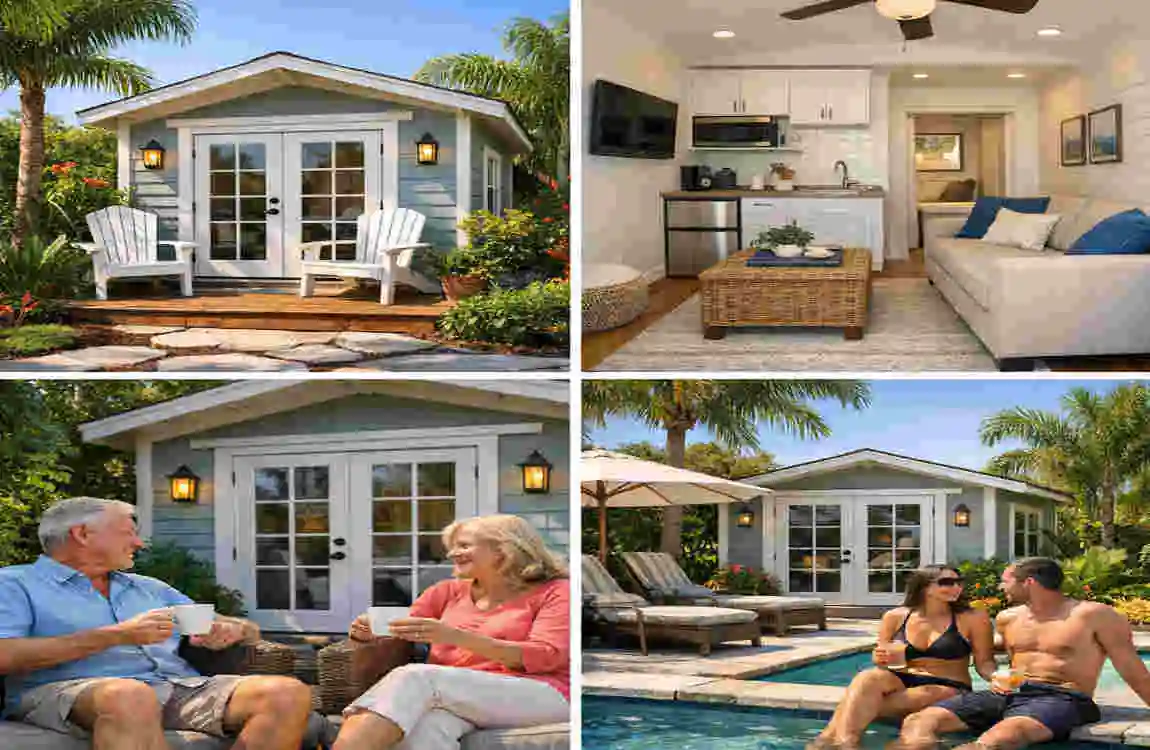
You might be wondering whether all this effort is actually worth it. The short answer is an absolute yes. Transforming your backyard shed into a habitable space is no longer just a fun weekend DIY thought; it is a serious financial strategy.
Riding the SB 48 Wave
The year 2026 brought a game-changer for Florida homeowners: the introduction of laws like SB 48. In everyday language, this new legislation makes it significantly easier to build an ADU—which is just a fancy real estate term for a guest house—in your backyard.
Before these changes, you often had to jump through endless hoops, face strict zoning laws, or even legally split your lot just to let someone sleep in a backyard structure. Now, local governments are actively encouraging these conversions to help solve the statewide housing shortage. The red tape has been slashed, making your path to a guest house smoother than ever.
Unlocking Massive Rental Income
Let’s talk about the money. Florida is a top destination for tourists, snowbirds, and new residents. If you live in a high-demand area like Miami, Tampa, or Orlando, a well-designed guest house can easily pull in $1,500 or more per month as a long-term rental.
If you decide to go the short-term rental route with platforms like Airbnb, that number can soar even higher during peak winter months. This passive income can help you pay off your mortgage faster, fund your family vacations, or build a comfortable retirement nest egg.
Family Housing and Property Value
Maybe you don’t want strangers in your backyard. That is completely fine! Many homeowners are converting sheds into safe, private spaces for aging parents or adult children moving back home. It provides family closeness while maintaining everyone’s privacy.
Furthermore, a permitted, fully functional guest house adds incredible value to your property. Real estate experts note that a legal ADU can boost your home’s total value by 15% to 20%. Plus, when you build it with Florida’s strict hurricane resilience standards in mind, you are adding a highly durable asset to your land.
Florida Regulations for Shed Conversions
Before you run out to buy drywall and paint, we need to have a serious chat about the rules. While the laws are friendlier in 2026, Florida still has strict building codes. You want to do this right, so you do not face hefty fines down the road.
The 120 Square Foot Rule
Here is a simple rule of thumb for Florida sheds: if your shed is under 120 square feet, you often do not need a building permit to put it in your yard. However, the moment you decide to turn that shed into a habitable space—meaning people will sleep, cook, or use a bathroom in there—the rules change completely.
To convert any shed into a guest house, you absolutely need building and zoning approvals. Thankfully, most Florida counties now offer streamlined online portals where you can submit your plans and get approvals much faster than in the past.
SB 48 Changes Explained
So, what exactly did the new 2026 laws change for you? The biggest win for homeowners is the reduction in setbacks. A “setback” is simply the required distance between your building and your property line. In the past, you might have needed 10 or 15 feet of clearance. Today, for ADUs under 1,000 square feet, those setbacks have been dramatically reduced, meaning you can utilize a shed that sits closer to your fence.
The new laws also mandate faster approval timelines for local building departments. You are no longer waiting six months just to get a stamp of approval on a basic 300-square-foot floor plan.
HOA Variances and Hurricane Codes
If you live in a community governed by a Homeowners Association (HOA), you must check its specific bylaws. While state laws override some local restrictions, you still need to apply for an HOA variance if their rules conflict with your plans. Keep them in the loop to avoid neighborly disputes.
Finally, do not forget about Mother Nature. Florida requires specialized hurricane-rated materials. Your conversion will need to pass rigorous framing, plumbing, and electrical inspections to ensure it can withstand severe weather.
Cost Breakdown: $20-$200/Sq Ft Factors
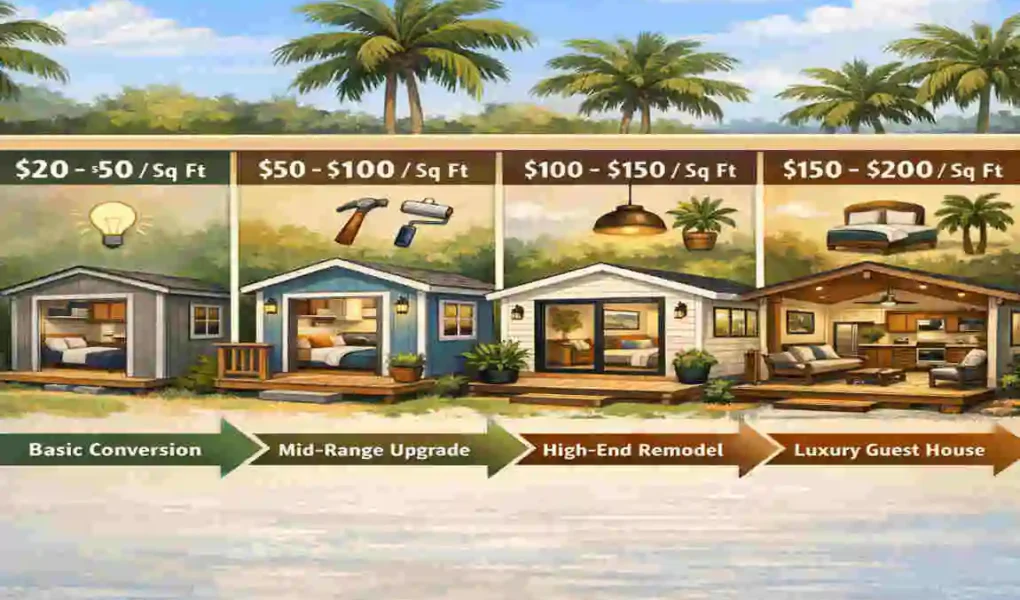
Now, let’s get to the main event: the money. When you ask how much it costs to turn a shed into a guest house in Florida, the $20 to $200 per square foot range can feel a bit overwhelming. Let’s divide this complex idea into understandable, bite-sized segments based on your budget.
The Budget Tier: $20 – $50 per Square Foot
If you are working with a tight budget, you will fall into this category. The low-end cost usually applies to smaller sheds—around 200 square feet.
In this tier, you are focusing on the bare essentials. You are adding basic fiberglass insulation, hanging standard drywall, putting in simple windows, and running basic electrical wiring for lights and a few outlets. You will likely skip the expensive plumbing, meaning your guests might have to use the bathroom in the main house. Many budget-conscious homeowners also start with a sturdy prefab shed kit to keep initial costs incredibly low.
The Mid-Range Tier: $50 – $120 per Square Foot
This is where the magic really starts to happen, and where most Florida homeowners land. In the mid-range tier, your shed truly becomes a standalone guest house.
Here, you are adding a dedicated HVAC system (like a modern, energy-efficient mini-split) to battle the brutal Florida summer heat. You will also see a small bathroom with a shower and a functional kitchenette with a sink and a hot plate. The finishes are nice but affordable—think luxury vinyl plank flooring and standard store-bought cabinets.
The Luxury Tier: $120 – $200 per Square Foot
If you want to create a five-star resort experience in your backyard, this tier is for you.
At the high end, you are sparing no expense. We are talking about custom cabinetry, quartz countertops in a full-sized kitchen, high-end tile in a luxurious walk-in shower, and top-tier smart home technology. You might even add expensive exterior features such as a wraparound composite deck, solar panels on the roof, and impact-resistant, floor-to-ceiling glass doors.
To make this crystal clear, take a look at this helpful cost breakdown table for a standard 400-square-foot shed conversion:
Cost Tier Sq Ft Range Key Features Total Example (400 sq ft)
Budget $20 – $50 Insulation, windows, basic electric $8,000 – $20,000
Mid-Range $50 – $120 Bath, mini-kitchen, HVAC mini-split $20,000 – $48,000
Luxury $120 – $200 Full kitchen, solar panels, decking $48,000 – $80,000
Step-by-Step Conversion Process
Are you feeling inspired? Great! Let’s walk through exactly how this project flows from a dusty shed to a dazzling guest house. Converting a shed requires a logical sequence of steps to ensure everything is safe, legal, and beautiful.
Assess Your Shed’s Structure and Foundation
Before you do anything, you must determine whether your current shed is strong enough to hold people. Many storage sheds are built on simple dirt plots or thin skids. A guest house needs a permanent, rock-solid foundation. You will likely need to hire a contractor to pour a concrete slab or install heavy-duty piers. They will also check the wooden framing to ensure it can support heavy drywall, insulation, and a new roof.
Secure Your Permits
We talked about this earlier, but it is a critical step. Do not skip this! Take your drawn-up plans to the county building department. Depending on your local government, getting these permits approved will take roughly 2 to 8 weeks and cost you anywhere from $500 to $2,000. It is a waiting game, but having legal paperwork protects your massive investment.
Insulate and Weatherproof
Florida humidity is no joke. If you do not insulate your shed properly, it will feel like a sauna, and mold will quickly take over. You need high-quality insulation in the walls, floor, and ceiling. Next, you must weatherproof the exterior. This means sealing every crack, wrapping the building in a moisture barrier, and ensuring your roof is watertight against torrential afternoon downpours.
Step 4: install Your Utilities
This is usually the most complicated step. You need power, water, and a way to handle waste. Electricians will trench wires from your main house panel to the shed. Plumbers will run water lines. If you live in a rural area of Florida, you might need to tie the shed’s plumbing into your existing septic system, which requires careful planning. If a septic tie-in is too expensive, some homeowners opt for modern composting toilets to save thousands of dollars.
Finish Interiors and Add Hurricane Protection
Finally, the fun part! You get to hang the drywall, paint the walls, install the flooring, and bring in the furniture. Because you live in Florida, this is also the time to install hurricane shutters or impact windows. Once the final coat of paint dries, your guest house is ready for its first visitor!
Detailed Cost Categories
To really understand where your hard-earned money is going, we need to peel back the curtain on the individual construction trades. Let’s break down the major cost categories that make up your total budget.
Foundation and Structural Changes: $5,000 – $15,000
Your shed needs good bones. If you are starting with a flimsy aluminum shed, you might actually need to tear it down and start fresh. Even if you have a solid-wood shed, you still need to anchor it properly to a foundation. Pouring a new concrete slab, reinforcing the roof trusses, and adding heavy-duty hurricane straps will eat up a significant chunk of your initial budget.
Plumbing and Electrical Work: $8,000 – $25,000
Water and electricity are the lifeblood of a comfortable guest house, but they do not come cheap. Hiring licensed electricians and plumbers is mandatory. Digging trenches across your yard to bury the pipes and wires takes heavy machinery and time.
As mentioned earlier, septic systems are critical in rural Florida. If your current septic tank is too small to handle an extra bathroom, you might have to upgrade the entire system, which would push you toward the higher end of this price estimate.
Interior Build-Out: $10,000 – $40,000
This category covers everything that makes the inside look like a home. It includes your framing, drywall, paint, flooring, interior doors, and trim. It also includes the cabinetry for your kitchenette, the toilet, the shower, and the bathroom vanity. The massive price gap here is simply a matter of taste. Do you want laminate counters from a big-box store, or imported Italian marble? The choice is entirely yours!
Exterior and Hurricane-Proofing: $3,000 – $10,000
Florida demands respect when it comes to the weather. Upgrading your shed’s exterior is non-negotiable. You might need to install heavy-duty fiber cement siding that resists rot and termites. You will definitely need to invest in impact-rated doors and windows, or at least strong metal hurricane shutters. Upgrading the roof to a strong metal seam will also factor into this cost.
Permits and Impact Fees: $1,000 – $5,000
We know nobody likes paying fees, but it is part of the game. Local municipalities charge for the time it takes to review your plans and send out inspectors. Some Florida counties also charge “impact fees” when you add a new living unit, to help cover the cost of local infrastructure like roads and schools.
A Quick Note on 2026 Inflation: It is important to keep in mind that construction costs have risen. Due to ongoing labor shortages in the skilled trades, you can expect 2026 prices to be about 5% to 10% higher than they were in 2025. Always factor in a little buffer for unexpected price hikes.
Real Florida Case Studies
Sometimes, looking at a bunch of numbers can be confusing. To help you visualize what is possible, let’s look at three real-world examples of Florida homeowners who successfully transformed their backyard sheds.
The Miami Budget Build (300 sq ft)
Meet Sarah from Miami. She had a tight budget and an existing 300-square-foot wooden shed in decent condition. She wanted to create a small studio for her college-aged son. Sarah focused on doing a lot of the painting and finishing work herself. She hired professionals for the electrical wiring and a mini-split AC, but decided to skip the expensive plumbing entirely. Her son uses the bathroom in the main house. By keeping things incredibly simple and avoiding major plumbing trenches, Sarah’s total conversion cost was only $35,000. She managed to create a beautiful, climate-controlled space on a strict budget.
The Orlando Luxury ADU (500 sq ft)
Now, let’s travel to Orlando and meet David and Maria. They wanted to build a high-end Airbnb rental near the theme parks. They had a massive 500-square-foot structure that sat right next to their backyard swimming pool. They went all out. They added a stunning full bathroom with glass shower doors, a full kitchen with stainless steel appliances, and French doors that open directly onto the pool deck. Because they spared no expense on luxury finishes and extensive plumbing, their total project cost hit $75,000. However, because they charge Premium nightly rates, they are thrilled with their investment.
The Tampa Prefab Success Story
Over in Tampa, a homeowner named James wanted a guest house for his visiting parents, but his old shed was rotting away. Instead of trying to fix it, he bought a brand-new, modern prefab shed specifically designed to be converted. Because the prefab shed already had the proper framing and windows in place, the conversion process was lightning fast. James acted as his own general contractor, managing the tradespeople himself. He managed to complete the entire, fully plumbed project for an astonishing $22 per square foot—a true mid-range success story achieved through smart shopping and heavy personal involvement.
Budget-Saving Tips
If you are reading this and thinking, “I want to do this, but I need to save some cash,” we hear you. You do not have to empty your entire life savings to get a beautiful guest house. Here are some of the best ways to keep your costs down.
- Opt for Prefabricated Sheds: If you do not already have a shed, buying a high-quality prefab shell is often much cheaper than paying a framing crew to build a structure from scratch in your yard.
- Embrace the DIY Spirit: Leave the plumbing, electrical, and structural work to the licensed pros. But painting? Laying click-and-lock vinyl floors? Assembling cabinets? You can absolutely do those non-structural tasks yourself and save thousands of dollars in labor costs.
- Choose a Metal Roof: While a metal roof might cost a tiny bit more upfront than standard asphalt shingles, it is incredibly durable in the Florida sun and highly resistant to hurricane winds. You will save a fortune on future roof replacements and repairs.
- Get Three Quotes: Never hire the first contractor you talk to. Always bring at least three local Florida contractors to your property to give you a detailed estimate. You will be shocked by how much their prices can vary!
- Look for Tax Credits: In 2026, there are excellent state and federal tax credits available if you install energy-efficient windows, solar panels, or high-efficiency HVAC systems. Leverage these credits to get money back on your taxes next year.
ROI and Long-Term Value
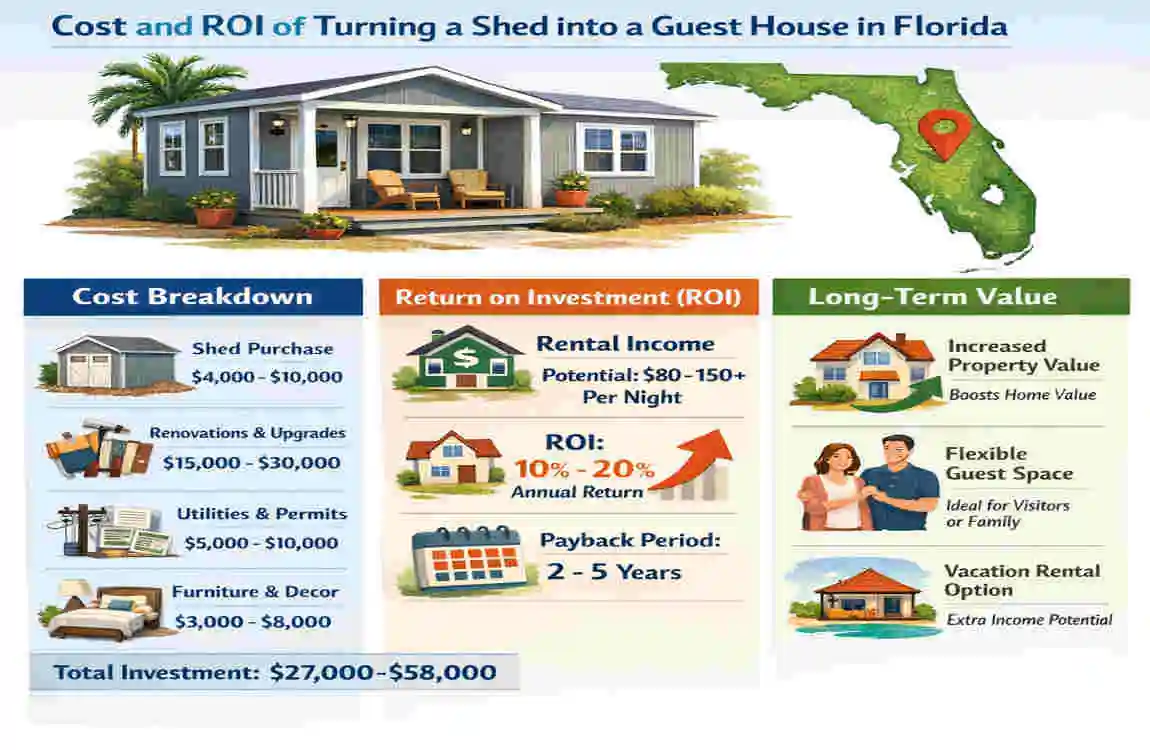
Let’s look at the big picture. Spending $30,000 or $50,000 on a shed conversion might feel scary, but you have to look at the Return on Investment (ROI).
If you decide to rent out your new guest house, the math works heavily in your favor. Let’s say you spend $40,000 on your conversion and rent it out for $1,500 a month. In just a little over two years, the rental income will completely pay off your initial construction costs. Most Florida homeowners find they can recoup their total costs in just 2 to 4 years. Everything after that is pure profit!
Furthermore, the Airbnb trends in Florida are incredibly strong right now. Current data shows that well-managed Florida guest houses enjoy an average 70% occupancy rate year-round. Tourists love the privacy of a detached guest house over the crowded atmosphere of a hotel.
Even if you never rent it out, you are still winning. As we mentioned earlier, a legal ADU can boost your property’s value by 10% to 15%. When the time eventually comes to sell your house, buyers will eagerly pay a massive Premium for a property that already has a completed guest house in the back.
FAQs
You probably still have a few lingering questions. Let’s tackle the most common things homeowners ask before starting this journey.
- How much does it cost to turn a shed into a guest house in Florida? Generally, you should expect to spend between $20 and $200 per square foot. A basic, simple conversion might cost $10,000 to $20,000, while a luxury, fully plumbed guest house can easily reach $50,000 to $80,000+.
- Do I really need permits for this? Yes, absolutely. While Florida allows small storage sheds (under 120 sq ft) without permits, the second you add electrical, plumbing, or make it a “habitable space” where someone will sleep, building permits and zoning approvals are legally required.
- How long does the whole process take? From the day you submit your plans to the city to the day you paint the final baseboard, a standard conversion usually takes between 8 and 16 weeks. This timeline depends heavily on how fast your local county approves permits and how quickly your contractors can work.
- Can any shed be converted? Not always. Old sheds with severe wood rot, weak floor joists, or low ceilings (under 7 feet) might not meet the building code requirements for a living space. It is sometimes cheaper to replace an old shed than to heavily modify it.