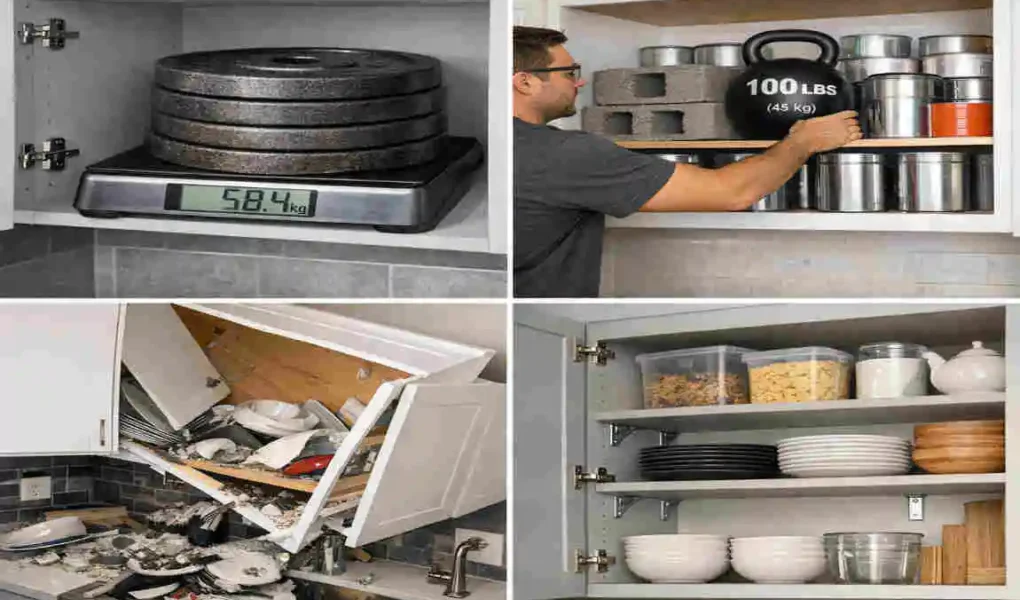
You are not alone. Many homeowners use top cabinets for plates, glasses, serving bowls, food containers, and even small appliances. The problem is simple: most people never stop to ask how much weight can top kitchen cabinets hold before loading them up.
The short answer is that top kitchen cabinets typically hold 30 to 50 pounds per linear foot when properly installed. In many kitchens, that works out to roughly 150 to 250 pounds total for a standard upper cabinet run. However, the real number depends on the cabinet material, wall support, cabinet depth, shelf quality, and installation method.
Understanding Top Kitchen Cabinet Basics
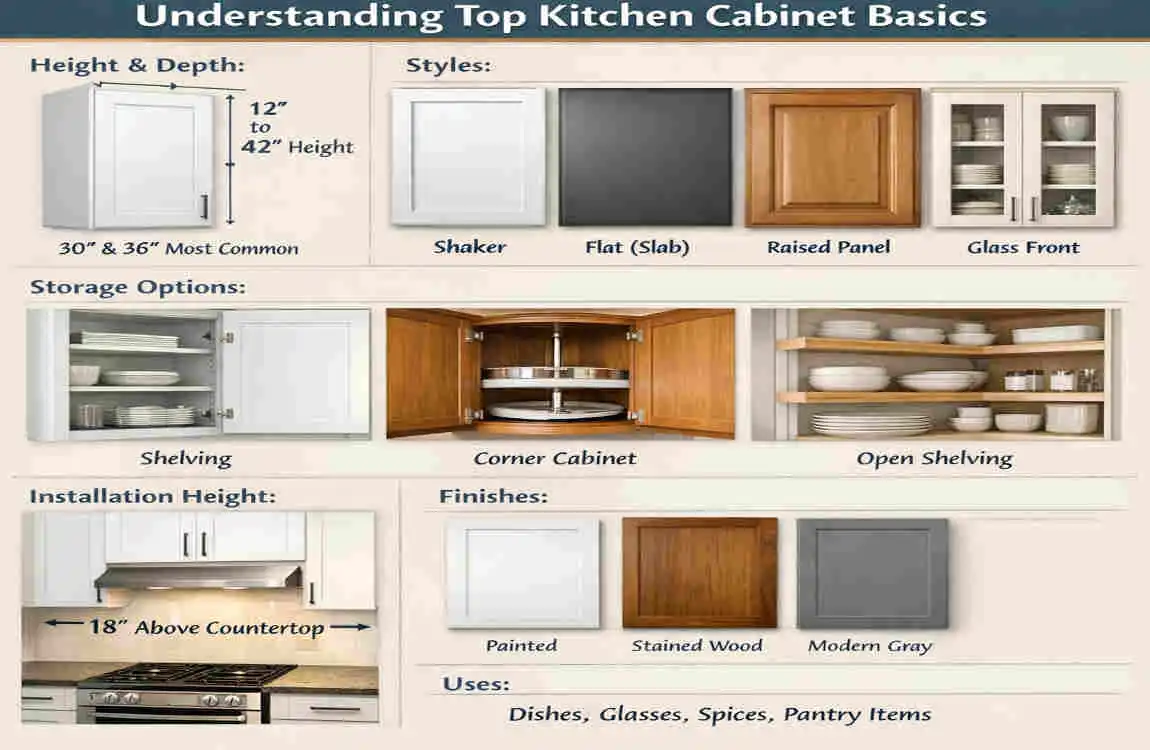
Before you can judge weight limits, it helps to understand what top kitchen cabinets actually are and how they differ from the lower cabinets in your kitchen.
What Top Kitchen Cabinets Are
Top kitchen cabinets are the wall-mounted cabinets installed above countertops. People also call them upper cabinets or wall cabinets. Unlike base cabinets, these cabinets do not sit on the floor. They hang from the wall, which means their strength depends heavily on both the cabinet box itself and the way it was mounted.
Most top kitchen cabinets are usually 12 inches deep, though some can go deeper, especially in custom kitchens. Heights vary, but common sizes include 30, 36, and 42 inches.
Because they are suspended, upper cabinets deal with a different kind of stress than base cabinets. A base cabinet transfers weight directly down into the floor. A top cabinet must withstand downward force, forward pull, and long-term stress on screws, brackets, shelves, and joints.
That is why the question “how much weight can top kitchen cabinets hold” matters so much. You are not only measuring cabinet strength. You are also measuring wall, fastener, and shelf strength.
Top Cabinets vs. Base Cabinets
Base cabinets are built to carry much heavier loads. They support countertops, cookware, and sometimes appliances. Upper cabinets are made for lighter storage like:
- Plates and bowls
- Glasses and mugs
- Pantry goods
- Spices and dry goods
- Light serving pieces
That does not mean upper cabinets are weak. It simply means they are designed for a different job.
Types of Top Cabinets
Not all wall cabinets are built the same, and construction style makes a big difference.
Framed Cabinets
Framed cabinets have a face frame attached to the front of the cabinet box. This adds rigidity and can help the cabinet stay square over time. Many traditional cabinets use this design.
Frameless Cabinets
Frameless cabinets skip the face frame and rely on thicker side panels and precise construction. They often offer more interior space, but their strength depends heavily on the quality of the materials and the hardware.
Stock, Semi-Custom, and Custom Cabinets
You will also find different cabinet categories:
- Stock cabinets are mass-produced and usually the most budget-friendly.
- Semi-custom cabinets offer better material options and more sizing flexibility.
- Custom cabinets are built to fit your kitchen and often use stronger materials and better joinery.
Standard Weight Capacities
As a general rule, upper cabinets hold around 30 to 50 pounds per linear foot when installed correctly. In total, many standard top cabinets can safely hold around 150 to 250 pounds, depending on width, material, and support.
Some Premium or reinforced cabinets may test much higher, but that does not mean every cabinet in every kitchen should be loaded to the maximum.
Factors That Affect How Much Weight Top Kitchen Cabinets Can Hold
If you really want to understand how much weight top kitchen cabinets can hold, you need to look beyond the cabinet label. Real-world cabinet strength depends on several connected factors.
Material Quality Matters First
The material used in the cabinet box has a major effect on strength.
Plywood is usually one of the best options for upper cabinets. It holds screws better, resists sagging better, and stays stronger over time. Particleboard and low-density fiberboard are cheaper, but they are more likely to weaken with moisture, sag under heavy shelf loads, or fail around screw holes.
Even if two cabinets look similar on the outside, their true weight capacity can vary widely depending on what is inside the panels.
Cabinet Size Changes the Stress
Bigger cabinets do not always mean stronger cabinets.
A deeper cabinet puts more weight farther away from the wall. That creates leverage, which increases stress on the mounting points. A taller cabinet may also cause more movement and twisting, especially if the load is not evenly distributed.
In simple terms, a 12-inch-deep upper cabinet is usually safer for heavy storage than a deeper wall cabinet.
The Wall Itself Plays a Huge Role
A strong cabinet can still fail if the wall connection is weak.
The best installation method is to fasten the cabinet to wall studs securely. Studs provide solid structural backing. Drywall alone is not enough for heavy loads, and even strong anchors have limits. If a cabinet is poorly attached, it may pull forward even if the box itself is still intact.
This is one of the biggest reasons upper cabinet failures happen. Homeowners often focus on shelf strength while ignoring mounting strength.
Hardware and Shelves Matter More Than You Think
The cabinet box is only one piece of the puzzle. The following parts also affect upper cabinet load limits:
- Shelf thickness
- Shelf span
- Shelf pins or clips
- Hinges
- Mounting rails
- Screws and brackets
A cabinet can look fine on the outside while the shelf inside slowly bows under too much weight.
Comparison Table: What Affects Cabinet Capacity?
Factor Impact on Capacity Example
Material Plywood is stronger and resists sagging better; particleboard is weaker and more moisture-sensitive Plywood uppers may safely support more weight than low-grade particleboard cabinets
Cabinet Depth and Height Deeper and taller cabinets create more leverage and stress A 12″ deep upper is more stable than a 15″+ deep wall cabinet
Wall Support Stud-mounted cabinets are far stronger than cabinets relying on drywall anchors Cabinets screwed into studs can hold far more than cabinets attached only to drywall
Hardware and Shelving Better hinges, thicker shelves, and strong shelf clips increase safe load capacity Cheap shelves may bow long before the cabinet box fails
Construction Style Framed and reinforced boxes often hold shape better over time A well-built framed cabinet may stay rigid longer under daily use
Age and Wear Older cabinets may loosen, warp, or weaken at joints Ten-year-old cabinets may not safely hold what they once did
Installation Quality and Age Also Matter
These factors determine how much weight top kitchen cabinets can truly hold in real life.
A cabinet can lose capacity because of:
- Loose mounting screws
- Water damage
- Shelf bowing
- Joint separation
- Repeated slamming of doors
- Improper leveling during installation
Maximum Load Limits by Cabinet Type
Not all upper cabinets should be loaded the same way. Cabinet grade has a direct effect on safe capacity, durability, and long-term performance.
Stock Cabinets
Stock cabinets are the most common option in many kitchens. They are available in standard sizes, ready-made, and usually cost less than custom options.
Because they are designed for broad use and affordable pricing, stock cabinets often use thinner materials, basic hardware, and simpler construction. Many stock uppers safely hold 100 to 200 pounds, depending on width and installation quality. In terms of linear footage, that often works out to about 25 to 40 pounds per linear foot.
Some stock cabinets perform very well, especially when they use better plywood boxes or reinforced backs. But many budget versions are not made for heavy dishware or dense pantry storage.
Semi-Custom Cabinets
Semi-custom cabinets sit in the middle. They usually offer better materials, more size choices, and upgraded hardware.
That extra quality often improves strength. Many semi-custom upper cabinets can hold around 200 to 400 pounds total, or roughly 40 to 60 pounds per linear foot, depending on the configuration.
This is often the sweet spot for homeowners who want better durability without paying full custom pricing.
Custom and High-End Cabinets
Custom cabinets are built for the specific kitchen and often use stronger boxes, thicker shelves, better joinery, and high-quality fasteners. With proper reinforcement, some custom uppers can hold up to 500 pounds or more. However, that weight is usually tied to special construction details. It should not be treated as the standard for all wall cabinets.
In other words, top cabinets can sometimes hold a lot. But the average homeowner should still think in terms of safe daily use, not maximum test numbers.
Linear Foot Breakdown
A lot of people ask about cabinet size in practical terms. Here is an easy way to think about it.
If your upper cabinets are in good condition and properly installed, a safe planning range is often 30 to 50 pounds per linear foot.
That means:
- A 24-inch cabinet may safely handle around 60 to 100 pounds
- A 30-inch cabinet may safely handle around 75 to 125 pounds
- A 36-inch cabinet may safely handle around 90 to 150 pounds
- A 42-inch cabinet may safely handle around 105 to 175 pounds
These numbers are not guarantees. They are practical planning estimates.
Why Even Distribution Is Not Always Truly Even
Many people think they can divide the weight evenly across a shelf and stay safe. Real cabinets do not always work that way.
The highest stress often builds in a few places:
- At the rear mounting rail
- At the center of long shelves
- Around screw holes
- Near the front edge when heavy items are pulled forward
Real-World Weight Tests and What They Show
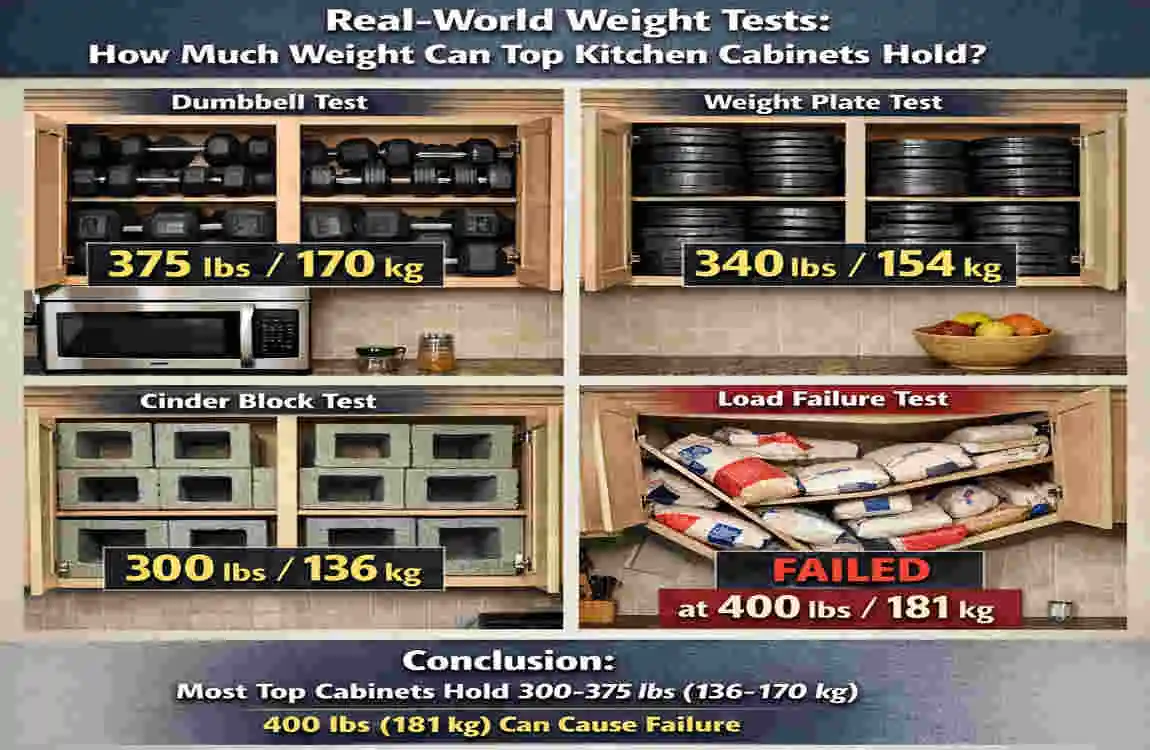
Homeowners often want a simple number, but real-world cabinet strength is more complicated than that. In testing, some cabinets can withstand impressive loads for a short time before failing under normal daily use conditions. That is why test results are helpful, but only if you understand what they actually mean.
Static Weight vs. Dynamic Weight
A cabinet holding still is one thing. A cabinet being used every day is another.
A static load means the weight sits there. A dynamic load includes movement. That movement might come from opening the doors, sliding dishes in and out, bumping shelves, or pulling weight toward the front.
This matters because some cabinets can pass a basic load test while still becoming unsafe in daily life. A shelf may look fine when weight is evenly distributed and untouched, but it starts bowing once someone pulls out stacks of plates again and again.
What Common Tests Suggest
In real-world demonstrations and installer experience, a few patterns show up again and again:
Stud-Mounted Cabinets Perform Much Better
Upper cabinets secured directly into wall studs handle much heavier loads than cabinets attached weakly to drywall. This is one of the clearest and most consistent findings.
A properly installed 24-inch cabinet on studs may hold a very respectable amount of weight. But that same cabinet with poor anchors may fail at a much lower load because the wall connection gives out first.
Plywood Cabinets Usually Outperform Particleboard Cabinets
Plywood cabinet boxes and stronger shelf materials tend to better handle both heavy loads and long-term use. Particleboard may hold okay at first, but often shows shelf sag sooner, especially in humid kitchens.
Premium Cabinets Resist Sagging Longer
Higher-end cabinets may not always look dramatically different at first glance. Still, their thicker panels, stronger joints, and better mounting systems often show up in testing over time.
Realistic Test Takeaways
Here are a few practical examples based on common test patterns and field experience:
- A 24-inch cabinet mounted to studs may safely support a heavy load when weight is centered and supported.
- A similar cabinet using poor drywall attachment may fail much sooner, often by pulling away from the wall.
- Particleboard shelves often begin to sag under repeated moderate loads, even before the cabinet itself detaches.
- Custom or reinforced uppers usually perform better under both shelf load and box stability.
Table: Sample Weight Test Results and Failure Modes
Test Scenario Cabinet Type Approx. Max Held (lbs/ft)Common Failure Mode
Basic budget upper under static load Particleboard cabinet 25–30 Shelf sag or shelf clip failure
Standard cabinet mounted into studs Mid-grade framed upper 40–50 Hinge strain or gradual shelf bow
Better plywood upper with strong install Plywood framed cabinet 50+ Fastener stress under repeated use
Reinforced Premium cabinet setup Custom or upgraded upper 60–75 in some cases Usually holds if load is well managed
Weak install using poor anchors Any cabinet with poor wall support Often far below expected range Cabinet pulls from wall
Why Failure Usually Starts Before Total Collapse
Cabinets rarely go from perfect to total disaster in one second. More often, they give warnings first.
You may notice:
- A shelf starting to dip in the middle
- A slight gap forming between cabinet and wall
- Door alignment changing
- Mounting screws loosening
- Small cracking sounds under load
These are early signs that your cabinet is reaching or exceeding its comfortable limit.
What Standard Testing Really Means for You
Industry-style testing can provide useful insights, but remember this: passing a controlled test does not mean you should load your cabinets to the edge every day.
Your kitchen has humidity, vibration, repeated opening and closing, uneven loading, and time. Time is a huge factor. A cabinet that survives one heavy test may still sag after five years of constant overloading.
So when you ask how much weight top kitchen cabinets can hold, the better question is often: How much weight can they safely hold for years without damage?
That answer is usually lower than the dramatic numbers you may see in isolated tests.
Common Mistakes and Failure Signs
Most cabinet problems do not happen because the cabinet was terrible. They happen because the storage habits were poor.
Overloading One Side or One Corner
This is one of the most common problems. People stack heavy stoneware, mixing bowls, or canned goods on one shelf section and leave the rest lightly used.
That uneven load creates twist and concentrated pressure. The cabinet may not fail all at once, but one side can start loosening long before the rest of the box.
Treating Every Shelf the Same
Not all shelves can carry the same load.
The lower shelf in an upper cabinet may carry more comfortably than a long, thin adjustable shelf. Glass shelves, decorative shelves, and wide unsupported shelves usually need lighter loads.
Ignoring Shelf Spacing
If shelf spacing is too wide, users often stack tall and heavy items in one spot. That shifts more weight toward the center of a long shelf span, where sagging occurs fastest.
For heavier storage, many pros prefer shelf spacing in the 10 to 12-inch range so loads stay more manageable.
Forgetting the Front Edge Problem
A cabinet may seem balanced from left to right, but still be overloaded toward the front.
When heavy items are placed near the front edge, the cabinet experiences greater pull-away force from the wall. That can strain fasteners and mounting rails even if the total weight is technically within range.
Never Checking Older Cabinets
Many homeowners assume cabinets are fine because they have “always been there.” But age changes everything.
Wood can dry out. Particleboard can weaken. Screws can loosen. Moisture from cooking can gradually affect joints. If your cabinets are over ten years old, they deserve an inspection.
Warning Signs Your Top Cabinets Are Struggling
Watch for these red flags:
- Creaking sounds
- Doors that no longer line up
- Visible shelf bowing
- Gaps between cabinet and wall
- Loose screws or brackets
- Cracked interior corners
- Cabinet bottoms that look slightly uneven
If you notice any of these signs, reduce the load right away.
What You Should Do Immediately
If a cabinet shows stress:
- Remove the heaviest items first.
- Check whether the cabinet is firmly attached to studs.
- Inspect shelves for bowing or damage.
- Tighten loose hardware if appropriate.
- Call a professional if the cabinet is pulling away from the wall.
Pro Tips to Maximize Capacity Safely
The good news is that you can often improve both safety and usable capacity without replacing every cabinet in your kitchen.
Follow these pro tips so your top kitchen cabinets hold maximum weight without risk.
Installation Best Practices
Installation is the foundation of cabinet strength. Even a strong cabinet needs a strong connection to the wall.
Use Long Wood Screws Into Studs
The best practice is fastening cabinets with strong screws directly into wall studs. This creates a reliable structural connection and reduces the chance of pull-away failure.
Use a Solid Hanging Rail or Cleat
A continuous support system spreads the load more evenly across the wall. Many pros like a ledger board during install or a French cleat style system for added security.
Brace Longer Cabinet Runs
If your upper cabinets run wider than 36 inches or connect in a long line, side-to-side fastening between cabinets adds useful stability. A connected run often behaves better than a single isolated unit.
Reinforcement Upgrades That Actually Help
If you already have cabinets, reinforcement may be the smarter move.
Add Thicker or Stronger Shelves
Thin shelves are often the first weak point. Replacing them with stronger plywood shelves or reinforced shelves can reduce sagging.
Upgrade Shelf Supports
Small plastic shelf pins can become a problem under heavy loads. Stronger metal supports often perform better.
Add Plywood Gussets or Corner Bracing
These extra supports can help stiffen weak cabinet boxes, especially in older units.
Reinforce the Back Panel
A stronger back panel or extra internal rail can improve how the cabinet transfers load to the wall connection.
Smart Storage Strategies
Even a strong cabinet benefits from smarter loading.
Here is a practical storage checklist you can use:
- Keep heavy plates and dense serving bowls on lower upper shelves or, even better, in base cabinets when possible
- Store glasses, cups, and lightweight containers on the upper shelves
- Avoid stacking all heavy items in one cabinet
- Keep the heaviest items near the sides or rear, not all in the shelf center
- Do not store rarely used but very heavy appliances in wall cabinets
- Rotate storage if one cabinet is doing all the heavy lifting
A Simple Rule of Thumb for Everyday Use
If you do not know the manufacturer’s rating, use this practical rule:
Aim for no more than about 40 pounds per linear foot for everyday long-term storage unless you know your cabinets are better than average and professionally installed.
That number gives you a safer working limit and helps protect against sagging over time.
Best Items for Upper Cabinets
Upper cabinets are best used for:
- Everyday plates
- Bowls
- Glasses
- Mugs
- Light pantry items
- Plastic food containers
- Lightweight bakeware
Items Better Stored Somewhere Else
Some things are better moved to lower cabinets or pantry shelving:
- Cast iron pans
- Stand mixers
- Bulk canned goods
- Heavy stacks of ceramic serving ware
- Large bags of flour or rice
- Small appliances with metal bodies
Why Loading by “Feel” Is Risky
A lot of people say, “It doesn’t feel that heavy.” That approach causes problems because dense items add up fast.
A few examples:
- A stack of dinner plates can get heavy quickly
- Ceramic bowls are heavier than they look
- Glass jars packed together create a concentrated load
- Canned goods are extremely dense for their size
When to Upgrade or Reinforce
Sometimes the best answer is not “store less.” Sometimes the right answer is “improve the cabinet.”
Signs It Is Time for Reinforcement
You should seriously think about reinforcement if:
- Your cabinets are 10 or more years old
- They were installed during a budget remodel
- The cabinets are mounted on a questionable wall
- You regularly store dense dishware
- You see early signs of sagging or movement
- The shelves are thin or already bowed
In many cases, reinforcement is far more affordable than full replacement.
Reinforcement vs. Replacement
Here is the practical difference.
Reinforcement may include:
- Refastening cabinets into studs
- Replacing weak shelves
- Adding cleats or internal bracing
- Upgrading shelf supports
- Correcting alignment issues
That kind of work often costs far less than tearing out and replacing the whole upper cabinet system.
Full replacement makes more sense when:
- Cabinets have water damage
- Joints are separating
- The box material is failing
- The layout no longer works
- You are already planning a remodel
Basic Cost Comparison
In many kitchens, reinforcement may cost roughly a few hundred dollars. In comparison, full cabinet replacement can quickly reach a few thousand dollars or more, especially once labor, finishing, and installation are included.
If your cabinet boxes are decent but the support system is weak, reinforcement is often the better value.
Should You DIY or Call a Pro?
Small storage changes and basic visual inspection are DIY-friendly. But structural reinforcement is different.
Call a professional if:
- A cabinet is pulling away from the wall
- You cannot confirm stud attachment
- The wall surface is damaged
- The cabinet run has shifted
- You want to increase usable load safely
A professional can quickly tell whether the issue is the shelf, the cabinet box, the hardware, or the wall itself.
Pro Tip: If your kitchen sees heavy daily use, reinforcing your upper cabinets before failure is much cheaper than repairing damaged walls, broken dishes, or replacing cabinets later.
FAQs About Top Kitchen Cabinet Weight Capacity
How much weight can top kitchen cabinets hold per shelf?
A typical upper cabinet shelf often safely holds around 15 to 25 pounds, though stronger shelves may hold more. The exact number depends on shelf thickness, width, material, and support.
Do glass-front upper cabinets hold less weight?
Often, yes. Glass-front cabinets are usually better used for lighter storage. In many cases, it is smart to reduce the load compared to a standard solid-door upper cabinet.
Can drywall anchors support top kitchen cabinets?
They should not be your main support for heavy upper cabinets. For safe long-term use, cabinets should be mounted into wall studs whenever possible.
Is plywood better than particleboard for upper cabinets?
Yes. In most cases, plywood offers better screw holding power, better moisture resistance, and better long-term strength, especially for wall-mounted cabinets.
How do I know if my cabinet is overloaded?
Look for shelf bowing, creaking, loose screws, door misalignment, or a gap forming between the cabinet and wall. Those are common warning signs.
Can I store dishes safely in the top cabinets?
Yes, in most kitchens you can safely store dishes in upper cabinets if the cabinets are in good condition, properly installed, and not overloaded.
What is the safest everyday rule for loading upper cabinets?
If you do not know the official rating, a good everyday approach is to stay around 30 to 40 pounds per linear foot, load carefully, and keep the heaviest items lower or in base cabinets.