You’ve just bought a charming property with a bit of character. Maybe it has those unique arched doorways or a quirky attic space that screams “history.” As you stand in the living room planning your paint colours, a question pops into your head: “What year was my house built in?”
It’s a scenario almost every homeowner faces eventually. Whether you are trying to determine if your electrical wiring is safe, planning a historically accurate renovation, or just dying to know if your home has seen a century pass, finding the answer is crucial. It’s not just about curiosity; knowing your home construction year can impact your insurance rates, maintenance schedule, and even your property value.
Why Knowing Your Home’s Age Matters

Before we dive into the “how,” let’s talk about the “why.” Why is it so important to pin down the exact house-building date? It turns out that four-digit number is more than just trivia—it is a roadmap for maintaining your investment.
Energy Efficiency and Upgrades
Homes built in different eras were constructed with vastly different standards. A home built in 1990 will have very different insulation and window quality compared to one built in 1950. Knowing the age helps you prioritise energy-efficiency upgrades that make sense for that specific era of construction.
Safety and Warranties
If your home was built before certain regulatory changes, you need to be aware of potential hazards.
- Lead Paint: Common in homes built before 1978.
- Asbestos: Often found in flooring, insulation, and siding in pre-1980s buildings.
- Electrical: Older homes may have knob-and-tube wiring (pre-1940s) or aluminium wiring (1960s-70s), both of which can pose fire hazards.
Resale Value and Charm
For real estate purposes, the home’s age sets expectations for the buyer. Older homes (50+ years old) often qualify for property tax credits when located in historic districts. Conversely, proving your home is newer than it looks can be a major selling point for buyers worried about maintenance.
Check Your Closing Documents
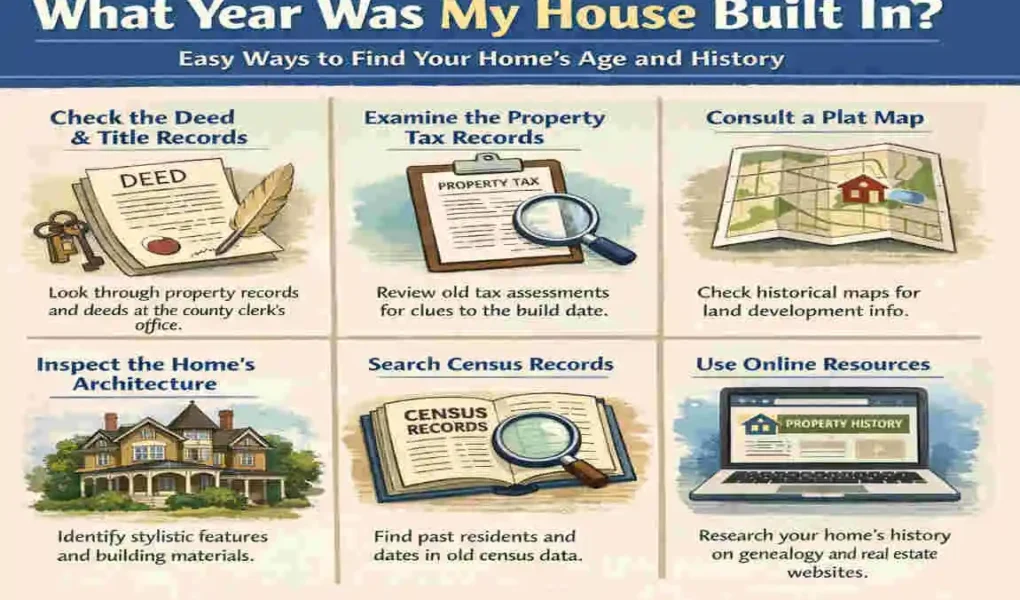
The absolute fastest way to find the answer is likely sitting in your filing cabinet right now. When you bought your home, you were buried under a mountain of paperwork. Somewhere in that stack is the answer.
Review your closing disclosure, deed, or title insurance policy. These legal documents almost always list a legal description of the property, which includes the year the structure was erected. If you financed your home, the appraisal report is another goldmine; appraisers are required to verify the home construction year to estimate value accurately.
Search County Records Online
If you don’t have your papers handy, the internet is your next best friend. Most county governments have digitised their records, making it easier than ever to perform a property history lookup.
You can visit the website of your local Tax Assessor or County Recorder. These sites usually have a “property search” or “parcel search” feature. Type in your address, and you will pull up the tax card or assessment roll. Look for fields labelled “Year Built,” “Effective Year Built,” or “Construction Date.”
While third-party sites are convenient, their accuracy can vary. Here is a quick breakdown of where to look:
Site Data Source Accuracy Level
County Assessor Site Official government tax data Exact (The Gold Standard)
Zillow Public records & user edits High (Usually pulls from county data)
Redfin MLS listings & public records Medium (Good for estimates)
Realtor.com MLS History Medium (Dependent on agent accuracy)
Using a free check home age tool on a real estate site is a great starting point, but always verify it against the official county site if you need to be 100% sure.
Contact the Local Tax Assessor
Sometimes, digital records are incomplete, especially for very old properties or rural homes. If the online search comes up empty, it is time to go old school.
Call or visit your local Tax Assessor’s office in person. They maintain physical ledgers and archives that may not yet be digitised. When you speak to the clerk, provide your address and your Parcel Identification Number (available on your property tax bill).
Ask to see the “field card” or “property card” for your home. Assessors use these cards to value the home and often include a sketch of the house and the original construction date.
Review Building Permits
If you want to play detective, head to your local building department. This is particularly useful if you suspect your home has had major additions and you want to distinguish the original structure from the new parts.
Most municipalities require a permit for new construction. These permits are public records. By requesting a search for your address, you might find the original permit filed by the builder.
Why this is useful:
- It confirms the date construction started, not just when it was sold.
- It lists the architect or builder, providing more context.
- It helps identify if that “vintage” sunroom was actually tacked on in the 1980s.
Search Online Property Databases
Beyond the standard real estate sites, there are specialised databases designed to help you find a house.
- Historical Maps: Websites such as the Library of Congress and local historical societies often host “Sanborn Fire Insurance Maps.” These detailed maps date back to the 19th century and show building footprints. If your house appears on a 1920 map but not on a 1910 map, you have significantly narrowed your window.
- Google Search Tricks: Try searching your address in quotes, followed by the words “year built” or “property record.” Sometimes, old real estate listings from years ago are still cached online and contain data that current listings miss.
Physical Clues in Your Home
If the paperwork is missing or inconclusive (as is common with homes built in the 1800s or earlier), your house itself holds the answers. You need to know where to look.
Attic and Basement Inspection
Grab a flashlight and head to the unfinished areas of your home.
- The Attic: Inspect the insulation and rafters. In older homes, builders often used old newspapers as insulation or backing behind walls. If you find a scrap of newspaper from 1952 stuffed in the rafters, your home was likely built around that time.
- Lumber Stamps: Inspect the exposed beams or joists. Lumber mills often stamp wood with a grade mark or a date.
- Structural Beams: Look for the cut of the wood. Rough-sawn beams with vertical saw marks suggest a late 19th-century build, while circular saw marks usually appear post-1900.
Hardware and Fixtures
Small details can reveal a specific decade.
- Nails: Square-cut iron nails usually indicate a home built before 1900. Wire nails became the standard after 1900.
- Wiring: If you spot “knob-and-tube” wiring (ceramic knobs supporting single wires), the home was likely built between the 1880s and the 1940s.
- Outlets: Unrounded, two-prong outlets are a sign of pre-1960s construction.
The Toilet Tank Trick
Believe it or not, your toilet is one of the most reliable historians in your house. Lift the heavy porcelain lid off the toilet tank and look inside (or on the underside of the lid). Manufacturers almost always stamp a date on the porcelain.
While toilets can be replaced, if your bathroom looks original and the tank says “14 May 1974,” it is a strong clue that your home was built in 1974.
Subfloor and Materials
Peel back a corner of the carpet if you can.
- Plywood: Large sheets of plywood subflooring generally indicate a home built after World War II.
- Planks: If the subfloor is made of diagonal wooden planks (usually 1×6 or 1×8 inches), the home is likely pre-1950s.
Architectural Style Dating

Even without looking at a single nail, the overall design of your house screams its age. Architecture follows trends just like fashion. Identifying your home’s style can help you estimate the era.
- Victorian (1870s–1910): Look for steep roof pitches, intricate trim (gingerbread), asymmetrical shapes, and large front porches.
- Craftsman / Bungalow (1905–1930): Identified by low-pitched gable roofs, deep front porches with thick tapered columns, and exposed roof rafters.
- Tudor Revival (1920s–1940s): Steeply pitched roofs, decorative half-timbering on the exterior, and tall, narrow windows.
- Mid-Century Modern (1945–1970): Characterised by flat planes, large glass windows, open floor plans, and a connection to nature.
- Ranch (1950s–1970s): Single-story, long profile, low roofline, often with an attached garage.
Hire Professionals
If you are hitting dead ends, it might be time to bring in an expert to definitively determine the home’s age.
Home Inspectors: A qualified home inspector does more than check for leaks. They are trained to identify the age of systems (HVAC, roofing, plumbing) and structural materials. They often give you a very accurate age range based on the construction methods used.
Real Estate Appraisers: If you are refinancing, the appraiser will research for you. However, you can also hire a private appraiser or a local historian to research the chain of title. This usually costs between $300 and $500, but for a home with significant history, it provides a comprehensive report that adds to the home’s provenance.
Advanced Research: Historical Societies

For those lucky enough to own a potentially historic home, local institutions are a treasure trove.
Visit your town’s Historical Society or the local history section of your public library. They often possess:
- Old photographs of your street.
- City directories (like old phone books that list residents by address).
- Detailed census records.
Finding a photo of your house from 1920 is not only proof of age; it is a fantastic piece of art to frame for your hallway!
Common Challenges and Fixes
Sometimes, the question “what year was my house built in?” isn’t straightforward.
- The “Renovation Mask”: If a house was gutted and remodelled in 2005, the records might be confusing, or the physical clues (like nails and wiring) might be gone. In this case, rely on the deed search and tax records rather than a physical inspection.
- Rural Property Gaps: In rural areas, record-keeping was often spotty until the mid-20th century. If tax records say “1900” exactly, be sceptical. Many assessors used “1900” as a placeholder for “we don’t know, but it’s old.” In these cases, architectural style and attic inspection are your best bets.
- Fire and Loss: Courthouses burn down, and records get lost. If official records are gone, look for “tract maps” or subdivision maps that show when the land was originally divided for development.
Why This Boosts Your Business
Note for Real Estate Professionals and Investors: Understanding how to find house age isn’t just for homeowners—it’s a vital skill for your business. Accurately dating a property allows you to:
- Market Effectively: Selling “historic charm” gets a higher price tag than selling “old house.”
- Estimate Rehab Costs: Knowing a house is from 1920 tells you immediately to budget for plaster repair and electrical updates.
- Build Trust: Being the expert who can tell a client, “This is a 1925 Craftsman based on the tapered columns,” establishes your authority immediately.
FAQ Section
Q: What year was my house built in if there are no records? A: If official records are missing, your best bet is to hire a professional home inspector or an architectural historian. They can use physical clues—such as the type of nails, saw marks on wood, and foundation materials—to estimate the construction era.
Q: Are there free ways to find house age? A: Yes! The most reliable free method is searching your local county tax assessor’s website. You can also inspect your home for dates stamped on toilets or look for old newspapers in the attic insulation.
Q: Why does Zillow say a different year than my tax bill? A: Real estate sites like Zillow rely on various data sources and sometimes user-submitted edits. Your county tax assessor’s records are generally the legal authority and are more accurate than third-party websites.
Q: How do I find the history of my house for free? A: Visit your local public library or historical society. They often have free access to old maps, city directories, and photo archives that can reveal who lived in your house and when it was built.
Q: What if my house age says “1900” but it looks newer? A: In many county records, “1900” is used as a default placeholder for “old home with unknown date.” If your home looks like a 1950s ranch but records say 1900, trust the architectural cues and try to find the original building permit.