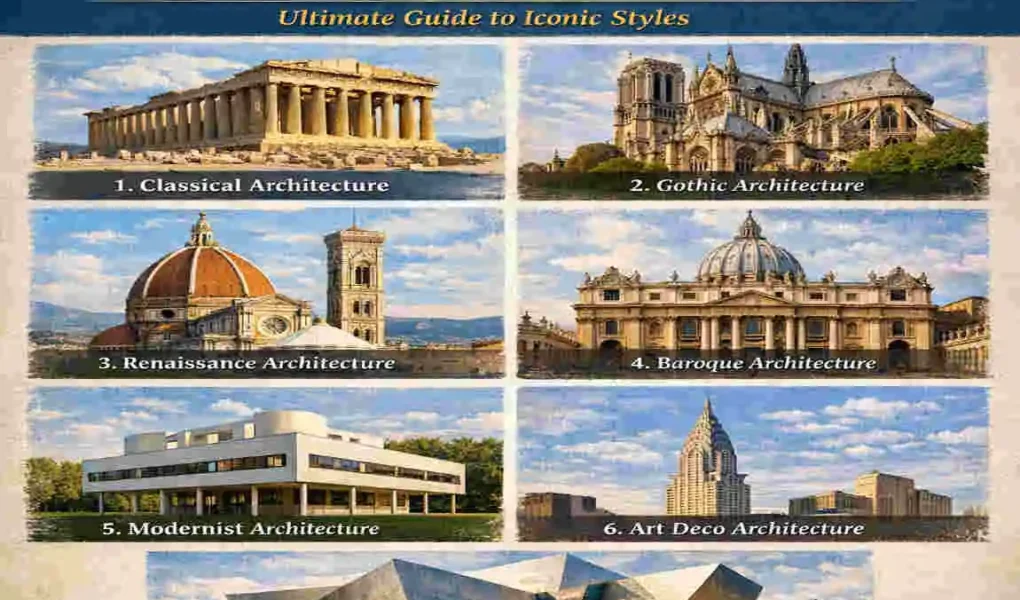
Ever wondered what the 7 different types of architecture are that have shaped our world? Picture yourself walking down a bustling city street. On one corner, you see a towering skyscraper made entirely of sleek glass and steel. Just down the block, a grand bank building sits heavy on the ground, supported by massive stone columns. Have you ever stopped to think about why these buildings look so incredibly different from one another?
But why should you care about the history of architectural styles? It is not just about appreciating old buildings. Understanding these styles gives you a totally new lens through which to view the world. If you are in business, real estate, or design, knowing these types of architectural styles helps you understand how physical spaces influence human behavior, commercial design, and even property value.
Why Understanding Types of Architecture Matters Today
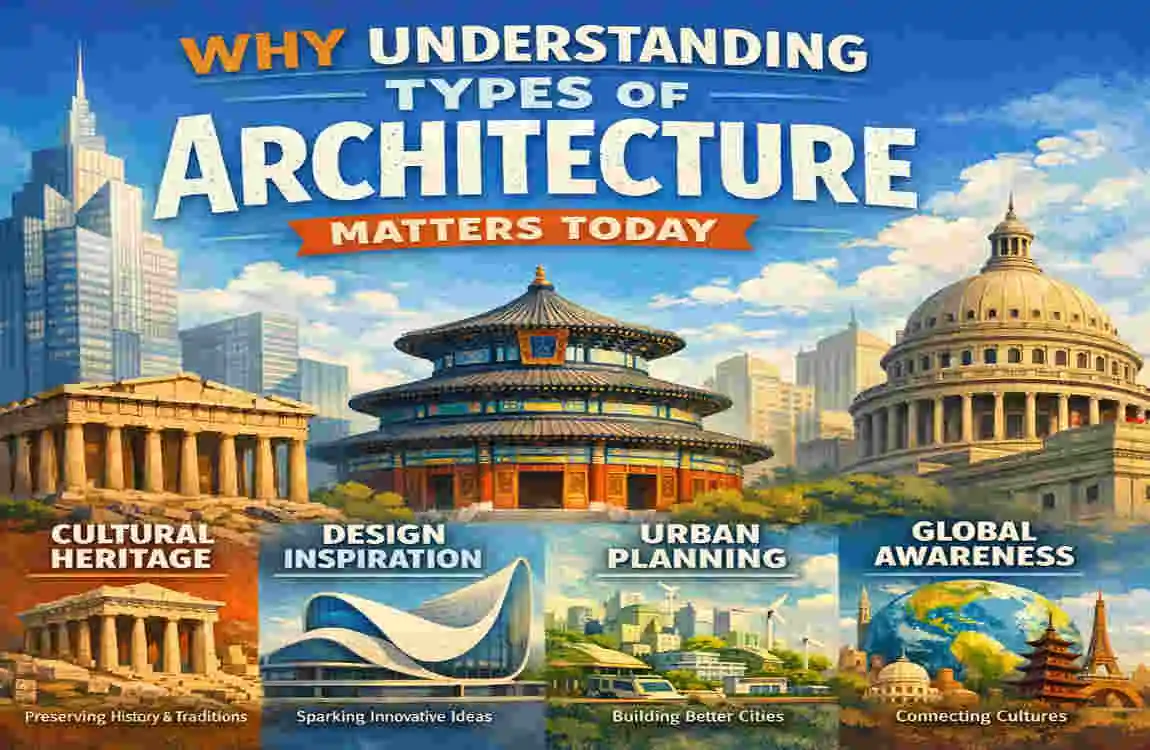
You might be thinking, “This is all fascinating history, but what does it have to do with my life or business right now?” The truth is, architectural styles matter today more than ever. They are not just dusty concepts from the past; they are active, living blueprints that inspire today’s sustainable business buildings, urban planning, and brand identities.
Think about the psychological impact of design. When a major bank wants you to trust them with your life savings, they do not usually build a wacky, asymmetrical office out of neon plastic. Instead, they borrow from older styles, using grand pillars and symmetrical stone facades to silently scream: “We are stable, we are powerful, and your money is safe here.”
There is a massive return on investment (ROI) tied to iconic designs. Luxury hotels often mimic classical or baroque styles to justify Premium pricing, making guests feel like royalty. Meanwhile, tech companies lean heavily on modernist, open-plan spaces to project an image of transparency, innovation, and forward-thinking.
Before we look closely at each specific style, here is a quick teaser list of the 7 types of architecture we will be exploring:
- Classical: Think ancient Greece and Rome, where massive stone columns and perfect symmetry ruled the day.
- Gothic: Picture medieval cathedrals reaching for the heavens with pointed arches and glowing stained glass.
- Renaissance: Imagine the rebirth of art in Italy, featuring beautifully proportioned domes and elegant harmony.
- Baroque: Visualize absolute drama, swirling curves, and opulent, over-the-top decorations meant to show off immense wealth.
- Neoclassical: Think of a return to the elegant, clean lines of the ancient world, often seen in grand government buildings.
- Modernist: Picture the “less is more” mindset, using industrial steel and glass to create functional, boxy skyscrapers.
- Contemporary: Imagine today’s boundary-pushing, eco-friendly buildings that twist and turn into mind-bending shapes.
Classical Architecture: Timeless Pillars of Grandeur
When you ask people to picture a famous historical building, they almost always imagine something with giant pillars. That is the magic of Classical architecture. It is the grandparent of almost all Western building styles, and it continues to command immense respect today.
Origins and History
Classical architecture was born in ancient Greece and Rome. We are talking about a massive span of time, roughly from the 5th century BCE through the 3rd century CE. The Greeks were obsessed with math, proportion, and finding absolute perfection in the physical world. They built temples to honor their gods, like the famous Parthenon in Athens.
Later, the Romans came along and adopted the Greek style, but they added their own massive engineering upgrades. The Romans invented a highly durable form of concrete, which allowed them to build arches, vaults, and massive domes that the Greeks could only dream of.
Key Features
If you want to spot Classical architectural features in the wild, look for these tell-tale signs:
- The Three Types of Columns: The Greeks gave us three distinct column styles, known as “orders.”
- Doric: The simplest and most sturdy, with plain, flat tops.
- Ionic: A bit more slender, featuring tops that look like rolled-up scrolls.
- Corinthian: The fanciest of the bunch, with tops carved to look like sprawling acanthus leaves.
- Strict Symmetry: If you slice a Classical building in half down the middle, both sides will mirror each other perfectly.
- Pediments: This is the triangular roof section you often see resting right on top of the columns at the front of a building.
- Durable Materials: These buildings were built to last forever using heavy marble, stone, and later, Roman concrete.
Iconic Examples
The most legendary classical architecture examples include the Parthenon in Greece, which still stands as a testament to early geometric perfection. In Rome, the Pantheon is an absolute marvel. It features a massive, perfectly round dome with an open hole in the center (the oculus) that lets sunlight stream onto the ancient floor. Even the White House in the United States borrows heavily from these ancient classical roots, using grand columns to project authority.
Modern Influence
Classical architecture never really died; it just took on new forms. We see Neoclassical revivals everywhere today. Take a look at your local courthouses, major banks, or state capitol buildings. They use these ancient Greek and Roman elements to make you feel a sense of civic duty, stability, and trust.
From a business perspective, luxury real estate developers and high-end hoteliers frequently use Classical design elements. Adding a grand, column-lined entryway to a luxury hotel immediately elevates the property’s perceived value, allowing businesses to charge Premium rates for that feeling of historical grandeur.
Gothic Architecture: Soaring Spires and Spiritual Heights
If Classical architecture is about staying grounded and perfectly proportioned, Gothic architecture is about reaching up and touching the sky. This style is highly dramatic, slightly spooky to some, and breathtakingly beautiful to all.
Origins and History
Gothic architecture took hold in Europe during the Middle Ages, roughly spanning the 12th to the 16th centuries. During this era, religion was the absolute center of daily life. The Catholic Church wanted to build spaces that made people feel tiny in the presence of the divine.
Architects wanted to build churches that were taller and brighter than ever before. However, traditional stone building methods required incredibly thick, heavy walls to hold up the roof, which meant you could only have very small windows. The inside of these older churches was dark and gloomy. To fix this, builders invented some brilliant new engineering tricks that gave birth to the Gothic style.
Key Features
Gothic builders acted more like daring engineers. They threw away the thick, solid walls and replaced them with a skeleton of stone. Here is how you can identify a Gothic masterpiece:
- Pointed Arches: Instead of the round arches the Romans used, Gothic arches come to a sharp point at the top. This simple change distributes the heavy weight of the roof much more efficiently down to the ground.
- Ribbed Vaults: Look up at a Gothic ceiling, and you will see an intersecting web of stone ribs. These ribs carry the weight of the roof, acting like an umbrella frame.
- Flying Buttresses: These are the most iconic feature of Gothic design. Because the walls were now mostly glass, architects needed a way to keep the building from falling outward. They built external, stone “kickstands” that push back against the walls from the outside.
- Stained Glass Windows: With the flying buttresses holding the building up, the walls were freed up to be filled with massive, colorful windows that bathed the interiors in glowing, heavenly light.
Iconic Examples
You cannot talk about Gothic architecture without mentioning the Notre-Dame Cathedral in Paris. Even after the tragic fire, its flying buttresses and menacing gargoyles remain legendary. Another breathtaking example is the Chartres Cathedral in France, which features some of the best-preserved medieval stained glass in the entire world.
Modern Influence
Today, we see the echoes of this style in “Neo-Gothic” designs. Many prestigious universities, like Oxford or Yale, intentionally use Gothic elements to make their campuses feel old, wise, and deeply academic.
There is a brilliant business angle here, too. Event spaces, luxury wedding venues, and even certain theme parks utilize Neo-Gothic aesthetics. The soaring heights and dramatic lighting create a built-in sense of awe, making these venues highly desirable for people looking to host unforgettable, brand-defining events.
Renaissance Architecture: Revival of Harmony and Proportion
After centuries of reaching for the heavens with jagged Gothic spires, Europe took a deep breath and decided to look back at the past. Renaissance architecture is the ultimate comeback story for the ancient world.
Origins and History
The Renaissance, which literally means “rebirth,” kicked off in Italy during the 14th century and lasted into the 17th century. Society was shifting away from the strict, religious focus of the Middle Ages and embracing “humanism.” People started believing that human beings, logic, and scientific observation were pretty amazing things.
Architects like Filippo Brunelleschi began traveling to Rome, digging through ruins, and sketching the old Classical buildings. They wanted to bring back the logical, pleasing proportions of the ancient world but adapt them to fit the modern cities of their time.
Key Features
Renaissance architecture is basically Classical architecture’s refined, mathematical cousin. It is calm, highly organized, and deeply soothing to look at. Let’s compare the Renaissance features directly with their Classical ancestors:
Feature Classical Architecture Renaissance Architecture
Columns Structural, used to hold up heavy stone roofs. Often decorative, attached directly to walls (pilasters).
Domes Massive, heavy, and concrete (like the Pantheon). Graceful, ribbed, and elevated on high “drums” to be seen from afar.
Symmetry : Strict mirroring of building sides, plus a deep focus on mathematical room ratios.
Decorations : Carved marble gods and historical battle scenes. Beautifully painted indoor frescoes, smooth stone facades.
In addition to domes and perfect symmetry, Renaissance buildings feature “ashlar masonry,” which is stone cut into perfectly smooth, square blocks.
Iconic Examples
The most famous turning point in this era was when Brunelleschi designed the massive dome for the Florence Cathedral. He figured out how to build a giant brick dome without using traditional wooden scaffolding, changing architecture forever. Later on, builders completed St. Peter’s Basilica in the Vatican, which features a breathtaking dome designed by the legendary artist Michelangelo.
Modern Influence
The Renaissance’s focus on perfect proportions makes spaces feel inherently comfortable and harmonious. Today, high-end residential architects use these principles to design luxury villas and sprawling estates.
Corporate headquarters also borrow from this playbook. When a business builds a headquarters with a grand, central dome and perfectly balanced wings, they are telling the public that its company is rational, balanced, and deeply established. This architectural choice often ties directly into Premium real estate pricing, as buyers naturally gravitate toward buildings that feel proportionally “right.”
Baroque Architecture: Opulent Drama and Movement
If Renaissance architecture is a calm, classical symphony, Baroque architecture is a loud, extravagant rock concert. It is dramatic, highly emotional, and completely over the top.
Origins and History
The Baroque style exploded across Europe in the 17th century. At this time, the Catholic Church was facing a massive challenge from the Protestant Reformation. Millions of people were leaving the Catholic faith. To win them back, the Church decided to use art and architecture as a giant advertising campaign.
They wanted to build churches that were so mind-blowingly opulent and dramatic that anyone who walked inside would instantly feel the immense power and glory of God (and the Church). Soon, kings and queens caught on to this trend and started using the Baroque style to build palaces that showed off their absolute wealth and political dominance.
Key Features
Baroque design breaks all the calm, mathematical rules of the Renaissance. It is best described as “architectural theater.” When you look at a Baroque building, look for these wild characteristics:
- Curved, Wavy Walls: Instead of flat, straight walls, Baroque architects designed facades that wave in and out. This creates a sense of movement, making the building look like it is breathing.
- Explosive Ornaments: Every square inch is covered in gold leaf, swirling plaster, twisting columns, and dramatic statues.
- Illusionistic Ceilings: Painters created ceiling murals that used advanced perspective tricks. When you look up, it looks like the roof has opened up directly into a swirling, chaotic heaven.
- Dramatic Lighting: Architects intentionally designed hidden windows to shine a spotlight on specific altars or statues, creating intense shadows and highlights.
Iconic Examples
The ultimate example of Baroque power is the Palace of Versailles in France. King Louis XIV built this sprawling, gold-drenched mega-palace to prove he was the absolute center of the universe. In Rome, St. Peter’s Square features a massive, curved colonnade designed by Gian Lorenzo Bernini, which reaches out like giant stone arms to welcome visitors into the dramatic church.
Modern Influence
You might not see everyday office buildings constructed in the Baroque style, but its influence is huge in the hospitality and retail sectors. Think about ultra-high-end fashion boutiques or theatrical resort casinos in places like Las Vegas or Macau.
These businesses use Baroque elements—like grand, sweeping staircases, gold accents, and intense, theatrical lighting—to disorient you in the best way possible. They create a fantasy world that makes consumers feel wealthy, encouraging them to spend money and enjoy a luxurious escape from reality.
Neoclassical Architecture: Enlightenment Elegance
Eventually, society gets tired of a wild party. After decades of the chaotic, gold-covered extravagance of the Baroque period, people wanted to calm things down again. Enter Neoclassical architecture, a style that brought back sanity, order, and quiet dignity.
Origins and History
The Neoclassical movement dominated the 18th and 19th centuries. This period perfectly aligned with the “Age of Enlightenment.” Philosophers and scientists were promoting reason, logic, and democracy. Simultaneously, archaeologists were making incredible discoveries, digging up the buried ancient Roman cities of Pompeii and Herculaneum.
Suddenly, everyone was obsessed with the ancient world all over again. They looked at the clean, pure lines of those ancient ruins and decided that this was the perfect architectural style to represent modern democracy, reason, and moral virtue.
Key Features
Neoclassical design is all about stripping away the messy fluff. It takes the original Classical style but scales it up to fit modern needs.
- Clean, Straight Lines: Say goodbye to the wavy, curved walls of the Baroque era. Neoclassical buildings are sharply rectangular and perfectly straight.
- Grandeur Without Excess: These buildings are massive and imposing, but they do not rely on gold paint or chaotic statues to impress you. They rely on their sheer size and perfect proportions.
- Prominent Porticos: A portico is basically a giant front porch featuring a row of massive columns holding up a triangular roof. Neoclassical buildings almost always have a dramatic portico at the entrance.
- Flat, Unadorned Roofs: Instead of giant, decorative domes taking over the skyline, Neoclassical roofs are often flat or subtly domed, keeping the focus on the grand facade below.
Iconic Examples
Look no further than Washington, D.C. to see the ultimate Neoclassical playground. The U.S. Capitol Building is a masterpiece of this style, intentionally designed to link the new American democracy to the ancient democracy of Greece. Across the pond, the British Museum in London features a breathtaking Neoclassical facade that makes it look like a towering ancient temple dedicated to global knowledge.
Modern Influence
If you want to project an image of absolute authority, you build in the Neoclassical style. Modern government buildings, courthouses, and libraries still lean on this design to command respect.
In the finance sector, traditional banks use Neoclassical branding heavily. Even if a modern bank does not build a brand-new stone temple, they often use imagery of Neoclassical pillars in their logos and marketing to quietly tell consumers, “We follow the rules, we are rational, and we are an institution you can trust.”
Modernist Architecture: Form Follows Function
When the 20th century rolled around, the world changed faster than ever before. We had airplanes, mass production, and sweeping social changes. Architects looked at old buildings with their stone columns and decorative carvings and thought, “This is fake. We do not live in the ancient world anymore.” This realization birthed Modernist architecture.
Origins and History
Modernism grew directly out of the Industrial Revolution. Factories were churning out new, incredibly strong building materials like mass-produced steel, large sheets of plate glass, and reinforced concrete.
Pioneering groups, like the Bauhaus school in Germany, and visionary architects, like Le Corbusier, decided it was time to strip buildings down to their absolute bare bones. They coined the famous phrase, “Form follows function.” This meant that the shape of a building should be based entirely on what the building is used for, not on trying to make it look pretty with fake historical decorations.
Key Features
Modernist buildings are brutally honest. They do not hide how they are built; they celebrate it. When you encounter a Modernist building, you will notice:
- Absolute Minimalism: You will not find a single unnecessary carved leaf, gargoyle, or decorative column here. The philosophy is strictly “less is more.”
- Industrial Materials: Buildings are proudly made of visible steel frames, raw poured concrete, and massive expanses of glass.
- Open Floor Plans: Because strong steel columns hold the building up, you no longer need thick walls inside to hold up the ceiling. This allows for massive, continuous open spaces indoors.
- Ribbon Windows: Architects designed long, continuous horizontal bands of windows that wrap completely around the building, letting in maximum natural light.
Iconic Examples
The Bauhaus Building in Dessau, Germany, perfectly captures this era with its asymmetrical, boxy design and walls made entirely of glass. In New York city, the Seagram Building stands as the ultimate Modernist skyscraper. It is a sleek, dark rectangle of glass and bronze that completely redefined what a corporate office building should look like.
Modern Influence
Modernism essentially created the modern city skyline. Every time you see a sleek glass skyscraper, you are looking at the legacy of this style.
Today, major tech companies and innovative startups heavily favor Modernist designs for their tech offices. When a company like Google or Apple designs an open-plan, glass-walled headquarters, they are using architecture to foster collaboration. The lack of internal walls breaks down traditional corporate hierarchies, and the massive windows project an image of a transparent, forward-thinking business.
Contemporary and Postmodern Architecture: Bold Innovation
As the 20th century came to a close, architects grew a little bored with the strict, serious boxes of Modernism. They wanted to have fun again. They wanted to bend the rules, express individuality, and solve modern environmental challenges. This desire gave rise to both Postmodernism and the Contemporary architecture we see today.
Origins and History
Postmodernism started in the late 20th century as a direct rebellion against the cold, joyless glass boxes of the Modernist era. Architects started playfully bringing back old elements—like weirdly shaped columns or bright colors—just to break the rules.
As we moved into the 21st century, Contemporary architecture took over. “Contemporary” isn’t one strict historical style; it simply means the cutting-edge architecture being built right now. Thanks to wildly advanced computer software, architects can now design and build shapes that were physically impossible just thirty years ago.
Key Features
Contemporary architecture is all about bold innovation, high technology, and saving the planet. Here are the major trends defining the buildings of today:
- Mind-Bending Curves: Forget rigid rectangles. Using parametric design software, architects create buildings that twist like ribbons, bulge, and swoop in impossible geometric shapes.
- Eclecticism: Contemporary design has no strict rules. Builders happily mix sleek glass with warm, natural timber and raw stone all in the same structure.
- Tech Integration: These are “smart” buildings. The architecture integrates deeply with technology, using automated systems to control airflow, lighting, and temperature based on how many people are in a room.
- Sustainability and Green Design: This is the biggest feature of our era. Contemporary buildings feature living green walls, massive solar panels, rainwater harvesting systems, and materials that have a low carbon footprint.
Iconic Examples
The Guggenheim Museum Bilbao, designed by Frank Gehry, is a titanium-clad masterpiece that looks like a futuristic ship rolling on waves. It is completely asymmetrical and visually stunning. In Dubai, the towering Burj Khalifa represents the absolute pinnacle of contemporary engineering, piercing the sky at unprecedented, gravity-defying heights.
Modern Influence
Contemporary architecture is actively redefining modern business real estate. Companies are moving away from traditional office parks and demanding “green offices” and smart buildings.
By investing in eco-friendly Contemporary architecture, businesses are future-proofing themselves. Not only do these highly efficient buildings save massive amounts of money on energy costs over time, but they also serve as a powerful branding tool. A business headquartered in a cutting-edge, sustainable building clearly communicates to the world that they care about the environment and is leading the charge into the future.
Comparing the 7 Types: Which Fits Your Vision?
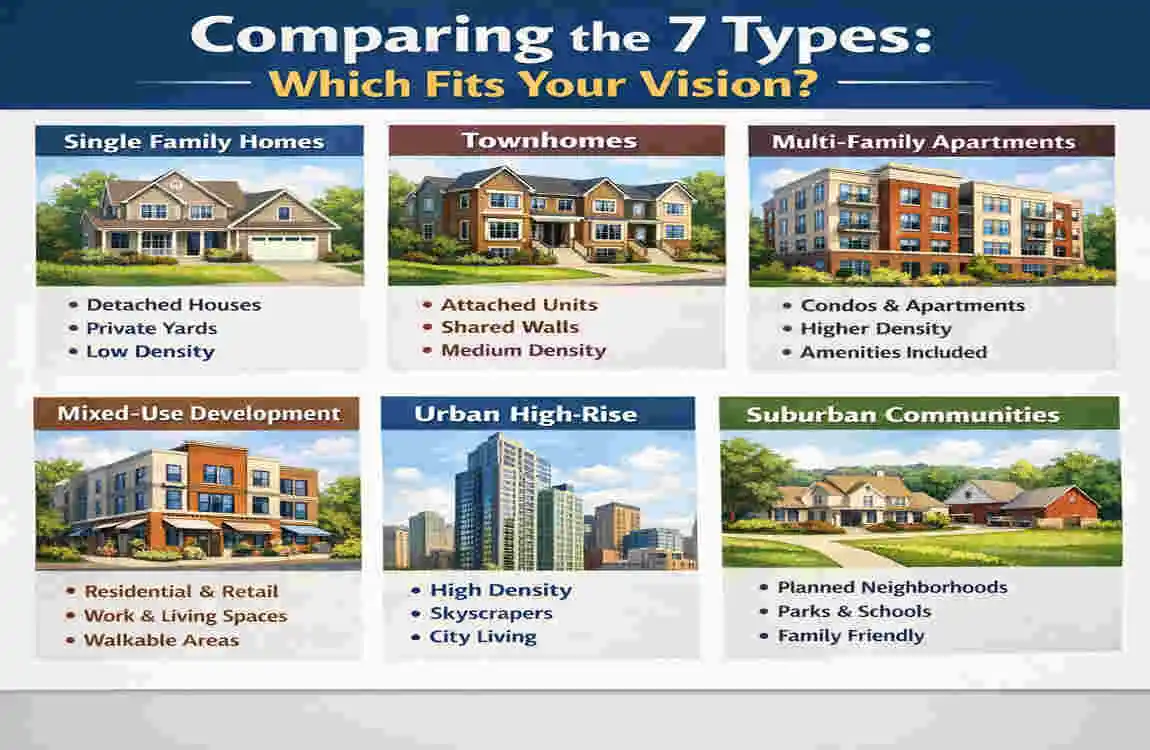
Now that we have explored the seven fundamental types of architectural styles, it can be incredibly helpful to view them side-by-side.
Whether you are studying for a design class, trying to figure out the history of your own city, or planning to construct a new commercial space, seeing these styles compared makes it easy to spot the differences.
Here is a quick cheat sheet to help you compare the defining elements of each architectural era:
Architectural Style Time Era Key Defining Feature Most Iconic Example Best Modern Business Use
Classical 5th C BCE – 3rd C CE Massive stone columns, perfect symmetry. The Pantheon (Rome) Luxury hotels want to project timeless prestige.
Gothic 12th – 16th Century Pointed arches, flying buttresses, stained glass. Notre-Dame (Paris) , breathtaking event venues or academic institutions.
Renaissance 14th – 17th Century : elegant domes, human-scale proportion, harmony. Florence Cathedral High-end residential villas and corporate HQs.
Baroque 17th Century Swirling curves, gold, absolute theatrical drama. Palace of Versailles Luxury retail spaces and grand resort casinos.
Neoclassical 18th – 19th Century Clean lines, grand columned porticos, serious tone. U.S. Capitol Building Financial institutions are projecting ultimate stability.
Modernist 20th Century Minimalist glass and steel boxes, open floor plans. Seagram Building Collaborative tech offices focusing on transparency.
Contemporary 21st Century (Today) Eco-friendly tech, computer-generated curved shapes. Guggenheim Bilbao : Forward-thinking brands want green, smart offices.
Imagine these styles on a timeline. We start with the heavy stone logic of the Classical era, reach up to God with Gothic spires, calm down with Renaissance math, go crazy with Baroque gold, return to reason with Neoclassical pillars, strip it all away with Modernist glass, and finally bend reality with Contemporary computers.
Which architecture type matches the project you have in mind?
How to Choose the Right Architectural Style for Your Business
If you are a business owner, real estate developer, or simply someone dreaming of building your own custom space, how do you actually choose the right style? You have to balance aesthetics with hard, practical reality.
Here are the top factors you must consider:
- Your Audience and Brand Identity: What feelings do you want to evoke? If you run a wealth management firm, you want clients to feel secure. Borrowing heavily from Neoclassical or Classical designs (like stone facades and symmetrical pillars) builds instant, subconscious trust. If you run a disruptive AI startup, a glass-heavy Modernist or twisting Contemporary building shows you are innovating.
- Location and Context: You cannot ignore your neighbors. A hyper-modern, twisted metal building might look amazing in a downtown tech hub, but it will look bizarre and offensive if placed in the middle of a historic, 19th-century brick neighborhood.
- Budget and Maintenance: Real stone columns and intricate Baroque-style plasterwork require specialized artisans, which costs a fortune. Modernist glass and steel are generally more straightforward to erect but can be expensive to heat and cool if not designed properly.
Hybrid Tips: Do not be afraid to blend styles! Many of the most successful retail spaces today take old, historic buildings (like an old Gothic church or a sturdy Neoclassical bank) and insert hyper-modern glass and steel structures inside them. This contrast creates a totally unique, unforgettable brand experience that honors the past while embracing the future.
Frequently Asked Questions
What are the 7 different types of architecture? The 7 fundamental types of architectural styles that have heavily influenced Western history are Classical, Gothic, Renaissance, Baroque, Neoclassical, Modernist, and Contemporary architecture.
Which architecture style is the oldest? Out of the major styles covered in this guide, Classical architecture is the oldest. It originated in ancient Greece and Rome, dating back to roughly the 5th century BCE.
How do modern types differ from classical types of architecture? Classical architecture relies heavily on thick, weight-bearing walls, solid stone, arches, and decorative columns to achieve visual perfection. Modern architecture completely ditches these heavy materials, using lightweight industrial steel and massive sheets of glass to prioritize functional, open spaces over historical decoration.
What is the defining feature of Gothic architecture? The most famous defining feature of Gothic architecture is the flying buttress. These external stone supports allowed builders to construct incredibly tall, thin walls filled with massive, heavy stained glass windows without the building collapsing.
Why is contemporary architecture focused on sustainability? Modern builders face massive global challenges regarding climate change and energy consumption. Therefore, contemporary architecture uses cutting-edge technology and materials to create green buildings that drastically reduce carbon footprints, utilizing solar power, smart ventilation, and sustainable materials.