
Are you currently navigating the complex world of social housing and finding yourself asking, “How much is rent for a 2-bedroom council house?” amid the rising cost of living in the UK? You are certainly not alone. With private rental prices skyrocketing across the country, securing a council tenancy has become a vital lifeline for millions of families. However, understanding the costs involved, the regional variations, and what to expect in 2026 can be confusing.
What Is Council Housing? Understanding the Basics

Before we dive into the specific pounds and pence, it is crucial to understand exactly what we mean by council housing. In the UK, council houses are a form of public housing (social housing) built and managed by local authorities. The primary goal of this system is to provide affordable, secure accommodation for people on low incomes or those in desperate need of housing support.
Historically, there was a massive boom in council house building following World War II, aimed at replacing slums and war-damaged properties. While the stock of these houses has declined significantly since the introduction of the “Right to Buy” scheme in the 1980s—which allowed tenants to purchase their homes at a discount—there are still approximately 2 million council-owned properties across the UK today.
Why Choose a 2-Bedroom Council Property?
For many applicants, a 2-bedroom property is the “goldilocks” standard. It is perfectly sized for couples, small families with one or two children, or single parents. Unlike private rentals, where space comes at a massive premium, council properties built in previous decades often adhere to “Parker Morris standards,” meaning they can be more spacious than modern new-builds.
A typical 2-bedroom council home usually ranges from 50 to 70 square meters. When you rent one of these properties, you aren’t just paying for a roof over your head; you are paying for a package that often includes:
- Secure Tenancies: Unlike the 6 or 12-month contracts in the private sector, council tenancies are often secure for life (secure tenancies) or fixed for long periods (flexible tenancies).
- Included Repairs: The council, as your landlord, is responsible for the structure and exterior of the building.
- Regulated Rents: Rents are set by a government formula, known as “Social Rent,” which keeps them significantly below market rates.
Typical 2-Bed Layouts
When you are bidding for a 2-bedroom council house, you will typically encounter a few standard layouts. Understanding these can help you decide which property type justifies the rent:
- The Terraced House: Usually includes a separate living room, a kitchen with access to a rear garden, and two bedrooms upstairs. These command the highest rent (avg £114/week).
- The Maisonette: Split over two floors but often part of a larger block. These usually have their own front door opening to the outside or a communal deck.
- The High-Rise Flat: All on one level. These are often the most affordable option (avg £106/week) and may include lift access and communal heating systems.
National Average Rent Costs: The Numbers
So, let’s get to the core question: how much is the rent for a 2-bedroom council house?
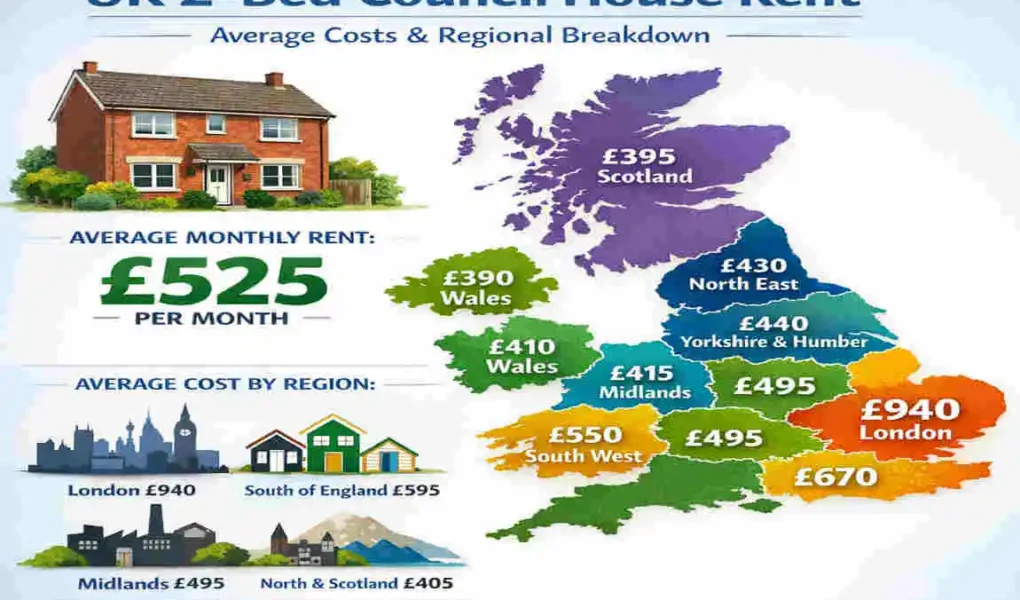
Based on data from the 2025-2026 financial year, the national average for a 2-bedroom council property generally falls between £90 and £115 per week. This translates to a monthly cost of roughly £390-£500. However, this is a broad average, and the specific type of property you choose plays a massive role in the final bill.
Local authorities, such as Renfrewshire Council and others across the UK, break down their rent charges by property type. Here is a clear look at how the averages stack up for the current financial year:
Rent by Property Type (2025/26 Estimates)
Property Type Weekly Rent (Avg)Monthly Cost (Avg)Annual Cost
2-Bed House £114.35 £495.51 £5,946
2-Bed Flat £106.87 £463.10 £5,558
2-Bed Maisonette £110.07 £476.97 £5,724
Weekly vs. Monthly Breakdown
It is important to note that most councils charge rent weekly. However, many of us budget monthly. To calculate your exact monthly rent from a weekly figure, you should not just multiply by 4 (as there are more than 4 weeks in a month). The correct calculation is:
Weekly Rent x 52 (weeks) divided by 12 (months)
For example, if your 2-bed house is £114.35 per week:
- £114.35 x 52 = £5,946.20 (Annual)
- £5,946.20 / 12 = £495.51 per month
This calculation is vital when comparing your potential council rent against your monthly salary or Universal Credit payments.
Additional Costs to Consider
The “base rent” listed above is for the accommodation itself. However, when budgeting for a 2-bedroom council house, you must also watch out for Service Charges.
- Flats: You will likely pay extra for the cleaning of communal hallways, lift maintenance, and concierge services. This can add £5-£20 per week to your bill.
- Houses: Usually have fewer service charges, but you are responsible for your own garden maintenance.
- Heating: Some council blocks have “communal heating” where the cost of heat is added to your rent. While convenient, this is a fixed cost you cannot easily reduce by turning off a radiator.
Regional Rent Breakdown: Location, Location, Location
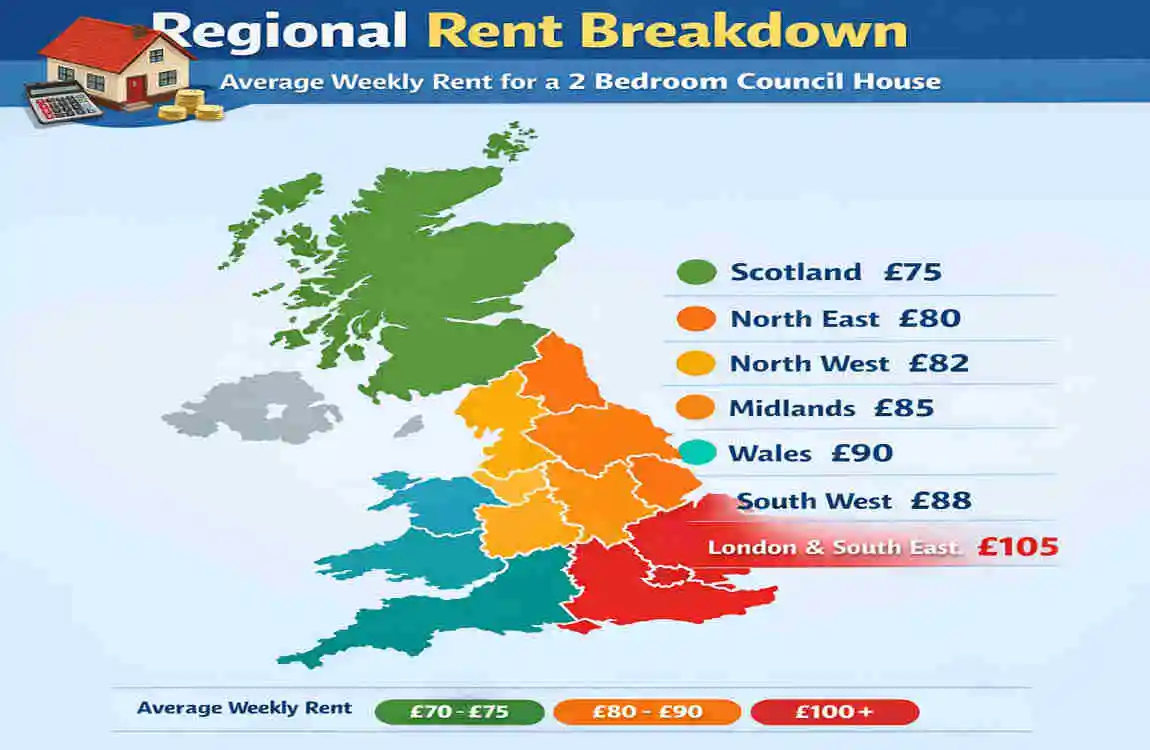
Just like in the private sector, geography is the single biggest factor influencing the rent for a 2-bedroom council house. A 2-bed flat in Central London is going to cost significantly more than an identical flat in rural Wales.
The government’s formula for setting “Social Rent” takes into account local property values and local earnings. This creates a distinct North-South divide in pricing.
The Regional Split Table
Region2-Bed Weekly Average% Difference from National Avg
London (Inner) £130 – £150 +25% to +40%
South East £110 – £125 +10% to +15%
Midlands £95 – £105 Average
North England £85 – £95 -10% to -15%
Scotland £80 – £95 -15% to -20%
Wales £85 – £95 -15%
London vs. The North
In London, demand is incredibly high, and property values are astronomical. Consequently, rents here are the highest. A 2-bedroom council flat in a borough like Southwark or Lambeth can easily cost £130+ per week. While this is still a fraction of the £2,000+ monthly cost for a private flat in the same area, it represents a significant chunk of income for those on minimum wage.
In contrast, looking at Northern England or Scotland, the picture is different. In areas like Midlothian or Renfrewshire, a 2-bedroom property might cost between £80 and £95 per week. Here, the gap between council and private rents is smaller, but affordability for tenants is generally better relative to local wages.
Scottish Variations
Scotland often operates slightly differently. Many councils there have worked hard to keep rent increases lower than inflation. For instance, while a 2-bed house in Renfrewshire averages £114, older tenement flats in Glasgow can be found for under £90. The Scottish Housing Regulator closely monitors these rates to ensure they remain affordable.
Affordability Metrics
A good rule of thumb used by housing advisors is the 30% Rule. Ideally, your housing costs (rent + service charge) should not exceed 30% of your net household income.
- If you earn £1,600 a month (net), 30% is £480.
- A national average council rent of £476/month fits perfectly into this budget.
- However, in London, paying £600+ might stretch this budget, requiring reliance on Housing Benefit or Universal Credit top-ups.
Recent Rent Increases & 2026 Forecasts
You might be wondering, “Will these prices stay the same?” Unfortunately, the answer is no. Council rents are subject to annual reviews, and recent years have seen consistent hikes.
The 2025-26 Landscape
For the 2025-26 financial year, we have seen varied approaches across the UK.
- Norwich City Council implemented a relatively modest 2.7% increase. For a tenant paying £100, this added just £2.70 a week.
- South Kesteven saw an increase of around 4.8%.
- South London Boroughs, facing massive budget deficits, have proposed increases of up to 7%. On a £115 rent, a 7% rise adds roughly £8 per week—over £400 a year.
What is Driving the Increases?
Why are councils putting rents up? It isn’t for profit. Local authorities have “Housing Revenue Accounts” (HRA) that must balance their own books. They cannot use money from parking fines or council tax to subsidize housing. The main drivers for the 2026 increases include:
- Inflation: The cost of bricks, cement, and labor for repairs has skyrocketed.
- EPC Upgrades: Councils are under legal pressure to upgrade homes to Energy Performance Certificate (EPC) Band C. This involves expensive retrofitting of insulation and heat pumps.
- Maintenance Backlogs: Many councils are dealing with damp and mold issues that require urgent, costly intervention.
The Government Rent Cap
To protect tenants, the central government usually sets a “Rent Cap” or a limit on how much social rents can rise. This is typically set at CPI (Consumer Price Index) + 1%. If inflation is 2%, rents can rise by 3%. However, in years of high inflation, the government may step in to cap this at a lower, hard figure (e.g., 7%) to prevent rents rising by 11% or 12%.
How This Affects Your Wallet
If you are already in a council property, you will receive a letter (usually in February) detailing your new rent for April.
- Scenario: You live in a 2-bed house paying £110/week.
- 2026 Forecast Increase: Let’s assume a 5% rise.
- New Rent: £115.50/week.
- Impact: You need to find an extra £22 per month. If you are on Universal Credit, you must update your journal immediately when the rent changes, or you will miss out on the extra support to cover this increase.
Factors Influencing 2-Bed Rents: It’s Not Just About Bedrooms
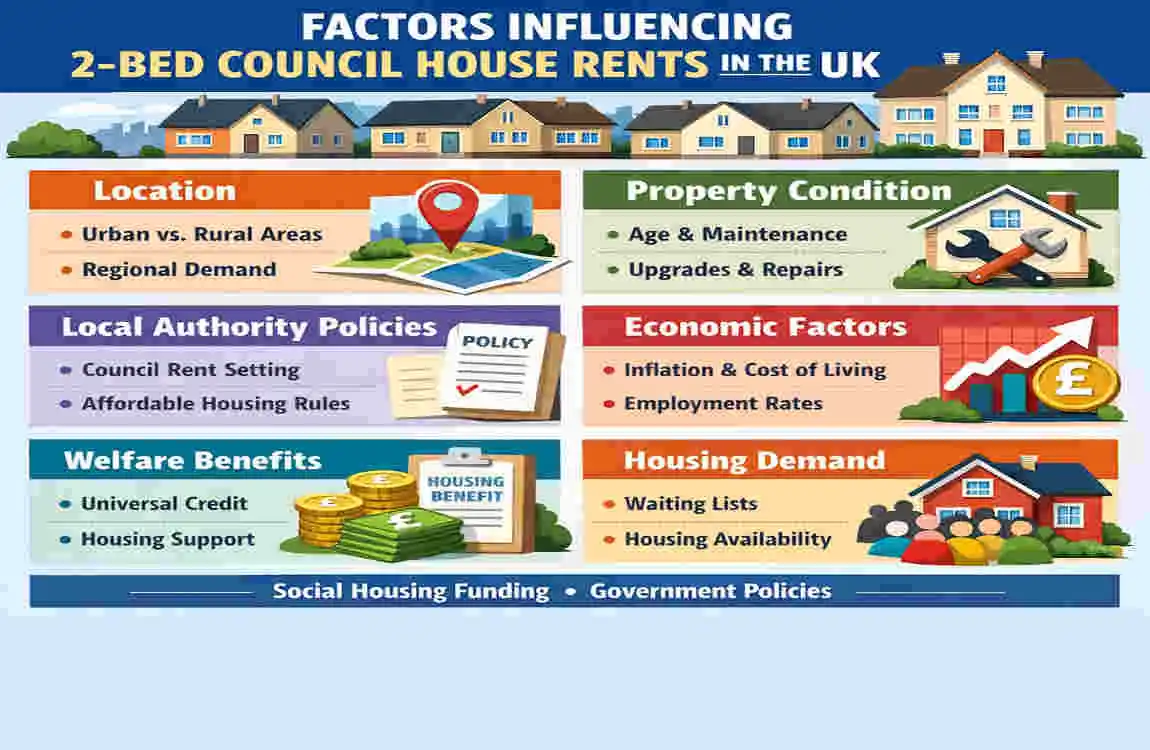
We have established the average is around £90-£115, but why might your neighbor pay £95 while you pay £105 for a similar-sounding 2-bed? Several nuanced factors come into play.
Property Age and Valuation
Council rents are partly based on the property’s value in 1999 (the reference year for the formula).
- Pre-1980s Builds: Older properties often have lower “formula rents” because their capital value is lower.
- New Builds: If you are lucky enough to get a brand new council house (yes, they are being built again!), the rent will likely be set at “Affordable Rent” levels. Affordable Rent is a specific technical term meaning up to 80% of the market rate.
- Social Rent 2-Bed: £100/week.
- Affordable Rent 2-Bed: £140/week (closer to private prices).
The “Garden Tax” and Amenities
Does the property have a private garden? A driveway? A garage? Each of these amenities adds points to the valuation, slightly increasing the weekly rent. A 2-bed flat on the 4th floor with no outdoor space will always be cheaper than a 2-bed semi-detached house with a garden in the same postcode.
Service Charges & Heating
As mentioned earlier, service charges can skew the comparison.
- High Rise Living: You might pay £90 base rent + £20 service charge (lifts, concierge, cleaning) = £110 total.
- House Living: You might pay £110 base rent + £0 service charge = £110 total. While the total remains the same, the rent portion differs. This matters because Housing Benefit covers rent and some service charges, but not things like personal heating or water usage.
Under-Occupancy (The Bedroom Tax)
This isn’t a rent cost, but a benefit deduction. If you live in a 2-bedroom council house but are a single person (or a couple) deemed to need only one bedroom, your Housing Benefit will be cut by 14%.
- Rent: £100.
- Benefit reduction: £14.
- You pay: £14 per week out of your own pocket. When asking “how much is rent,” you must also ask “how much of it will be covered?”
Eligibility & How to Apply for a 2-Bedroom Council House
Knowing the price is one thing; getting the keys is another. Council housing is in critically short supply. Who actually gets these affordable 2-bedroom homes?
Who Qualifies?
Generally, you must meet three main criteria:
- Local Connection: You usually need to have lived or worked in the council area for 2–5 years.
- Income Cap: Most councils have an income limit. If your household earns over a certain threshold (e.g., £40,000 – £60,000 depending on region), you may be ineligible.
- Housing Need: This is the big one. You are prioritized based on need, not just income.
The Priority Bands
Councils use a “Banding” system (usually A, B, C, D).
- Band A (Urgent): Homeless, fleeing domestic violence, or serious medical need.
- Band B (High): Overcrowded (e.g., sharing a 1-bed with 3 kids), or needing to move for hardship.
- Band C (Medium): Moderate overcrowding or shared facilities.
- Band D (Low): No immediate housing need (very unlikely to get a property).
For a 2-Bedroom specifically: You generally need to prove that your household composition requires two rooms. This typically means:
- A couple with one child.
- A single parent with one child.
- Two children of opposite sexes, where one is over age 10.
- A couple where one has a medical need for a separate room.
- Note: A single person will rarely be eligible for a 2-bed unless they have overnight access to children or a medical carer.
The Application Process: Step-by-Step
- Register: Go to your local council’s website (e.g., gov.uk/apply-for-council-housing) and fill out the form.
- Provide Evidence: Upload ID, proof of income, proof of children (Child Benefit letters), and address history.
- Wait for Assessment: This can take weeks. You will be assigned a Band.
- Bid: Most councils use “Choice Based Lettings.” You log in weekly, see available houses, and “bid” (express interest).
- Offer: If you are top of the list for that house, you get an offer. Refusing a reasonable offer can sometimes result in your removal from the list, so bid carefully!
Budgeting Tips & Alternatives
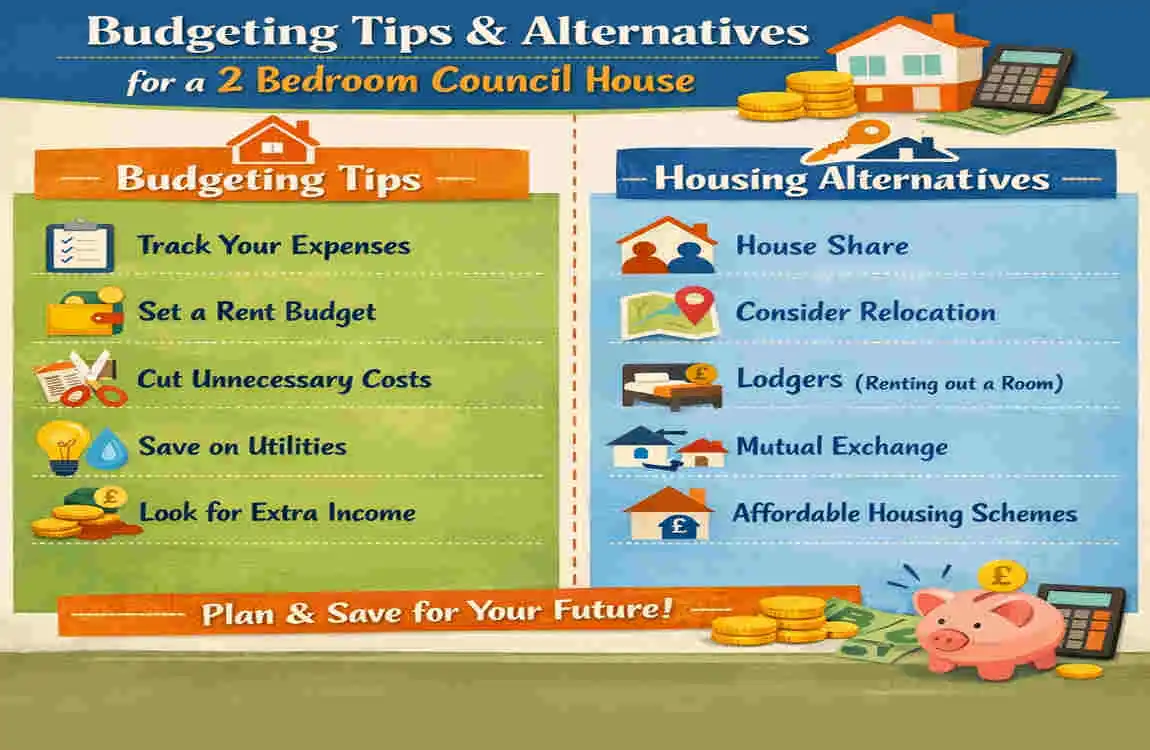
If you are lucky enough to secure a 2-bedroom council house, or if you are planning your finances for 2026, budgeting is essential.
Smart Budgeting for Council Tenants
- Pay by Direct Debit: Most councils prefer this. It ensures you never miss a payment and avoid arrears.
- Check for Discretionary Housing Payments (DHP): If your rent is £110 but your benefit only covers £100 due to the benefit cap or bedroom tax, apply to the council for DHP. It is a temporary pot of money to help bridge the gap.
- Factor in Council Tax: Remember, the rent figure (£90-£115) does not include Council Tax. A Band A property (common for council houses) will add another £100-£120 per month to your bills.
Alternatives to Council Housing
If the waiting list is 5+ years long (which is common for 2-beds), consider these:
- Housing Associations: These are independent non-profits. Their rents are similar to council rents (sometimes £5- £10 higher), but they often have more stock. You usually apply through the same council register.
- Shared Ownership: You buy a share (e.g., 25%) and rent the rest. The rent portion is lower than private rent.
- Private Rental Sector (LHA Rate): You can rent privately and claim benefits. However, the “Local Housing Allowance” (LHA) caps how much benefit you get. In many areas, the LHA is lower than the actual private rent, leaving you with a “shortfall” to pay.
Comparison Table: Council vs. Private (2-Bed Estimates)
Feature Council / Social Rent Private Rental
Weekly Cost £90 – £115 £180 – £350+
Deposit None / Small Advance 5 Weeks Rent
Security Lifetime / Long Term 6-12 Months
Decorating: You can decorate fully. Permission needed
Repairs Council handles all , Landlord handles
FAQ: How Much is Rent for a 2 Bedroom Council House?
Q: What is the average rent for a 2-bedroom council house in the UK? A: The rent for a 2-bedroom council property generally falls between £350 and £500 per month . Some tenants report paying around £500 per month for a full-price, non-discounted property . Unlike private renting, these costs are significantly subsidized to remain affordable for families.
Q: Does the location change the price? A: Yes, significantly. Properties in major urban centers like London or Manchester often sit at the higher end of the scale, usually closer to the £500 per month mark due to higher local property values . Conversely, rural areas or smaller towns will typically be cheaper.
Q: How is the rent actually calculated? A: Local councils do not pull these numbers out of thin air. Your weekly rent charge is calculated based on specific factors including the type of property (house vs. flat), the number of bedrooms, and even the type of heating system installed .
Q: When does the rent change? A: Councils typically review their rent charges annually. Any increases or changes to your rent usually become effective from your April rent payment each year .