Imagine coming home after a long day. You unlock the door, and the lights gently fade up to a warm glow. The thermostat has already adjusted to your perfect temperature, and your electric vehicle is charging silently in the garage. This isn’t just luck; it’s the result of smart, intentional wiring.
On the flip side, imagine the lights flickering every time the refrigerator turns on, or worse, the smell of burning plastic behind a wall. It is a scary reality, but faulty wiring causes over 50,000 house fires globally every year. In rapidly growing cities like Lahore and Karachi, where energy demand is skyrocketing, outdated wiring is a ticking time bomb
Electrical Basics: Understanding How to Wire a House
Before you grab a pair of wire strippers, you need to understand the invisible force you are working with. Electricity flows like water, and understanding the “plumbing” of your electrical system is the first step.
The Holy Trinity: Volts, Amps, and Watts
To wire a house, you need to know three terms:
- Voltage (Volts/V): Think of this as water pressure. In the US, standard outlets are 120V. In Pakistan and the UK, the standard is 220–240V. This higher voltage means you can run powerful appliances efficiently, but it also underscores the importance of safety.
- Amperage (Amps/A): This is the volume of water flowing. A thick wire can carry more amps than a thin one. If you try to push too many amps through a thin wire, it will heat up and catch fire.
- Wattage (Watts/W): This is the total power used. (Volts x Amps = Watts).
The Service Entry
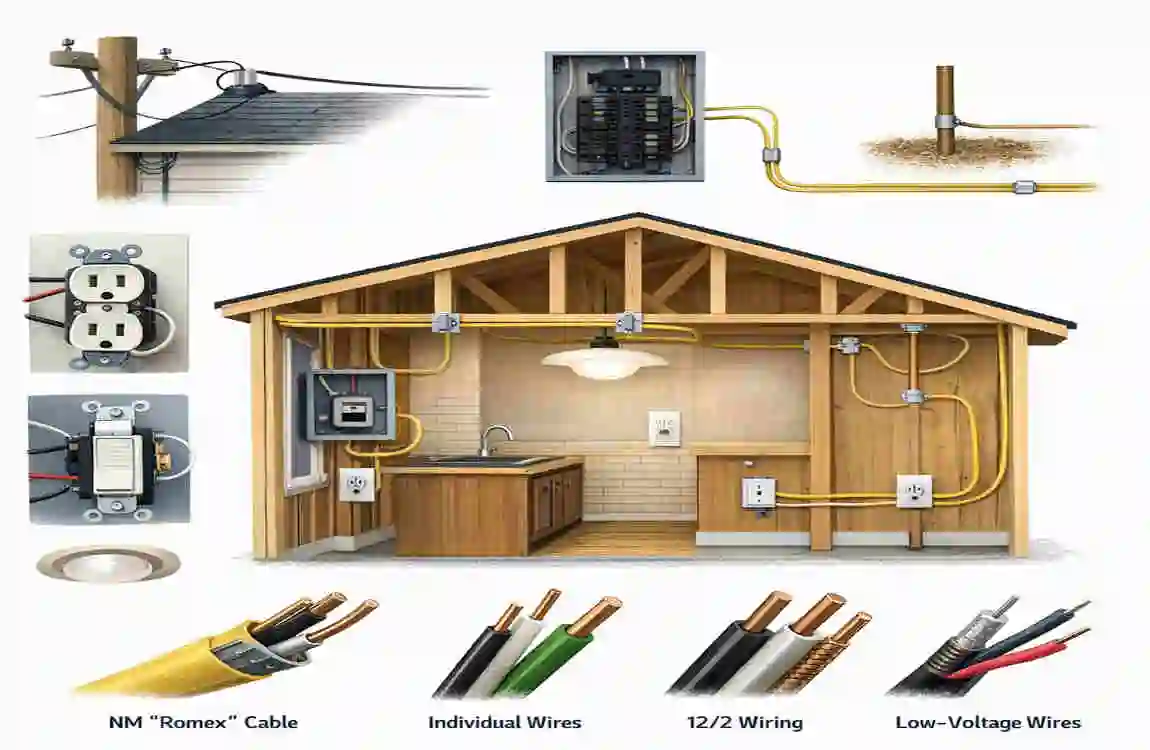
Electricity enters your home from the street via the “Service Entry.” It hits your electric meter (which counts how much you use) and then goes into your Main Service Panel (the breaker box). For a modern home in 2026, you generally need a panel rated for at least 200 Amps. If you plan on having multiple AC units and an Electric Vehicle (EV) charger, you might even consider a 400 Amp service.
Codes and Compliance
You cannot just run wires wherever you please. You must follow the rules. In Pakistan, the Electricity Rules 2023 provide the framework, often mirroring international standards like the NEC (National Electrical Code).
- Permits: You will likely need a permit from your local authority (like LESCO in Lahore or K-Electric in Karachi) before starting major work.
- Inspections: An inspector will need to look at your “rough-in” wiring (before you put up drywall) and your “final” wiring (after outlets are installed).
Planning Your House Wiring Project
You wouldn’t build a house without a blueprint, and you shouldn’t wire one without a schematic. Planning is where you save money and prevent headaches.
Calculating Your Load
First, list everything you plan to power. Don’t just think about today; think about five years from now.
- Heavy Hitters: Air conditioners (split units), electric ovens, water heaters, and EV chargers.
- Standard Loads: Lights, fans, TV, computers.
- Future Loads: Smart home hubs, security cameras, and home servers.
Room-by-Room Circuit Strategy
A common mistake is putting too many components on a single circuit. If you plug a vacuum cleaner into the same circuit as your gaming PC and the lights flicker, that circuit is overloaded. Here is a recommended breakdown:
Area Circuits Needed, Wire Gauge (Approx), Smart Features to Add
Kitchen 4–6 Circuits (Heavy Duty) 4mm² – 6mm² Under-cabinet lighting, USB outlets for recipe tablets.
Bedrooms 2–3 Circuits (General) 2.5mm² Smart switches by the bed, reading lights.
Living Room 2–3 Circuits (Media) 2.5mm² Floor outlets for lamps, recessed TV power.
Garage Dedicated 50A Circuit 6mm² – 10mm² Level 2 EV Charger, high-power tools.
Bathrooms 1 Dedicated Circuit 4mm² GFCI outlets (shock protection), heated towel rails.
Budgeting for the Project
Wiring is an investment. In Pakistan, a full rewire for a standard 10-marla house can range from PKR 500,000 to PKR 2,000,000, depending on the quality of materials and the level of smart integration. Smart breakers and high-end switches will raise costs, but they add immense value.
Essential Tools and Materials for Wiring a House
You cannot do professional work with amateur tools. Having the right gear ensures your connections are tight and safe.
The Electrician’s Toolkit
Here is what you need in your belt. We have estimated costs in PKR to help you budget.
ToolPurposeEstimated Cost (PKR)
Non-Contact Voltage Tester Safety #1. Beeps if a wire is “live.” 2,000 – 4,000
Wire Strippers/Cutters remove insulation without cutting the copper. 1,500 – 3,000
Lineman’s Pliers: Twisting wires together and cutting thick cables. 2,500
Fish tape: A long metal coil used to pull wires through pipes. 3,000 – 5,000
A multimeter measures exact voltage and checks for continuity. 4,000 – 10,000
Drill with Auger Bits: Boring holes through wooden studs. 15,000+
Materials You Will Buy
- Wire: In Pakistan, stranded wire inside PVC conduit (pipes) is common. In the US, “Romex” (solid wire wrapped in a yellow or white sheath) is standard. Ensure you buy the right thickness (gauge). Thinner numbers mean thicker wire.
- Conduit/Pipes: Protects the wires inside walls.
- Boxes: Plastic or metal boxes that hold your switches and outlets.
- Smart Breakers: Brands like Schneider or Siemens offer breakers that connect to your phone to monitor energy usage.
Step-by-Step Guide: How to Wire a House
Now, let’s get our hands dirty. This guide assumes you are wiring a room or a new build.
Preparation and Safety
Kill the Power: Go to your main panel and shut off the main breaker. Use your voltage tester to confirm everything is dead. 2. Map the Layout: Take a marker or spray paint and mark exactly where every box will go on the unfinished walls (studs/bricks)—Mark “S” for switches and “O” for outlets. Standard height for outlets is usually 12 inches from the floor; switches are 48 inches.
Rough-In Wiring
“Rough-in” means installing the boxes and running the wires, but not yet connecting the devices.
Mount the Boxes: Nail or screw your electrical boxes to the studs. Ensure they stick out slightly so they will be flush once the drywall or plaster is added. 2. Drill the Path: If you have wooden studs, drill holes through the center of them to create a path for your wire. If you have brick walls (common in Pakistan), you will need to cut channels (chases) into the brick to lay your conduit pipes. 3. Run the Wire: This is the hard work. Feed your wire from the main panel to the furthest outlet.
Label Everything: As you pull wires into the panel, label them immediately. “Kitchen Fridge,” “Master Bedroom Lights.” You will thank yourself later.
The Main Panel (The Brain)
Mount the Subpanel: Secure the metal breaker box to the wall. 2. Separate Neutrals and Grounds: Connect all the white (or blue/black, depending on region) neutral wires to the neutral bus bar. Connect the bare copper or green ground wires to the ground bus bar. 3. install Breakers: Snap the breakers into place. Connect the “hot” (red/brown) wire to the breaker screw.
Outlets, Switches, and Fixtures
Once the walls are finished (painted and plastered), you return for the “finish” work.
1. Strip and Connect: Strip about 3/4 inch of insulation off the wire ends. 2. Wiring Outlets:
* **Hot wire** goes to the Gold/Brass screw.
* **Neutral wire** goes to the Silver screw.
* **Ground wire** goes to the Green screw.
* *Remember:* “Black on Brass” (or Red on Brass in PK).
install GFCIs: In bathrooms, kitchens, and outdoor areas, install GFCI (Ground Fault Circuit Interrupter) outlets. These have “Test” and “Reset” buttons and cut power instantly if water comes into contact with the circuit, preventing electrocution.
Smart Wiring Integration
Don’t just run electrical wire. Run Cat6 Ethernet cable to every room. Wireless internet is great, but a hardwired connection is faster and more stable for 4K streaming and gaming. Run these cables to a central “media closet” where your router will live.
Smart Home Wiring: Future-Proof Your House
When learning how to wire a house in 2026, you can’t ignore the “smart” aspect. Standard wiring makes a house functional; smart wiring makes it intelligent.
The Low-Voltage Advantage
Consider running low-voltage wiring for automated blinds, smart doorbells, and LED accent lighting.
- PoE (Power over Ethernet): This is a game-changer. It allows you to run a single Ethernet cable to a security camera or a smart screen that provides both internet and power. No need for a separate plug!
Integrated Ecosystems
If you plan to use Google Nest or Apple HomeKit, wire for it now.
- Neutral Wires at Switches: Many smart switches (like Lutron Caseta or Philips Hue modules) require a “neutral” wire in the switch box to stay powered on even when the lights are off. Older homes often skipped this. Always run a neutral wire to every switch box to ensure you can use smart dimmers later.
Voice Control Ready
Imagine saying, “Alexa, Goodnight,” and your house locks the doors, turns off the lights, and lowers the thermostat. This requires a strong Wi-Fi mesh network. Plan for ceiling-mounted Wi-Fi access points in your wiring plan (using that Cat6 cable we mentioned) to ensure no dead zones.
Common Wiring Mistakes and Troubleshooting
Even seasoned DIYers make mistakes. Here are the ones to avoid to keep your house from failing an inspection—or worse.
Undersized Wires: Never use a wire that is too thin for the breaker. If you have a 20-amp breaker but use thin wire meant for 15 amps, the wire will melt before the breaker trips.
Overcrowding Boxes: Stuffing too many wires into a small plastic box is a fire hazard. It causes heat buildup. If you have lots of connections, buy a “deep” box to give the wires room to breathe.
Loose Connections: A loose wire nut or screw is the #1 cause of electrical fires. When you twist wires together, tug on them to make sure they are tight. Wrap them in electrical tape for extra security.
Testing: Before you plug anything in, use your multimeter. Check for “continuity” to ensure there are no breaks in the line, and check for “shorts” (where hot touches ground).
Costs, Permits, and When to Hire a Pro
We touched on the budget earlier, but let’s break down the reality of costs and regulations, specifically for the Pakistani market.
Cost Breakdown
Scope of Work: Estimated Cost (PKR per sq. ft/meter)
Basic Rewiring 5,000 – 8,000
Standard New Build 8,000 – 12,000
Smart / Premium Wiring 12,000 – 15,000+
The Permit Process in Pakistan
If you are in Lahore, you deal with LESCO. If in Karachi, K-Electric.
- Application: You submit your wiring plan.
- Demand Note: You are responsible for the meter connection fees.
- Test Report: A licensed electrical contractor must sign off on a test report verifying that your wiring is safe.
- Connection: The utility company installs the meter.
When to Call the Pros
Suppose you are comfortable changing a light fixture. Great. But if you are dealing with the Service Entry, the Main Panel, or Sub-panels, hire a pro. The risk of fatal shock is too high for guesswork.
Maintenance and Upgrades Post-Wiring
Once the walls are closed up, your job isn’t done forever.
- Annual Inspection: Once a year, open your main panel (carefully!) and look for any signs of scorching or loose breakers.
- Surge Protection: install a “Whole House Surge Protector” at your main panel. In areas with unstable grid power (load shedding), this protects your expensive smart TV and computer from frying when the power surges back on.
Frequently Asked Questions (FAQs)
How to wire a house for beginners? Start small. Do not try to wire the whole house at once. Begin by understanding the circuit loop: Power leaves the panel on the “Hot” wire, powers the device, and returns on the “Neutral” wire. Practice wiring a single outlet on a workbench before you try it in the wall. Always invest in a good voltage tester.
What permits do I need for house wiring in Pakistan? You generally need a connection permit from your local distribution company (DISCO), such as LESCO, IESCO, or K-Electric. To get the meter installed, you will need a “Test Form” signed by a licensed electrical contractor certifying that your internal wiring meets safety standards.
Can I wire my own house legally? In many Western countries, you can wire your own house if you live in it, provided you pass inspections. In Pakistan, while you can do the physical work yourself, you cannot get a meter connection without the signature and stamp of a licensed professional on the Test Form. It is best to work alongside a pro.
What is the best wire gauge for a house? It depends on the usage. For lighting, 1.5 mm² (14 AWG) is standard. For standard wall outlets, 2.5 mm² (12 AWG) is best. For heavy appliances like ACs and heaters, you need 4 mm² or 6 mm². Never use wire that is too thin for the load.
How much does it cost to rewire a house in 2026? Rewiring an existing house is more expensive than wiring a new one because you have to open up walls. In Pakistan, a full rewire of a standard 3-bedroom house can cost between PKR 500,000 and PKR 1,000,000, including labor, new wires, switches, and a modern breaker panel.