It’s a crisp, chilly Saturday morning. You stretch, throw off the warm duvet, swing your legs over the side of the bed, and put your feet down. Do you wince as your toes hit cold, hard hardwood? Or do you sigh in contentment as your feet sink into a plush, soft surface? If it’s the latter, you already know the power of a good rug. If it’s the former, don’t worry—we are about to fix that.
Stepping into a bedroom that feels instantly cozy and stylish isn’t just about expensive furniture or perfect lighting; often, it comes down to the foundation of the room. Rugs do so much more than cover the floor. They anchor your furniture, add necessary warmth, define specific zones, and significantly boost the aesthetics of your sanctuary. In fact, interior design studies suggest that the right textiles and rugs can increase a room’s perceived coziness by nearly 40%.
Why Proper Rug Placement Transforms Your Bedroom

You might be thinking, “Can’t I just put the rug in the middle of the room?” Well, you could, but you’d miss out on the design magic that comes with intentional placement. Bedroom rug placement ideas aim to create flow and visual harmony. When a rug is placed correctly, the room feels “finished.” It stops the furniture from looking like it is floating in a sea of flooring.
Visual Balance and Grounding
The primary benefit of proper placement is visual balance. A rug acts as an anchor. It connects the bed to the nightstands and the bench, creating a cohesive “island” of furniture. Without this anchor, the pieces can feel disconnected. When you nail the placement, the eye travels smoothly across the room, making the space feel organized and intentional.
Comfort and Acoustics
Let’s talk about comfort. Your bedroom is your retreat. It is where you recharge. Having a soft layer underfoot is essential for that cozy factor. Beyond touch, rugs are incredible sound absorbers. If you have hardwood or tile floors, you know they can echo. A well-placed rug dampens sound, making your bedroom quieter and more peaceful—exactly what you need for a good night’s sleep.
Zoning Your Space
For larger rooms or studio apartments, rugs are the best tools for zoning. You can use different rugs to separate the sleeping area from a reading nook or a dressing area. This helps your brain switch modes—when you step onto the plush rug by the bed, it’s time to sleep; when you step onto the flat-weave by the chair, it’s time to read.
3 Key Rules to Remember:
- The 2/3 Rule: Generally, hanging the rug two-thirds of the way under the bed works best for most rooms.
- Frame the Group: Your rug should frame the furniture group, not just sit under one table leg.
- Traffic Patterns: Make sure high-traffic areas (like the path to the bathroom) are covered or clearly defined so you don’t trip on edges.
Rug Sizing and Selection Guide Before Placement
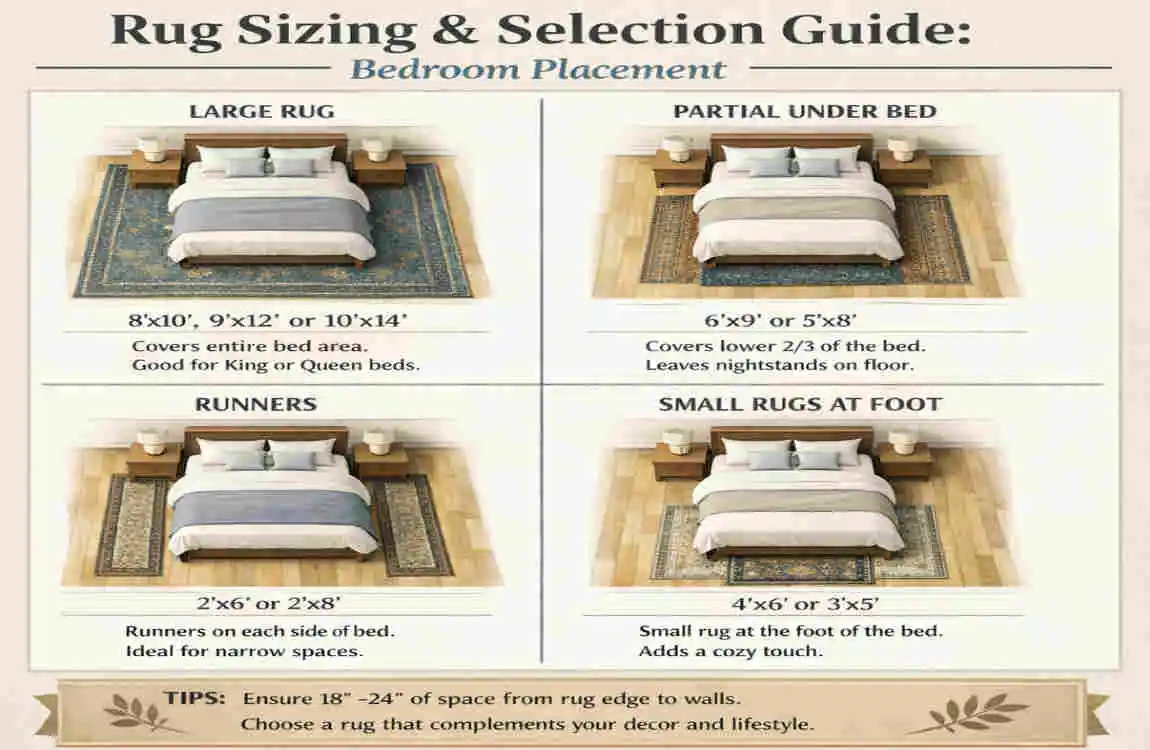
Before we jump into the layouts, we have to talk about sizing. The number one mistake people make when figuring out how to place rugs in bedroom layouts is buying a rug that is too small. A “postage stamp” rug makes the room look smaller and cheaper.
You generally want a rug that covers enough floor space to make an impact. A good rule of thumb is to choose a rug that covers about 80% of the negative space in the area you are defining, or leaves about 10 to 18 inches of bare floor around the edges of the room.
Here is a quick reference table to help you match your bed size to the rug size:
Bed Size Minimum Rug Size Ideal Rug Size” Grand” Rug Size
Twin / Twin XL 5′ x 8′ 6′ x 9′ 8′ x 10′
Full / Double 5′ x 8′ 6′ x 9′ 8′ x 10′
Queen 6′ x 9′ 8′ x 10′ 9′ x 12′
King / Cali King 8′ x 10′ 9′ x 12′ 10′ x 14′
Choosing the Right Material
Material matters as much as size. For bedrooms, you want comfort.
- Wool: This is the gold standard. It is soft, durable, and naturally stain-resistant. It adds immediate luxury.
- Synthetics (Polypropylene/Nylon): These are great for allergy sufferers and are very easy to clean. If you allow pets in the bedroom, this might be your best bet.
- Natural Fibers (Jute/Sisal): These add great texture but can be rough on bare feet. If you love the look, consider layering rugs by placing a smaller, softer rug on top of a large jute one.
Classic Bed-Centered Anchor
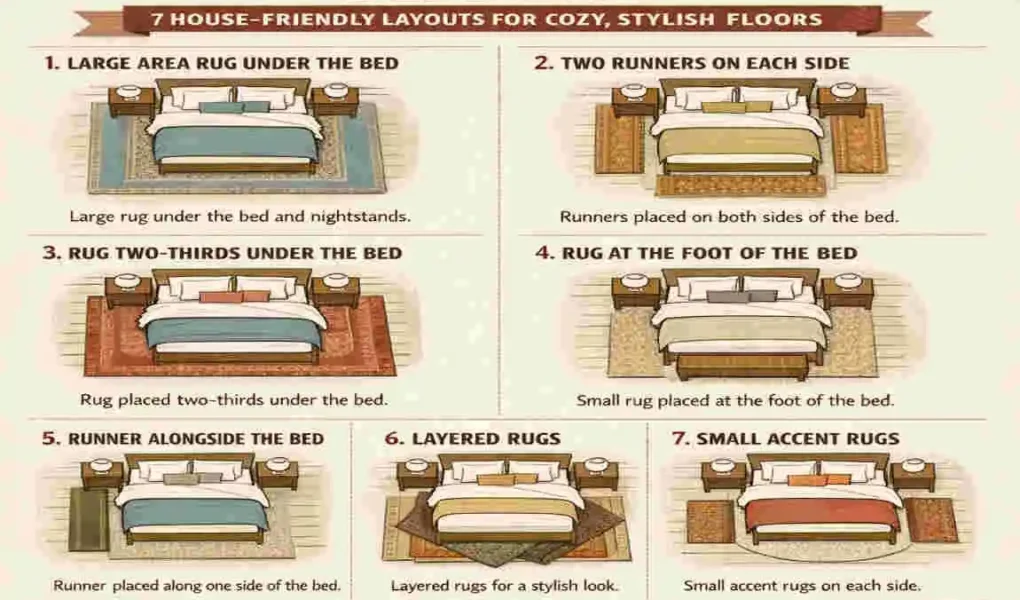
This is arguably the most popular and fail-safe method for rug placement. It is the layout you see in most catalogues and interior design magazines because it works for almost any room style, from traditional to contemporary. It anchors the bed as the undeniable focal point of the room.
Why This Works
This layout creates wonderful symmetry. By placing the rug perpendicular to the bed, you extend the usable floor space on both sides and the foot of the bed. It makes a standard 12×14 ft room feel spacious and grounded. It ensures that when you and your partner climb out of bed, you both land on something soft.
Step-by-Step How-To:
- The Position: Lay the rug down horizontally (perpendicular to the direction of the bed).
- The Tuck: Slide the rug underneath the bed so that the front two-thirds of the bed are sitting on the rug. You want the rug to stop just before it hits your nightstands.
- The Nightstands: In this layout, your nightstands should not be on the rug. They should sit on the bare floor, with the top edge of the rug starting just a few inches past the nightstand legs.
- The Border: Ensure you have about 18 to 24 inches of rug extending from the sides and the foot of the bed.
Variations and Tips
If you have a bench at the foot of the bed, this layout is perfect because the rug will extend underneath the bench, tying it into the bed setup.
- Common Mistake: Buying a rug so small that once you tuck it under the bed, you only have 2 or 3 inches visible on the sides. This looks skimpy. Ensure the wide border is visible!
Layered Luxury for Texture Lovers
If you browse Pinterest or Instagram for bedroom rug placement ideas, you have definitely seen the layered look. This trend isn’t going away because it adds incredible depth, texture, and a “collected” feel to the room. It is perfect for those who can’t decide between a neutral base and a fun pattern.
Why House-Friendly
This is surprisingly practical. It allows you to cover a large area with a cheaper, durable rug (like jute or sea grass) and then add a splash of luxury with a smaller, more expensive rug (like a vintage wool or faux hide) on top. It’s a great way to hide stains on an old carpet, too!
Step-by-Step How-To:
- The Base: Start with a large, neutral rug (like a 9×12 Jute). Place this using the “All-Four-Sides” method (see Layout 5) or the Classic Anchor method. It should cover most of the floor.
- The Accent: Place a smaller rug (like a 5×8 or even an irregularly shaped sheepskin) on top of the base rug.
- The Placement: You can center the top rug, but it often looks more stylish if it’s slightly off-center or placed diagonally at the foot of the bed.
- The Pop: Use the top rug to introduce a color or pattern that ties in your throw pillows or duvet.
Budget Tip
Thrifting is your friend here. You can buy a brand new, inexpensive large sisal rug for the base, and then scour flea markets for a smaller, vintage Turkish or Persian rug for the top layer. This gives you a high-end designer look for a fraction of the cost.
Side Runner Path for Narrow Rooms
Sometimes, we don’t have the luxury of a massive main suite. If you are figuring out how to place rugs in narrow or small bedroom spaces (like a 10×12 ft room), a giant area rug might overwhelm the space or interfere with door swings. Enter the runner.
Why It’s a Lifesaver
Runners are excellent for “galley”- style bedrooms or rooms where the bed must be pushed against one wall. They provide the comfort of a rug exactly where you need it (where you step) without the hassle of lifting a heavy mattress to place a large area rug. It guides traffic flow and prevents slips on slick floors.
Step-by-Step How-To:
- Selection: Purchase two matching runners. A standard size is roughly 2.5 ft x 8 ft, but measure your bed length to be sure.
- Placement: Place one runner on each side of the bed.
- Alignment: They should run parallel to the bed. Keep a small gap (about 2-3 inches) between the edge of the bed frame and the rug to avoid it looking crowded.
- The Anchor: Ensure the runners extend from the nightstand area down to the foot of the bed.
Style It Up
Since runners are smaller, they are a lower financial commitment. This is your chance to go bold! Choose a runner with a vibrant geometric pattern or a bright color to inject high energy into a small room. If your bed is against a wall, you only need one runner on the open side—simple and effective.
Zoning with Multiple Rugs
For those lucky enough to have a large main suite, one rug may not be enough. If your room is multipurpose—serving as a sleeping area, a reading lounge, and a dressing room—you need the best rug layouts for bedrooms that define these zones. This concept is similar to an open-concept living room.
Why Cozy and Functional
Using multiple rugs breaks up the “gymnasium” feel of a large room. It creates intimacy. It tells the brain that the armchair in the corner is a distinct place for relaxation, separate from the bed.
Step-by-Step How-To:
- Sleep Zone: Use a large rug under the bed (Layout 1 or 5) to anchor the sleeping area.
- Lounge Zone: Identify your seating area (perhaps two chairs and a small side table). Place a smaller rug, like a 5×7 or a 6-foot round rug, under this furniture group.
- Front Legs Rule: For the lounge zone, ensure that at least the front legs of the chairs are on the rug to anchor them.
- The Vanity: If you have a vanity table, a small faux fur rug, or a small rectangular rug under the stool, it adds a touch of glam and warmth.
Family Friendly Tip
If you have kids or pets who hang out in your room, use synthetic or washable rugs for the “Lounge Zone” since that is where snacks or coffee might be consumed. Keep the delicate wool rug for the “Sleep Zone” where shoes are usually off.
All-Four-Sides Enclosure
This is the “Hotel Luxe” look. If you want your bedroom to feel like a suite at the Ritz, this is the layout for you. It involves a very large rug that creates a perimeter around the entire bed setup.
Ideal for Large Rooms
This layout requires space. It is best suited for rooms at least 12×15 ft. It enhances a home’s resale appeal by showcasing its spaciousness.
Step-by-Step How-To:
- The Size: You will likely need a 9×12 ft or even a 10×14 ft rug for a Queen or King bed.
- The Placement: Place the rug so that the entire bed frame, the bench at the foot, and importantly, the nightstands are all sitting completely on the rug.
- The Border: Aim for an equal border of rug showing around the furniture group—roughly 18 to 24 inches on all sides.
- Wall Gap: Ensure there is still at least 10 inches of bare floor between the edge of the rug and the walls/baseboards. You don’t want it to look like poorly installed wall-to-wall carpet.
Mistake to Avoid
Avoid overly busy patterns with this layout. Because the rug is so large, a frantic pattern can dominate the room, making it feel chaotic. Stick to subtle textures, tone-on-tone patterns, or solid colors to maintain that serene, hotel vibe.
Foot-of-Bed Focus for Small Spaces
Sometimes, you want to show off your beautiful hardwood floors, or perhaps you have a beautiful antique bed frame you don’t want to hide. Cozy bedroom rug arrangements don’t always require the rug to be under the bed. The “Foot-of-Bed” layout is a modern, airy approach.
Why It Works
This layout extends the bed visually. It draws the eye lengthwise through the room, which makes a shorter room feel longer. It is also much easier to install because you don’t have to lift the heavy mattress!
Step-by-Step How-To:
- The Tuck (Or Lack Thereof): Take an 8×10 or 5×8 rug (depending on room width). Place it horizontally at the foot of the bed.
- The Gap: You can either tuck just 2-3 inches under the foot legs of the bed, OR let the rug float completely free, starting about 4 inches from the foot of the bed.
- The Connection: If you have a bench or ottoman, place it on this rug to bridge the gap between the bed and the rug.
- Layering: This is a great spot to throw a sheepskin over the corner of the rug for extra plushness.
Great for Apartments
This is excellent for renters. It is easy to move, requires a smaller (and cheaper) rug than Layout 5, and still provides a designated “dressing area” on the floor where you likely stand to get ready in the morning.
Creative Asymmetrical Flair
Who says you have to follow the rules? Modern design is all about breaking the grid. If you love an eclectic, artistic vibe, exploring asymmetrical rug placement strategies in the bedroom might be your calling.
Why Stylish
This adds personality and movement to a room. It effectively hides architectural flaws (like weirdly placed vents or uneven walls) by drawing the eye to the design on the floor.
Step-by-Step How-To:
- Off-Center: Place a medium-to-large rug at an angle under one corner of the bed.
- The Balance: To balance the “off-center” weight, place a pouf, a large plant, or a floor mirror on the opposite side of the room.
- The Mix: You can combine a rectangular rug placed askew with a round rug elsewhere in the room.
- The Geometry: Look for rugs with abstract shapes or organic edges (like cowhides) as they lend themselves naturally to asymmetry.
Trend Alert: 2026
As we move through 2026, we are seeing a resurgence of “wabi-sabi” style—finding beauty in imperfection. An asymmetrical rug placement feels lived-in, casual, and effortlessly cool. It says, “I didn’t try too hard, but look how good this looks.”
Common Mistakes to Avoid in Bedroom Rug Placement

Even with the best intentions, things can go wrong. Here are a few quick pitfalls to watch out for so you don’t waste your money.
- The “Floating Island”: This happens when the rug is way too small. If the rug floats in the middle of the room, touching nothing, it makes the space feel disjointed. Always connect the rug to furniture.
- Ignoring Door Clearance: Before you buy that thick, plush Moroccan shag rug, check the bottom of your bedroom door. Will it clear the rug when you open it? If not, you’re in for a headache every time you enter the room.
- The Wall-to-Wall Lookalike: Leaving less than 6 inches of floor around the rug makes it look like you tried to install carpet and failed. Let the floor breathe!
- Skipping the Rug Pad: This is huge. Without a pad, rugs slip, slide, and bunch up. This is a tripping hazard, and it looks messy. A thick felt pad also adds extra luxury and soundproofing.
Essential Tips for Maintenance and Styling
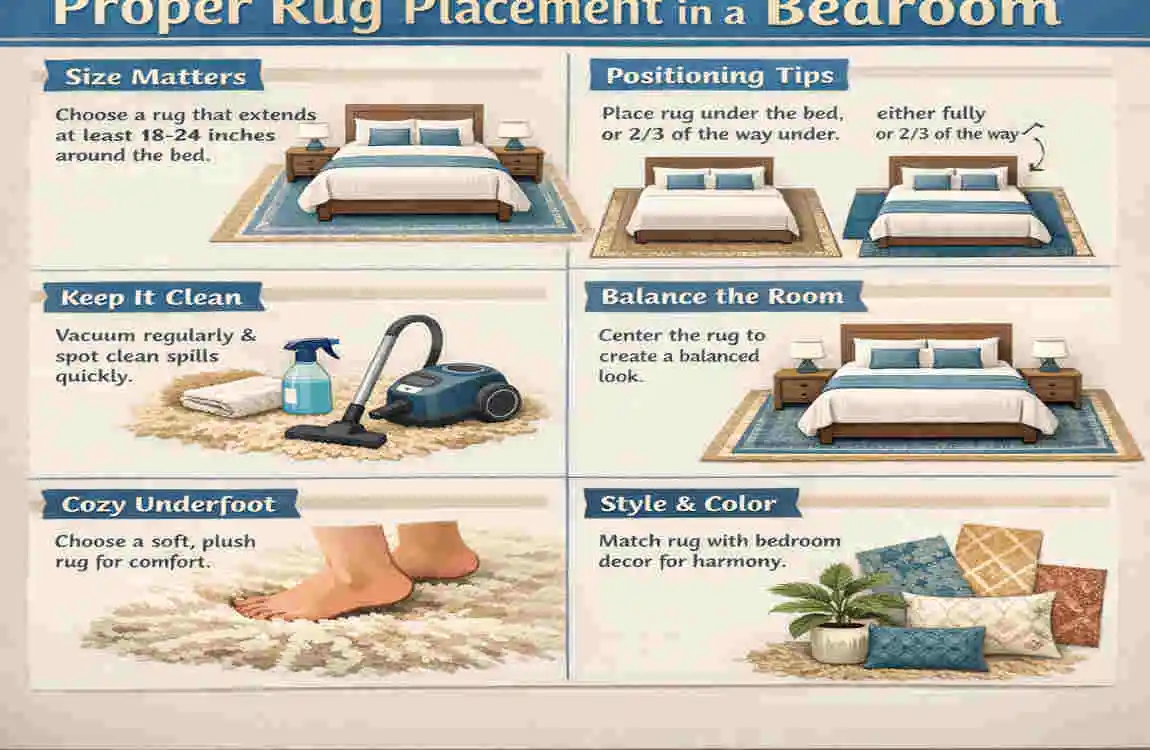
Once you have mastered how to place rugs in bedroom layouts, you need to keep them looking fresh.
Routine Care: Bedrooms are generally lower traffic than living rooms, which is great. However, dust accumulates under the bed. Make sure to vacuum your rug weekly. If you have a heavy bed on top of the rug, use the hose attachment to reach as far under as possible.
Rotation is Key: If your bedroom gets strong sunlight from one window, your rug will fade unevenly over time. Rotate your rug 180 degrees every 6 months (maybe when you flip your mattress!) to ensure even wear and fading.
Styling: Tie the room together by pulling colors from the rug into your wall art or bed throw. If your rug is neutral, go wild with colorful pillows. If your rug is a bold Persian pattern, keep the bedding simple and white for a crisp contrast.
FAQ: Bedroom Rug Placement Basics
Q: Does the rug have to go under the entire bed? A: No. The most popular layout is to place the rug perpendicular to the bed frame, tucking it about 2/3 of the way under. This leaves space for the rug to stick out on the sides and foot of the bed.
Q: Should my nightstands sit on the rug? A: In most standard-sized bedrooms, no. The rug should start a few inches in front of the nightstands. However, in very large master suites (luxury style), you can place a massive rug so that the bed and nightstands sit completely on top of it.
Q: What is the best rug size for a Queen bed? A: An 8′ x 10′ rug is the ideal standard. It provides a nice 18-24 inch border on the sides. In a pinch, a 6′ x 9′ works, but it might feel a bit tight.
Q: What is the best rug size for a King bed? A: You really need a 9′ x 12′ rug to balance the width of a King bed. An 8′ x 10′ can look like a “postage stamp” under a King frame.
Q: Can I put an area rug over wall-to-wall carpet? A: Absolutely! This is a great interior design trick to add color and texture to a boring rental or plain room. Just make sure to use a firm rug pad underneath so the top rug doesn’t ripple or bunch up.
Q: My room is too narrow for a large rug. What do I do? A: Use runners. Place a runner (approx. 2.5′ x 8′) on each side of the bed. It gives you the soft landing you need without overcrowding the limited floor space.
Q: How much floor should show around the edges of the room? A: Aim to leave about 10 to 18 inches of bare floor between the edge of the rug and the walls. This “breathing room” prevents the space from looking cluttered.