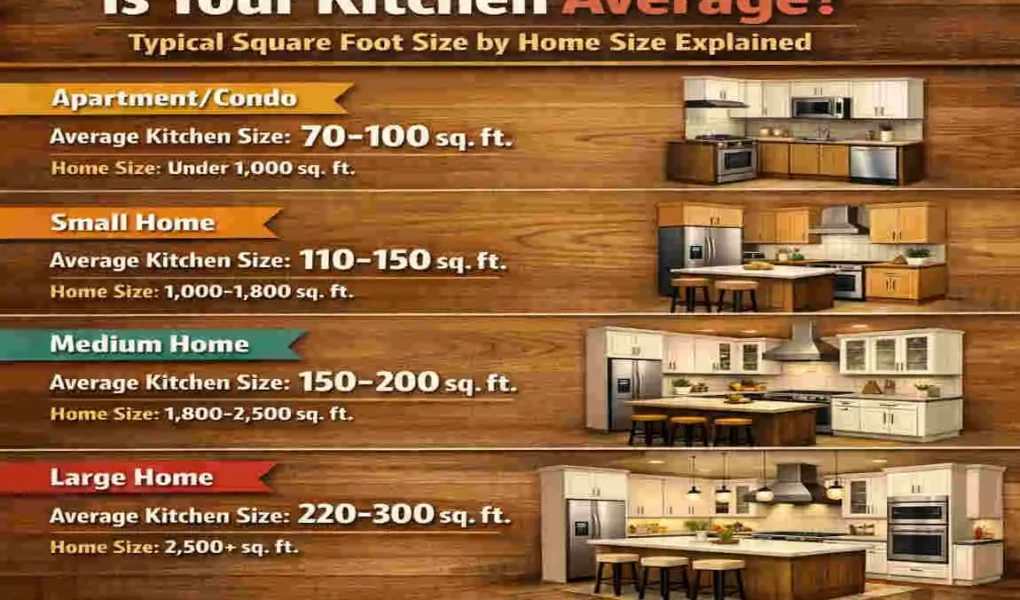
How big the average kitchen is in square feet? If your cooking space feels cramped, cluttered, or simply outdated, you are definitely not alone. Many homeowners find themselves bumping elbows while chopping vegetables and wondering if their kitchen is smaller than it should be.
Let us settle the debate right now: the U.S. average kitchen size sits right around 161 to 169 square feet. To help you visualize that space, imagine a room that measures roughly 13 by 13 feet.
But here is the catch—that average number does not tell the whole story. Your ideal kitchen size depends entirely on your house’s overall footprint. A cozy downtown apartment will naturally feature a different culinary setup than a sprawling suburban estate.
Why Kitchen Size Matters
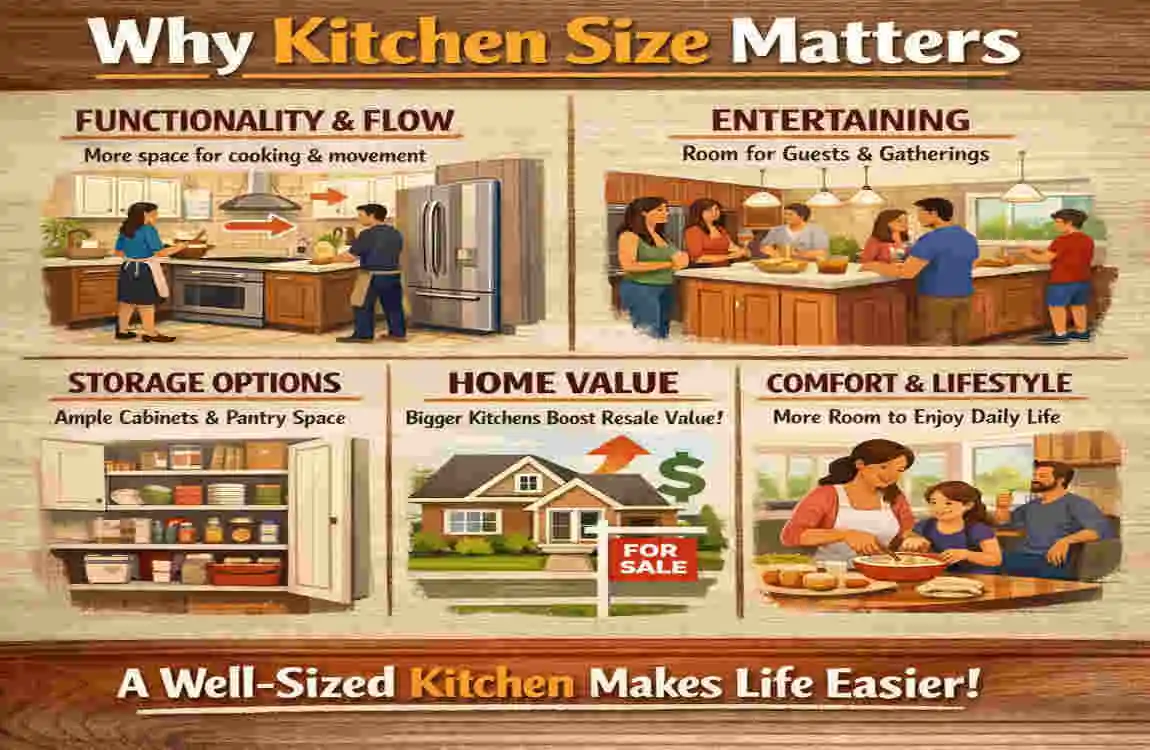
You use your kitchen every single day. It is the heart of your home, the place where you brew your morning coffee, prepare family meals, and gather with friends. Because you spend so much time here, the sheer size of the space dramatically impacts your daily comfort and your home’s functionality.
When your kitchen is too small, cooking becomes a frustrating chore. You run out of counter space for your appliances, your cabinets overflow with pots and pans, and multiple people cannot cook together. On the flip side, a kitchen that is properly sized for your home allows for a seamless, enjoyable cooking experience.
Beyond your daily routine, kitchen size plays a massive role in your financial future. Real estate experts consistently note that beautiful, well-proportioned kitchens boost overall home prices by 7% to 10%. Buyers heavily prioritize this room when touring properties. In fact, homes featuring kitchens larger than 200 square feet tend to sell 20% faster than those with cramped cooking quarters.
Let us look at a few reasons why finding the perfect size is so crucial:
- Daily use and comfort: To comfortably fit the classic “workflow triangle” (the optimal path between your sink, stove, and refrigerator), you generally need at least 100 square feet—anything less, and you might find your appliances awkwardly crammed together.
- Resale value and buyer appeal: Modern homebuyers want space. If your kitchen looks like an afterthought, buyers will likely deduct the cost of a remodel from their offer.
- Modern open-concept trends: Today’s buyers and builders prefer open-concept designs where the kitchen flows seamlessly into the living and dining areas. Because of this architectural shift, modern kitchens now average 15% to 20% of a home’s total square footage.
Evolution of Kitchen Sizes
If your older home has a tiny kitchen, you can blame history. Back in the 1950s, builders viewed the kitchen strictly as a utilitarian workspace. It was usually a small, walled-off room meant only for the person cooking the meals. During that era, the average kitchen measured a mere 70 square feet!
Fast forward to 2026, and the narrative has completely flipped. We now use our kitchens for entertaining, doing homework, and socializing. Because our overall homes have grown significantly larger over the decades, kitchen sizes have expanded to match. Today, the National Kitchen and Bath Association (NKBA) reports that a 13-by-13-foot space (roughly 169 square feet) serves as the standard benchmark for a modern remodel.
Average Kitchen Size Overall
So, let us answer the core question on your mind: how big is the average kitchen in square feet? Across standard U.S. homes ranging from 1,500 to 4,000 square feet, the average kitchen measures between 161 and 169 square feet.
However, “average” is a flexible term that depends on the type of home you are looking at. A newly built house in the suburbs will boast a vastly different average than a historic home in a dense city.
National Benchmarks
To give you a clearer picture of what you might expect to find in the real estate market today, let us break down some national benchmarks.
- The broad U.S. average: When you look at all single-family homes combined—old and new, large and small—the average kitchen size falls somewhere between 150 and 250 square feet.
- Brand new builds: Modern builders understand the demand for spacious kitchens. If you purchase a newly constructed two-story home today, you can expect an average kitchen size of about 174 square feet.
- Regional footprints: Location dictates space. If you live in a spacious suburban neighborhood, your kitchen will likely exceed 200 square feet. However, if you reside in a dense urban environment where square footage is at a Premium, a standard kitchen might hover around 120 square feet.
To make these numbers easier to digest, we have compiled a quick reference table showing the average square footage and dimensions for standard kitchen categories.
Kitchen Type Average Square Feet Typical Dimensions
Standard / Average 161 – 169 sq ft 13 x 13 ft
Small / Compact 103 sq ft 10 x 10 ft
Large / Expansive 238+ sq ft 15 x 16 ft
Kitchen Size by Home Size
You cannot judge a kitchen in a vacuum. A 150-square-foot kitchen might feel incredibly spacious in a tiny cottage. Still, that same kitchen would feel dreadfully small in a sprawling mansion. Therefore, understanding the typical square footage by home size is the best way to determine whether your space is truly proportional.
Let us break down exactly what you should expect based on your property’s total square footage.
Small Homes (Under 1,500 sq ft)
If you live in a smaller home, your kitchen will naturally reflect that compact footprint. In houses under 1,500 square feet, the average kitchen measures about 103 square feet.
In these cozy environments, you have to prioritize efficiency over sheer space. You will frequently find galley layouts in these homes. A galley layout features two parallel walls of cabinets and countertops with a narrow walkway down the middle. This design eliminates wasted corner space, keeping your workflow triangle incredibly tight and efficient.
Mid-Size Homes (1,500 to 3,000 sq ft)
This category encompasses the vast majority of standard family homes. If your house falls into this mid-size range, your typical kitchen will be between 161 and 191 square feet.
Interestingly, the home’s layout influences the kitchen size here. A single-story ranch home in this size range typically features a kitchen of about 151 square feet. However, a multi-story home of the same total square footage will often boast a slightly larger kitchen, averaging closer to 174 square feet.
Large Homes (3,000 to 4,000 sq ft)
When you upgrade to a large home, the kitchen becomes a major focal point of the main floor. In houses measuring between 3,000 and 4,000 square feet, expect the kitchen to range from 191 to 238 square feet.
With this amount of space, homeowners can easily incorporate massive center islands, wrap-around cabinetry, and comfortable seating areas directly within the kitchen’s footprint.
Luxury Homes (Over 4,000 sq ft)
Welcome to the ultimate culinary dream. In luxury estates exceeding 4,000 square feet, the kitchen is no longer just a room; it is a sprawling, multi-functional entertaining wing.
Luxury kitchens easily surpass 300 square feet, frequently pushing past 450 square feet. In these high-end homes, the kitchen and its adjacent pantries often consume up to 20% of the home’s total square footage.
Here is a handy breakdown of how kitchen size scales with your overall home size:
Total Home Square Feet, Average Kitchen Square Feet, Percentage of Home
Under 1,500 sq ft 103 sq ft ~ 7%
1,500 – 3,000 sq ft 161 – 174 sq ft 10% – 12%
3,000 – 4,000 sq ft 191 – 238 sq ft ~ 15%
Over 4,000 sq ft 300+ sq ft ~ 20%
Small Kitchens: Making 100 Sq Ft Work
Do not feel discouraged if your tape measure reveals a smaller number. Nearly 1 in 3 U.S. homes fall below 1,500 square feet, meaning millions of homeowners are happily cooking in kitchens that hover around 100 square feet.
Furthermore, for our readers in bustling international cities like Lahore and dense urban hubs worldwide, compact living is the norm. A 100-square-foot kitchen presents unique pros and cons. The primary benefit is efficiency—you never have to walk far to reach your ingredients or utensils. The main drawback, of course, is the lack of storage and counter space.
However, with a bit of creativity, you can make a compact kitchen feel incredibly functional. Here are a few space-saving hacks to transform your small space:
- Embrace multi-functional islands: If you have the floor space for a small island, make sure it works overtime. Choose a rolling cart or a narrow island that features deep drawers, a built-in cutting board top, and space to tuck barstools underneath.
- Utilize vertical storage: When you lack floor space, you must look up. Install your cabinets to the ceiling to store seasonal items. Use magnetic knife strips on the wall to clear up your countertops. Hang pots and pans from a sturdy ceiling rack.
- Rethink your appliances: Modern manufacturers create brilliant, slim-line appliances designed specifically for tight spaces. Consider an 18-inch dishwasher instead of the standard 24-inch model, or invest in a combination microwave-convection oven.
- Explore clever hacks: A quick search for “IKEA kitchen hacks” will reveal brilliant ways to maximize an 8-by-12-foot room. Think pull-out pantry shelves that slide perfectly into the narrow gap next to your refrigerator, or fold-down wall tables that serve as instant dining spots.
Large Kitchens: Beyond 200 Sq Ft
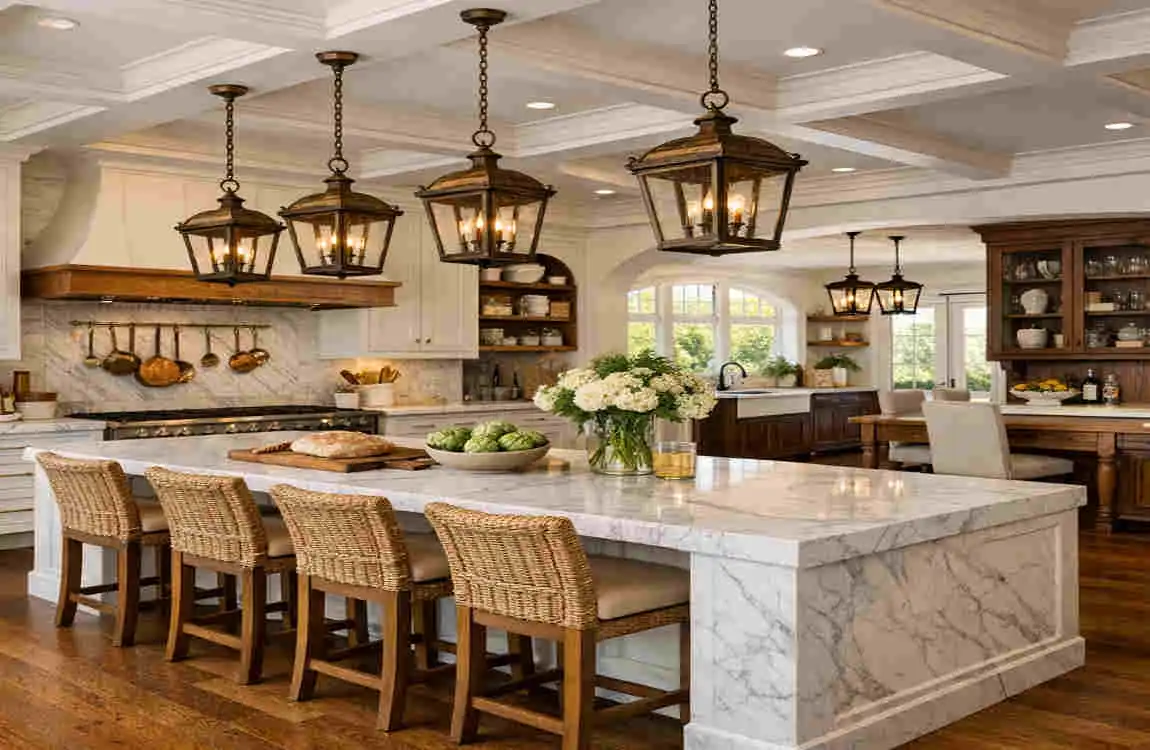
If you are fortunate enough to have a kitchen that exceeds 200 square feet, a world of luxurious possibilities opens up. However, designing a massive kitchen requires careful planning to ensure the space does not feel echoey or inefficient.
When your kitchen exceeds 250 square feet, you will likely move away from galley designs and lean toward U- or L-shaped layouts. These expansive designs allow you to spread out your appliances and create a beautiful flow.
Here are some of the luxury perks and trends you can incorporate into a large kitchen:
- Multiple work zones: Instead of a single workflow triangle, a massive kitchen allows for dedicated zones. You can build a specialized baking zone with lower marble counters for kneading dough. You can create a dedicated coffee station with its own small sink. You could add a secondary prep sink on your massive center island so two people can cook simultaneously without crossing paths.
- Walk-in pantries and butler’s pantries: Large kitchens often feature hidden storage rooms. A butler’s pantry acts as a brilliant staging area for dinner parties, keeping the messy prep work hidden from your guests.
- Smart appliance integration: In a sprawling 15-by-20-foot space, you have room for all the high-tech toys. Think double-wall ovens, built-in espresso machines, massive smart refrigerators, and under-counter wine coolers.
Keep in mind, transforming a large space comes with a matching price tag. Remodeling a kitchen that pushes beyond 200 square feet typically costs upwards of $50,000, and luxury upgrades can easily push that budget much higher.
Regional Variations
While we have focused heavily on the standard U.S. housing market, it is fascinating to see how the average kitchen changes depending on exactly where you live in the world. Geography, culture, and real estate markets heavily dictate how we design our cooking spaces.
In the United States, you will find stark regional contrasts. If you buy a historic brownstone in the Northeast, you will likely encounter a highly compact, urban-style kitchen designed a century ago. Conversely, if you build a home in the expansive South or West, sprawling open-concept plans are the expected norm.
Looking globally, the differences become even more pronounced. In European cities, the average kitchen often maxes out around 120 square feet, prioritizing high-efficiency European appliances and sleek, minimalist storage. In many parts of Asia, including standard homes in and India, traditional kitchens are often smaller—typically 80 to 120 square feet. These spaces are incredibly efficient, designed for robust daily cooking despite the smaller footprint.
Why do these variations exist? Here is a list of five key factors that influence kitchen size around the world:
- Real estate costs: In densely populated urban centers, the cost per square foot is too high to dedicate massive amounts of space to a single room.
- Cultural cooking habits: Some cultures view the kitchen strictly as a hidden workspace for heavy cooking. In contrast, others view it as a primary entertainment lounge.
- Climate and architecture: Older homes in colder climates often featured closed-off kitchens to trap the heat from the stove, resulting in smaller, distinct rooms.
- Family size: Regions with larger, multi-generational households often prioritize expansive kitchens to accommodate multiple cooks and massive family meals.
- Historical preservation: Many global cities feature strict building codes protecting older properties, preventing homeowners from blowing out walls to create modern open concepts.
Remodel Tips to Optimize Size
Are you feeling inspired to tackle a home improvement project? Whether your kitchen is a tiny 100-square-foot nook or a sprawling 300-square-foot masterpiece, optimizing your layout is the key to a successful remodel.
As a professional home improvement team, we highly recommend following a strategic approach when upgrading your space.
Measure Your Space
Before you buy a single cabinet, you must know exactly what you are working with. Grab your measuring tape and measure the length and width of your room. Multiply those two numbers together, and you have your total square footage.
However, measuring goes beyond floor space alone. You must account for your “work zones” and clearances. For a kitchen to feel comfortable, you need a minimum of 4 to 6 feet of clearance space between opposite counter runs. If you plan to add an island, ensure you have at least 42 to 48 inches of walking space around all sides. Otherwise, you will not be able to open your oven door or dishwasher without completely blocking the room.
Cost by Size
Budgeting is the most stressful part of any remodel, but understanding your square footage helps you estimate costs accurately. Most contractors price materials like flooring, countertops, and cabinetry by the square foot.
- Small kitchens (approx. 100 sq ft): A full remodel for a compact space typically ranges between $10,000 and $20,000, assuming you do not move plumbing or electrical lines.
- Large kitchens (200+ sq ft): When you double the space, you more than double the cost. Large kitchen remodels generally run between $30,000 and $50,000, with high-end appliances pushing that number higher.
To ensure your remodel runs smoothly, follow this simple list of steps:
- Assess your traffic flow: Notice how people currently walk through your kitchen. Does the open dishwasher block the doorway? Does the refrigerator door hit the island? Identify these bottlenecks first.
- Choose the right layout: Pick a layout that complements your size. Stick to a galley or L-shape for small spaces. Explore U-shapes or massive islands for larger footprints.
- Set a smart budget: Financial experts recommend budgeting 10% to 15% of your home’s total overall value for a complete kitchen remodel. This ensures your upgrade perfectly aligns with your neighborhood’s real estate market.
Frequently Asked Questions (FAQ)
How big is the average kitchen in square feet? In standard U.S. homes, the average kitchen measures between 161 and 169 square feet, roughly equivalent to a 13-by-13-foot room.
What is the typical kitchen size by home square footage? Kitchen sizes scale with the home. Houses under 1,500 sq ft average 103 sq ft of kitchen space. Mid-size homes (1,500-3,000 sq ft) average 161-174 sq ft. Large homes (3,000-4,000 sq ft) average 191-238 sq ft, and luxury homes over 4,000 sq ft feature kitchens exceeding 300 sq ft.
What is the minimum kitchen size allowed by code? While building codes vary by municipality, the International Residential Code (IRC) generally requires a kitchen to have at least 50 square feet of floor space to accommodate basic appliances and meet clearance requirements safely.
Does a larger kitchen increase home resale value? Yes. Homes featuring updated kitchens larger than 200 square feet are highly attractive to buyers, often selling up to 20% faster and boosting the overall home sale price by 7% to 10%.
How much space do I need for a kitchen island? To comfortably install an island, your kitchen should ideally be 150 square feet. You must leave an absolute minimum of 36 inches (preferably 42 to 48 inches) of walking clearance on all sides of the island to allow for safe traffic flow and appliance door clearance.
What is the best layout for a small kitchen? The galley layout is widely considered the most efficient design for small kitchens around 100 square feet. By utilizing two parallel walls, it maximizes vertical storage and keeps the cooking workflow incredibly tight and accessible.