
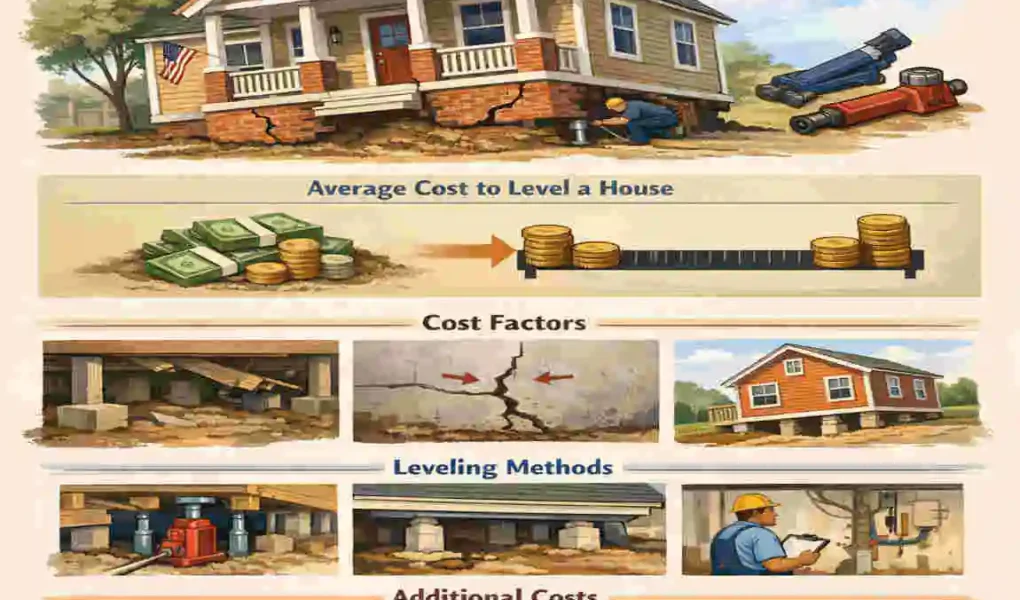
Imagine this scenario: You have finally bought your dream home. It has character, charm, and a classic wood-frame aesthetic that feels warm and inviting. But lately, you have noticed something unsettling. Your coffee cup slides across the table on its own, or maybe the bathroom door refuses to latch unless you lift it. You look at the walls and see a jagged crack running from the corner of the window up to the ceiling.
Your heart sinks. You realize the foundation is shifting.
If this sounds familiar, don’t panic. It is a common issue, but it is one you need to address immediately. The question racing through your mind right now is likely, “How much does it cost to level a wood-frame house?”
To give you the short answer: The average cost to level a wood-frame house typically ranges between $3,000 and $25,000. However, this price can fluctuate widely depending on your home’s size, the method used, and your location.
Why does this matter? Because ignoring a sinking foundation is like ignoring a cavity in your tooth—it only gets more expensive and painful the longer you wait. A level home ensures structural integrity and safety and can even boost your resale value by 10-15%.
What Is House Leveling and Why Do Wood Frames Need It
Before we dive into the checkbook, let’s understand what we are actually paying for. luxury House leveling isn’t just about making things look straight; it is about restoring the structural spine of your home.
The Mechanics of Leveling
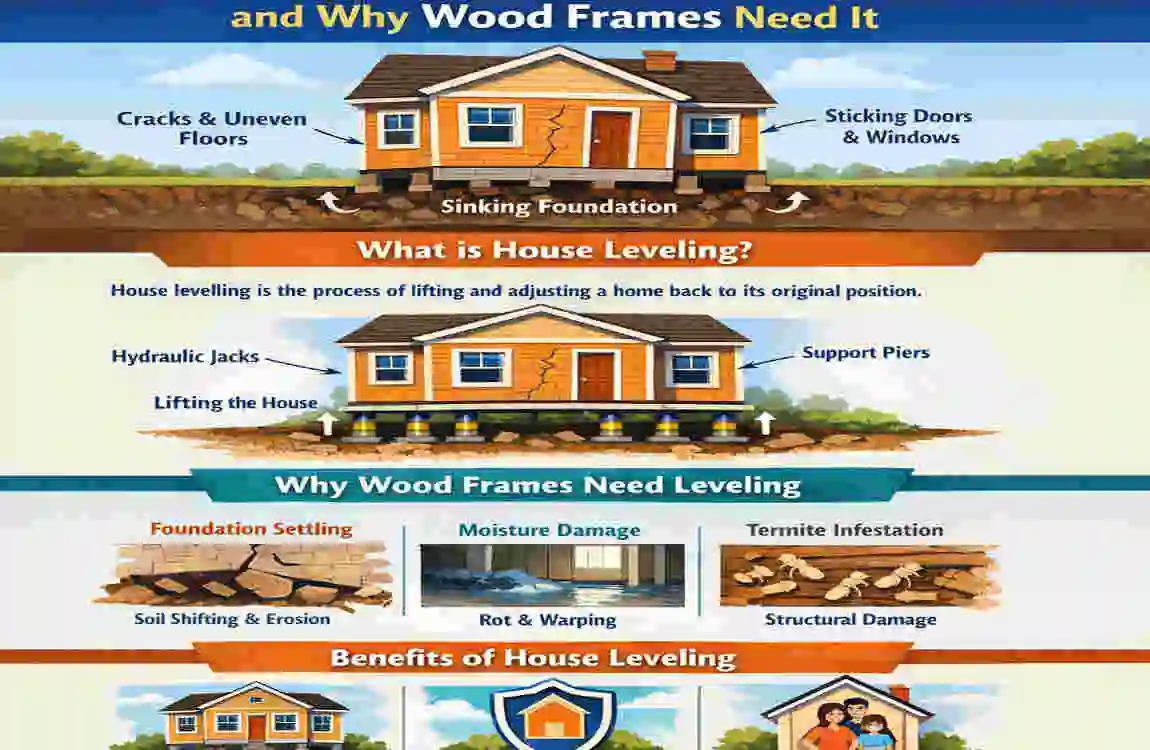
House leveling involves lifting and adjusting the piers, beams, or slabs that sit underneath your wood frame. Think of your house like a table. If one leg is shorter than the others, the table wobbles. To fix it, you have to lift that corner and slide a shim underneath or replace the leg entirely.
For a wood-frame house, this usually involves crawling under the home (into the crawlspace) and using heavy-duty hydraulic jacks to physically lift the structure back to its original position. Once it is level, contractors install steel piers, concrete blocks, or new wood beams to keep it there.
Why Wood Frames Are Vulnerable
Wood-frame houses are beautiful, but they have specific vulnerabilities that concrete-block homes might not.
- Rot and Moisture: Wood is organic. If your crawlspace isn’t encapsulated, moisture from the ground can seep into your beams. In humid climates like Lahore or the American South, this can lead to “dry rot,” in which the wood loses strength and crumbles, causing the house to sag.
- Pests: Termites love wood. If they eat through your support beams, gravity takes over.
- Soil Movement: Wood-frame houses are often built on “pier and beam” foundations. If the soil shifts—due to drought or heavy monsoon rains—the piers can sink, taking the house with them.
Signs You Need Leveling Immediately
How do you know if you are in the danger zone? Look for these symptoms:
- Sloping Floors: Use the “marble test.” Place a marble on the floor; if it rolls fast to one side, you have a slope.
- Sticking Doors and Windows: When the frame distorts, rectangular openings become parallelograms, jamming doors.
- Drywall Cracks: Look for cracks specifically above door frames or extending from corners.
- Bouncy Floors: If the floor feels like a trampoline when you walk, the joists underneath are likely damaged or unsupported.
- Gaps in Trim: Look at your baseboards or crown molding. Are they pulling away from the wall?
- Chimney Leaning: If your chimney looks like the Tower of Pisa, the foundation below it has failed.
- Water in the Crawlspace: Standing water suggests drainage issues that are actively undermining your foundation.
If you delay, you risk catastrophic failure. A simple leveling job costing $5,000 can turn into a full structural rebuild costing upwards of $50,000.
Average Costs: National and Regional Breakdown
Now, let’s get to the core of your search: How much does it cost to level a wood-frame house?
On a national scale in the United States, homeowners typically pay between $5 and $25 per square foot. For a standard 1,500-square-foot home, this usually falls around $8,000, but it can go much higher.
However, “average” is a tricky word. The method used to level the house significantly changes the price. Since wood-frame houses often use pier-and-beam foundations, let’s look at the specific costs for the most common methods.
Cost by Leveling Method
MethodCost per Sq FtTotal for 1,500 sq ft HomeBest For
Pier & Beam Adjustment $10 – $20 $15,000 – $30,000 Standard wood crawlspaces with settling issues.
Slab Jacking (Mudjacking) $3 – $8 $4,500 – $12,000 Minor settling where concrete slabs are involved.
Helical Piers $15 – $30 $22,500 – $45,000 Severe cases requiring deep stabilization; heavy loads.
Shimming (Minor) $2 – $4 $3,000 – $6,000 Minor adjustments where the piers are stable but the wood has compressed.
Regional Variations
Where you live dictates the price of labor and materials.
In the United States, if you live in the South or regions with expansive clay soil (like Texas), foundation repair is very common. Competition is high, which keeps labor costs low, averaging around $10,000 for a standard job. However, if you are in a remote rural area, you might pay a premium for the contractor’s travel time.
In Pakistan (Context for Lahore/Islamabad Readers): For our readers dealing with construction in South Asia, the pricing model is different. You aren’t paying in dollars per square foot, but rather in material and labor contracts.
- Total Project Cost: Expect to pay between PKR 1 Million to 5 Million (approx. $3,500 – $18,000 USD).
- Why the Variance? Importing high-quality steel helical piers is expensive due to tariffs. Local concrete solutions are cheaper but may not last as long in the heavy monsoon seasons that affect Lahore’s soil.
Inflation Note: Keep in mind that construction costs have risen globally by about 10% since 2025. Steel prices and labor shortages are driving these numbers up, so a quote you got two years ago is likely no longer valid.
Key Factors Influencing Wood House Leveling Prices
You might call a contractor and hear a quote of $5,000, while your neighbor with a similar house gets quoted $15,000. Why the discrepancy? Several variables influence the final bill.
Home Size and Layout
It is simple math: a larger home is heavier. It requires more jacks to lift and more piers to support. A cozy 1,000-square-foot cottage might only cost $5,000 to shim and level. Conversely, a sprawling 3,000-square-foot Victorian home with multiple load-bearing walls could easily exceed $20,000. Multi-story homes are also more expensive because the weight load on the foundation is doubled.
Severity of Damage
Are we talking about a slight dip in the kitchen, or has a main beam snapped in half?
- Minor Shim: If the piers are good but the wood beam has shrunk, contractors just wedge steel shims in the gap. This is cheap ($2k-$4k).
- Major Rot: If the beams are rotten, they have to be cut out and replaced while the house is suspended in the air. This is labor-intensive and expensive ($15k+).
Accessibility and Crawlspace Height
Contractors charge for “misery.” If your crawlspace is roomy and dry, the job is easier. If your crawlspace is only 18 inches high, filled with mud, spiders, and old debris, the price goes up. Experts call this the “Crawlspace Premium,” and it can add 20% to labor costs.
Soil Conditions
The soil under your house is the culprit.
- Sandy Soil: easier to dig but requires deeper piers to find stability.
- Clay Soil: Hard to dig and expands/contracts violently.
- Lahore Context: In areas with heavy rainfall and shifting alluvial soils, engineers might require soil testing (costing an extra PKR 50,000) to determine how deep the piers must go.
Essential Add-Ons
The leveling quote often doesn’t include the necessary extras. Be prepared for these:
- Permits and Structural Engineering Reports: $500 – $2,000.
- Vapor Barriers: Essential for preventing future rot. $1 – $2 per sq ft.
- Beam Replacement: If the wood is too far gone. Adds roughly 30% to the bill.
- Plumbing Repairs: Lifting a house can cause old pipes to snap. You might need a plumber on standby ($500+).
Cost Breakdown by Project Phase
To help you budget, let’s break down the timeline of a typical leveling project. You aren’t just paying for the “lift”; you are paying for a multi-stage construction process.
Inspection and Engineering ($300 – $1,000)
Before a single tool is lifted, a structural engineer or a foundation specialist must assess the home. They use laser levels (altimeters) to map exactly how much the floor has dropped. They may also perform soil borings. While some contractors offer “free estimates,” a formal engineer’s report (often required for permits) costs money.
Preparation and Demo ($1,000 – $3,000)
The crew arrives. They have to clear the area around the luxury house. This might involve removing landscaping to access vents or clearing out junk from the crawlspace. If you have skirting around your pier-and-beam home, it may need to be removed to place the jacks.
The Leveling Process ($5,000 – $15,000)
This is the main event.
- Hydraulic jacks are placed under the beams.
- The team slowly—very slowly—lifts the house. They monitor the interior to ensure the drywall doesn’t explode from the stress.
- Once level, they install the new piers or shim the existing ones.
- Cost Driver: The more piers needed, the higher this cost.
Finishing and Stabilization ($1,000 – $5,000)
You can’t just walk away once it’s level. The crew must stabilize the new supports. They might pour concrete footings. They will also reinstall skirting and often install a moisture barrier to protect their work.
Hidden Fees Table
Fee TypeEstimated CostNotes
Permits 1-2% of project value. Varies by city/municipality.
Travel/Fuel: A 5-15% surcharge applies if you live 50+ miles from the city.
Landscape Repair $500+ Fixing bushes/grass damaged by equipment.
DIY vs. Professional Leveling: Cost and Risk Comparison
In the age of YouTube, you might rent some bottle jacks and try to level the house yourself. Please, pause and consider this carefully.
The DIY Reality
Yes, you can buy a 20-ton jack for $100. However, house leveling is not just about pushing the house up; it is about knowing where to push and how much.
- Equipment Costs: To do this safely, you need multiple jacks (lifting on a single point can crack your house in half), cribbing, heavy timbers, and safety gear. This can easily cost $2,000.
- The Failure Rate: According to industry stats from Angi, nearly 70% of DIY foundation attempts fail, requiring a professional to fix the original problem, plus the new damage caused by the homeowner.
- Legal Issues: In most jurisdictions, structural work requires a license. If you sell the home later, unpermitted foundation work can kill the deal.
Professional Advantages
When you hire a pro, you are paying for assurance.
- Warranties: Reputable companies offer transferable warranties ranging from 10 to 25 years. If it sinks again, they fix it for free.
- Insurance: If a pro drops your house (it happens!), their liability insurance builds you a new one. If you drop your house, your homeowner’s insurance will likely deny the claim due to negligence.
Comparison Chart
OptionEst. Cost Savings, Risk Level, Time Required, Warranty?
DIY 40-60% (Initial) Extremely High 1-2 Weeks (Full-time) No
Professional Baseline Pricing Low 3-7 Days Yes (10-25 Yrs)
The Verdict: Unless you are solely adding a small shim to a shed or a very small cabin, do not attempt to level a main residence yourself. The risk of destroying your plumbing, electrical, and structural framing is too high.
Saving Money on Wood Frame House Leveling
Just because you shouldn’t do it yourself doesn’t mean you have to pay top dollar. Here are seven budget hacks to lower your “how much does it cost to level a wood frame house” estimate.
- Shop Around: Always get at least three bids. Prices can vary by 30% between companies.
- Go Off-Season: Foundation companies are busiest in summer and dry seasons. Call them in the winter. They might offer a discount to keep their crews working.
- Bundle Repairs: If you need drainage work (such as French drains) or gutter repair, ask the same company to handle it. Bundling can save on mobilization fees.
- Clear the Area Yourself: You can save $500-$1,000 by clearing the crawlspace and removing landscaping yourself before the crew arrives.
- Local vs. National: Large national franchises have high overheads. Local, family-owned businesses often have lower rates. (For our PK readers: local contractors using concrete piers are significantly cheaper than firms importing steel piers.
- Catch it Early: Leveling a house that has settled 1 inch is cheap. Leveling a house that has settled 4 inches is expensive. Don’t wait.
- Financing: Most major repair companies offer financing. Additionally, look into Home Equity Loans. Since this repair improves home value, banks are often willing to lend against your equity at lower rates (4-7% APR).
Step-by-Step Guide to Budgeting and Hiring
Ready to move forward? Follow this roadmap to ensure you hire the right team at the right price.
Assess the Damage. Walk to your home. Take photos of cracks. Note where doors stick. Having this list helps you communicate with the contractor and ensures they address all your concerns.
Get 3 Quotes. Don’t just look at the bottom-line number. Look at the method. Is Contractor A proposing simple shims while Contractor B suggests deep helical piers? Ask them to explain why.
Verify Credentials
- USA: Check for state licensing and membership in the Foundation Repair Association.
- Pakistan: Look for registration with the Pakistan Engineering Council (PEC) or with local bodies such as the PKPWA. Ask for references from past clients.
Sign a Detailed Contract. The contract should specify the number of piers, the depth at which they will be driven, the cleanup process, and the warranty terms. Ensure there is a clause for “unforeseen damages” so you know how hidden rot will be billed.
Monitor and Post-Care Once the job is done, you might need to repaint walls or adjust doors (sometimes lifting the house fixes the door, sometimes it makes it stick in a new way!). Keep an eye on your drainage to ensure the problem doesn’t return.
Tools: Use online cost calculators like Homewyse or HomeAdvisor to get a rough baseline for your specific zip code before negotiating.
Common Mistakes and Red Flags
As you navigate this process, be on the lookout for these expensive pitfalls.
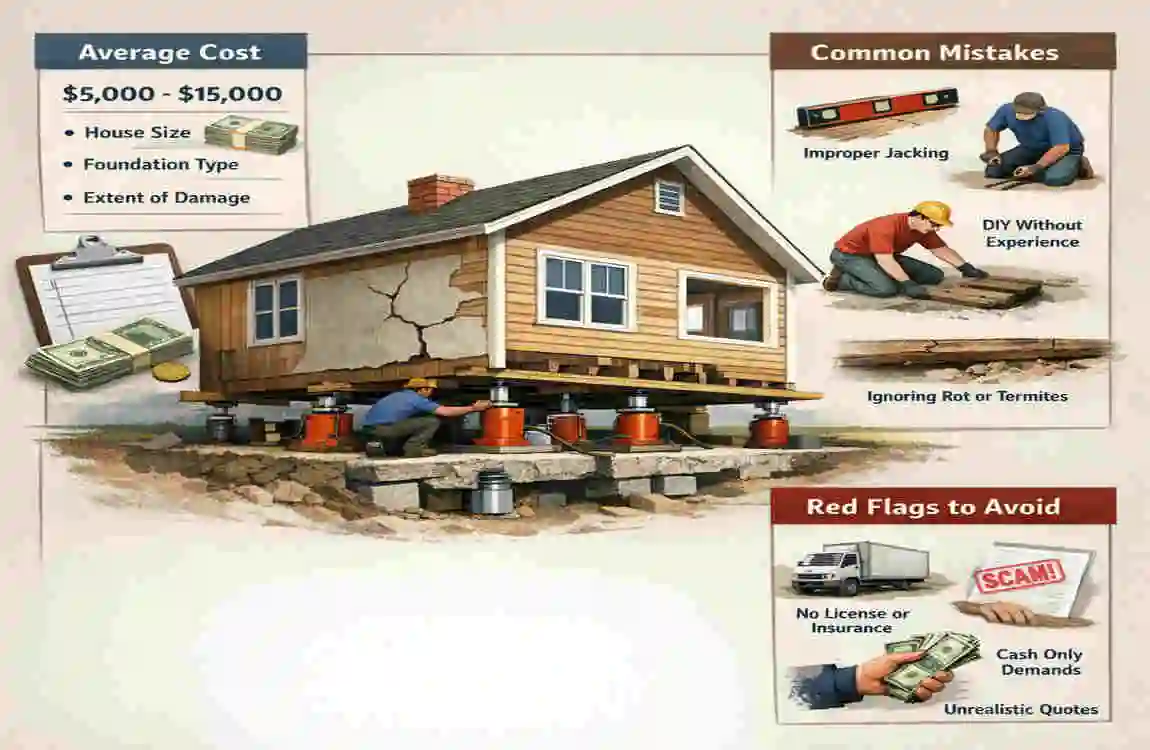
- The “Band-Aid” Fix: Some contractors might suggest just pouring more concrete over an existing bad foundation. This adds weight and often makes sinking faster.
- Skipping Inspections: If a contractor says, “We don’t need a permit,” run. You want the city inspector to verify that the work is safe.
- Cheap Piers: Not all concrete is created equal. Cheap, homemade concrete cylinders can crack in five years. Ensure they are using high-PSI, commercial-grade materials.
- Ignoring the Water: You can spend $20,000 leveling the luxury house, but if you don’t fix the broken gutter dumping water on the foundation, the house will sink again.
- Large Upfront Deposits: Never pay 100% upfront. A standard deposit is 10-30%, with the rest due upon completion and satisfaction.
FAQs
How much does it cost to level a wood-frame house in the U.S. vs. Pakistan? In the U.S., costs range from $5,000 to $25,000, depending on the method. In Pakistan, particularly in urban centers like Lahore, costs range from PKR 1 million to 5 million ($3,500 – $18,000) due to imported material costs and soil complexity.
What is the average house leveling price for pier and beam foundations? For pier and beam homes, the most common wood frame foundation, the average cost is between $4,000 and $8,000 for minor repairs, and up to $15,000 for extensive leveling and beam replacement.
Is house leveling worth the cost? Absolutely. It prevents catastrophic structural collapse and restores property value. Most real estate agents agree that you cannot sell a home with a known foundation issue for market value; you will lose more on the sale price than the cost of the repair.
How long does wood house leveling take? Most residential projects take between 3 and 7 days. This includes setup, the actual lifting process (which is slow and careful), and stabilizing the new piers.
Can insurance cover foundation leveling costs? Generally, no. Standard homeowner’s insurance considers foundation settling a maintenance issue. However, if the damage was caused by a specific covered event—like a burst pipe flooding the crawlspace—you might have a claim. Always check with your agent.