
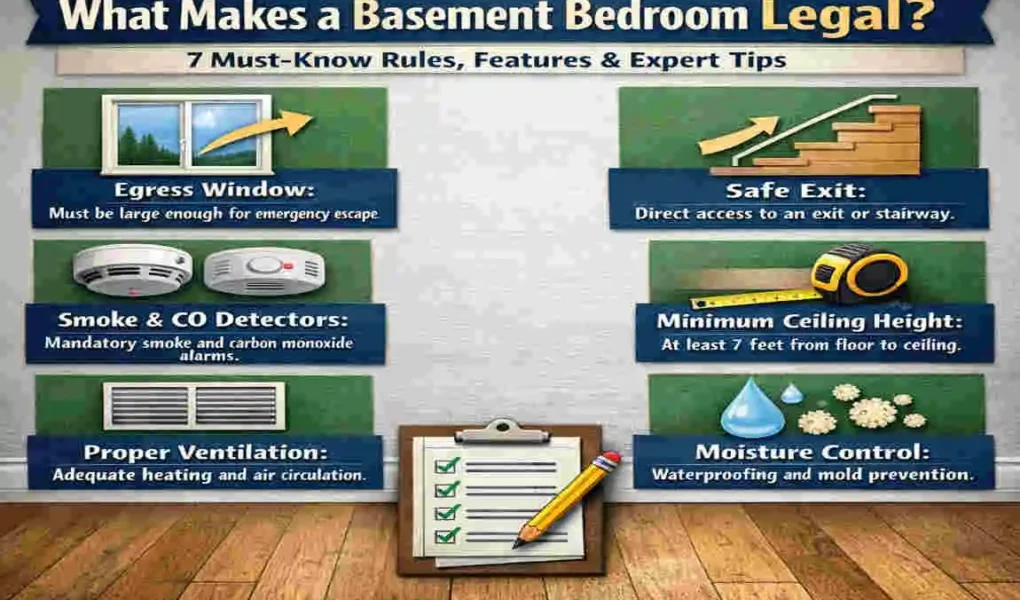
Have you ever found yourself staring at that dark, dusty, and unused space under your main floor, wondering about its true potential? You are certainly not alone. Across the country, homeowners are facing a massive housing shortage, shifting family dynamics, and a growing need for extra space. Whether you are welcoming a new baby, creating a suite for aging parents, or simply wanting to boost your property’s resale value, finishing your lower level is a brilliant solution. But before you start buying drywall and picking out paint colors, you need to understand exactly what makes a basement bedroom legal, safe, and fully compliant with modern building standards.
You might be thinking, “Can’t I just throw a mattress on the floor, add a lamp, and call it a day?” Unfortunately, the answer is a resounding no. Building codes exist for a very good reason. They are not just bureaucratic red tape designed to make your renovation more difficult; they are life-saving guidelines that protect your family from fire hazards, electrical dangers, and structural failures. Furthermore, a non-compliant room will not be recognized as a true bedroom when it comes time to sell your home, meaning you could lose out on tens of thousands of dollars in potential resale value. It can even void your homeowner’s insurance if an unpermitted space leads to property damage.
Rule : Egress for Emergency Escape
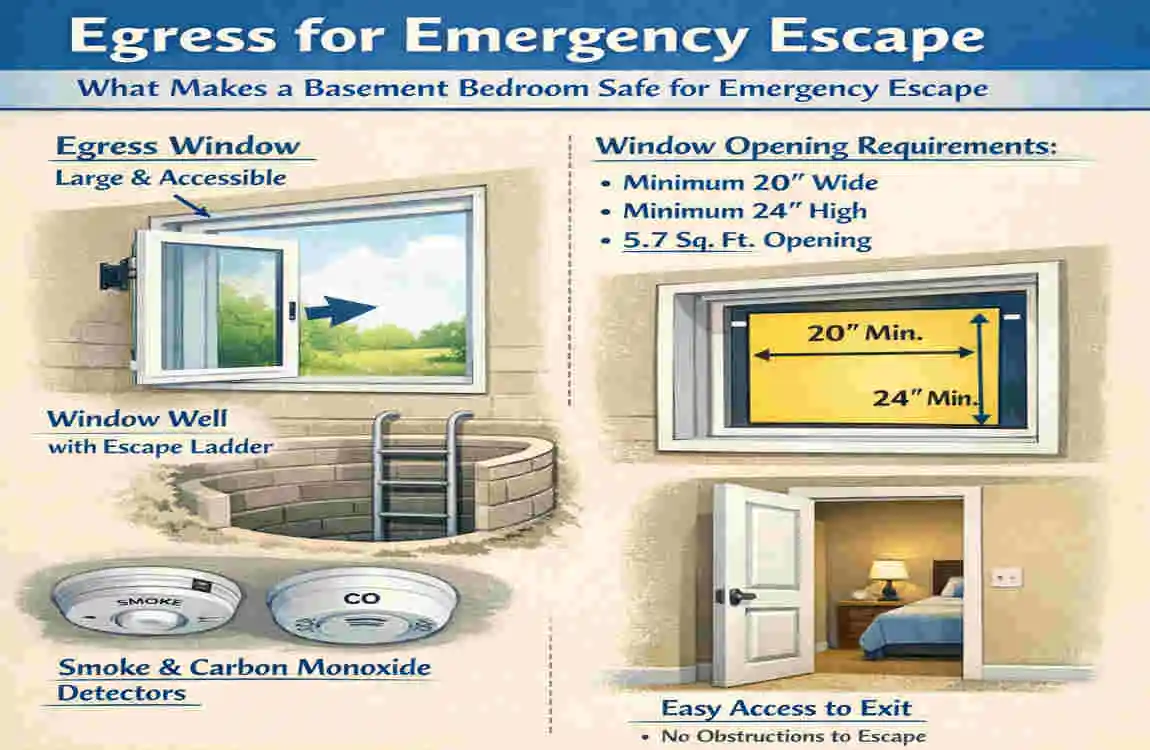
When it comes to building codes, safety is the absolute top priority. If you only remember one thing from this entire article, let it be this: legal basement bedrooms require a proper egress window or door. “Egress” is simply a fancy architectural term for a safe, reliable, and direct way out during an emergency.
The Importance of a Safe Exit
Imagine a worst-case scenario where a fire breaks out on the main floor of your home in the middle of the night. The interior stairs are blocked by smoke or flames. If your lower-level sleeping area does not have a secondary escape route, anyone inside is effectively trapped. That is why the International Residential Code (IRC) is incredibly strict about egress requirements. An egress window is not just for you to climb out of; it is also specifically sized to allow a fully equipped firefighter with a heavy oxygen tank to climb in to rescue you.
Sizing Up the IRC Standards
Because of this dual purpose—getting you out and getting emergency personnel in—the dimensions of your escape window must meet exact mathematical standards. According to the IRC, an egress window must provide a minimum of 5.7 square feet of clear opening space. Notice the word “clear.” This means the actual empty space when the window is fully wide open, not the size of the glass itself.
Furthermore, the window must have a minimum opening height of 24 inches and a minimum opening width of 20 inches. Keep in mind that you cannot simply use the absolute minimums for both width and height, because a 24-inch by 20-inch opening only equals 3.3 square feet, which falls short of the 5.7 square foot requirement. You have to expand one of those dimensions to hit the magic 5.7 number! Finally, the bottom sill of the window can be no higher than 44 inches from the finished floor, ensuring that children and adults alike can reach it and climb out without needing a step stool.
Understanding Window Wells and Installation Costs
Because basements are, by definition, underground, your egress window will likely sit below the exterior soil line. This means you must dig and install a window well outside the house. The window well must provide at least 9 square feet of floor area, with a minimum width and projection of 36 inches. This gives you enough physical room to crawl out of the window and stand up outside.
If your window well is deeper than 44 inches into the ground, the code requires you to install a permanently affixed ladder or built-in steps so you can climb up to the yard.
Expert Tip: When choosing your window style, casement windows (which crank out to the side like a door) work best for underground applications. They open entirely, giving you the maximum clear opening without requiring a massive frame.
Adding an egress window involves excavating dirt, cutting through your concrete foundation, installing the well, ensuring proper drainage, and framing the window. Because it is labor-intensive, you should expect costs to range anywhere from $1,000 to $5,000 installed, depending on your foundation type and the depth of your excavation.
Rule : Minimum Ceiling Height
Nobody likes walking into a room and feeling like the ceiling is going to crush them. Low ceilings make spaces feel cramped, dark, and uncomfortable. Beyond mere comfort, however, ceiling height is a critical factor in determining the legality of your living space.
Why Headroom Matters
The IRC dictates very specific headroom requirements to ensure that a room is actually habitable. A space meant for sleeping, dressing, and relaxing needs enough vertical volume to allow for proper air circulation and comfortable movement. If your ceiling is too low, the room cannot be classified as a bedroom.
The general rule of thumb under standard code is that your finished ceiling must be at least 7 feet high over at least 50% of the floor area. In the remaining areas of the room, the ceiling can drop slightly, but it must be no less than 6 feet 8 inches high.
Navigating Obstacles Like Beams and Ducts
If you look up at your unfinished ceiling right now, you will likely see a maze of obstacles. Air ducts, water pipes, electrical wires, and massive structural support beams cross back and forth. These are the lifeblood of your home’s infrastructure, but they pose a massive headache for finishing your ceiling.
How do you handle these obstructions? You have a few solutions. The most common is to install a dropped ceiling or box out the ductwork using drywall soffits. However, remember that even these boxed-out areas must adhere to the minimum height clearances. If a structural beam hangs down and reduces your ceiling height to 6 feet 2 inches, you have a code violation on your hands.
If your home is much older and the entire foundation is too shallow, you might have to resort to extreme solutions like excavation or underpinning. This involves literally digging out the concrete floor, removing dirt, and pouring a new, lower foundation slab to give you the required height. It is a highly expensive and complex project, but sometimes it is the only way to achieve compliance.
Regional Code Variations
It is important to understand that the IRC is a baseline. Local municipalities can, and often do, adopt stricter variations of these rules. For example, densely populated areas like New York city have incredibly stringent requirements due to historical fire risks. Other areas are more lenient depending on the age of the structure.
Take a look at this quick comparison of height requirements by code to see how things can vary:
Code Type Min Height (Primary Area)Exceptions Allowed
IRC (US) 7 feet (over 50% of the room) 6 feet 8 inches in the remainder
Ontario (Canada) 6 feet 5 inches Sloped areas under stairs
Expert Tip: When determining your height, always measure from the finished floor to the lowest fixture. If you are adding plush carpet with a thick pad, or snap-together vinyl planks over a subfloor, you are going to lose an inch or two of vertical space. Always account for the finished materials before assuming you meet the 7-foot minimum!
Rule : Adequate Room Size
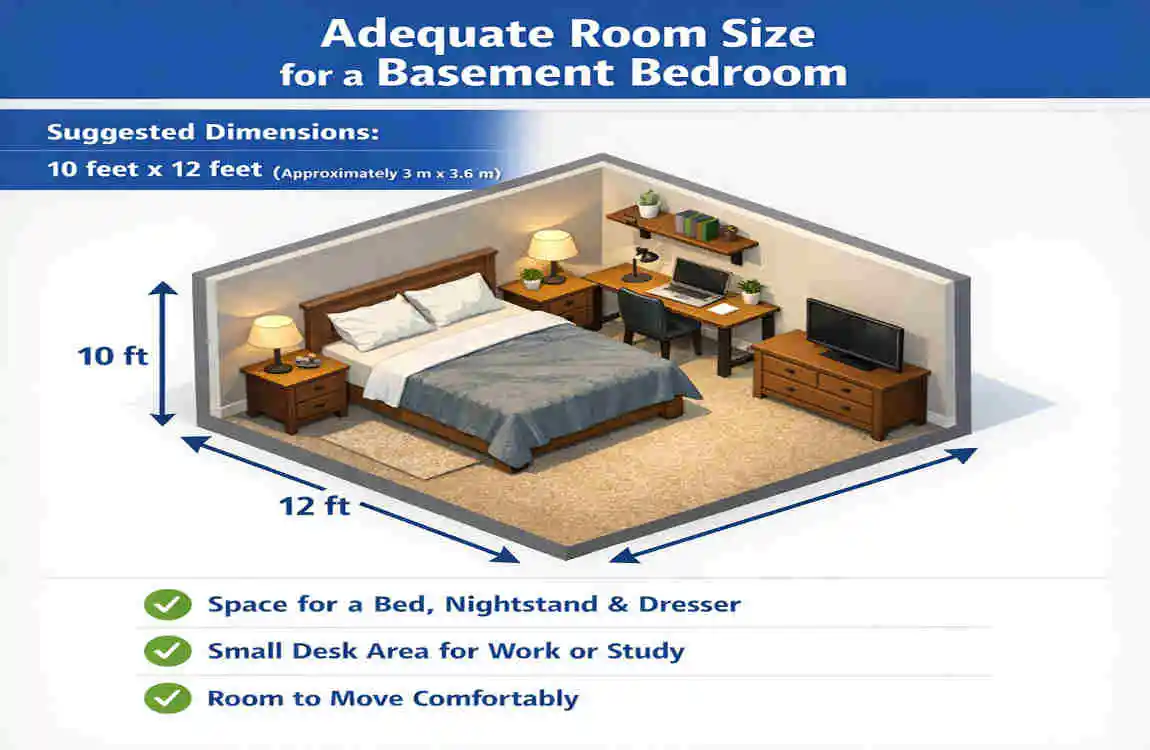
A bedroom is not just a place to put a bed; it is a personal sanctuary. It needs to have enough square footage to allow occupants to move around safely, store their belongings, and exit quickly in an emergency. You cannot simply wall off a tiny 5×5 foot closet and call it a sleeping quarter.
The Basics of Bedroom Dimensions
The building code ensures that rooms are sized appropriately for human habitation. For a single-occupancy room—meaning a room designed for one person to sleep in—the floor area must be a minimum of 70 square feet.
But square footage isn’t the only metric. The shape of the room matters immensely. You could technically have a room that is 3 feet wide and 24 feet long, which equals 72 square feet, but you could never comfortably fit a bed in a 3-foot-wide hallway! Because of this, the code mandates that no wall dimension can be under 7 feet. A 7×10 foot room is perfectly legal and meets both the square footage and the minimum dimension requirements.
Planning for Multiple Occupants
What if you are planning to have two children share the room, or you are building a primary suite for a couple? The requirements shift slightly. For every additional person occupying the room, you need to add more space.
While a single person needs 70 square feet, a room designed for two people requires a minimum of 100 square feet. This ensures that there is enough breathable air volume in the room overnight and enough floor space to navigate around two beds or one larger bed.
Here is a simple table for quick reference when planning your layout:
Occupancy Level Minimum Floor Area Minimum Wall Dimension
1 Person 70 square feet 7 feet
2 People 100 square feet 7 feet
The Real Estate Factor
Why do these dimensions matter so much? Beyond safety, undersized rooms will fail municipal inspections, meaning you will not get your final permit approved. Worse yet, when you try to sell your home, a real estate appraiser will refuse to count an undersized room as a bedroom. This can drastically hurt your home’s official listing and appraisal value.
Expert Tip: Always include a built-in closet! While the IRC building code does not strictly demand a closet for a room to be considered habitable, the real estate market absolutely does. Buyers expect it, and real estate agents will often refuse to list a room without a closet as a true bedroom. Plan for at least a standard 6 square foot closet in your design to ensure your investment pays off on listing day.
Rule : Natural Light and Ventilation
Humans are not mushrooms; we cannot thrive in dark, damp, completely enclosed boxes. Natural light regulates our circadian rhythms, boosts our mood, and makes a space feel welcoming. Ventilation keeps the air fresh and prevents the buildup of dangerous indoor air pollutants and odors. Therefore, building codes mandate specific light and air requirements for habitability.
Letting the Sunshine In
A legal sleeping space must have access to natural sunlight. Artificial lighting from lamps and overhead fixtures does not count toward this requirement. The rule states that the total glass area of your windows must equal at least 8% of the total floor area of the room.
Let’s break down those calculations so they are easy to understand. Imagine you are building a spacious lower-level suite that measures 200 square feet. To meet the 8% rule, you would multiply 200 by 0.08, which gives you 16. Therefore, you need a minimum of 16 square feet of glazing (the technical term for the glass portion of the window).
The Breathing Room: Ventilation Basics
Alongside light, the room must be able to “breathe.” The ventilation requirement dictates that the operable part of your window—the part that actually opens to let fresh air in—must equal at least 4% of the room’s total floor area.
Using our 200-square-foot room example again, 4% of 200 is 8. You need 8 square feet of operable window space. Conveniently, if you install a window that meets the 8% light requirement and half of that window can open, you automatically meet the 4% ventilation requirement!
Upgrading to Energy-Efficient Windows
When installing these required windows, you have a prime opportunity to upgrade your home’s thermal envelope.
Expert Advice: Do not cheap out on the glass. Use highly energy-efficient double-pane glass with Low-E coatings. Underground spaces are naturally cooler and prone to heat loss. Modern double-pane windows will help you meet strict, modern insulation codes, keeping your space warm in the winter and reducing your energy bills significantly.
Avoiding Common Mistakes
A very common mistake homeowners make is installing the correctly sized window, but then accidentally reducing its effective area. This happens when deep, narrow window wells block the sunlight from reaching the glass, or when heavy, permanent security bars or immovable screens block the operable sash. Ensure your window well is wide enough to let light pour in, and ensure any covers or grates over the well can be easily pushed open from the inside without the use of keys or tools.
Rule : Heating and Electrical Systems
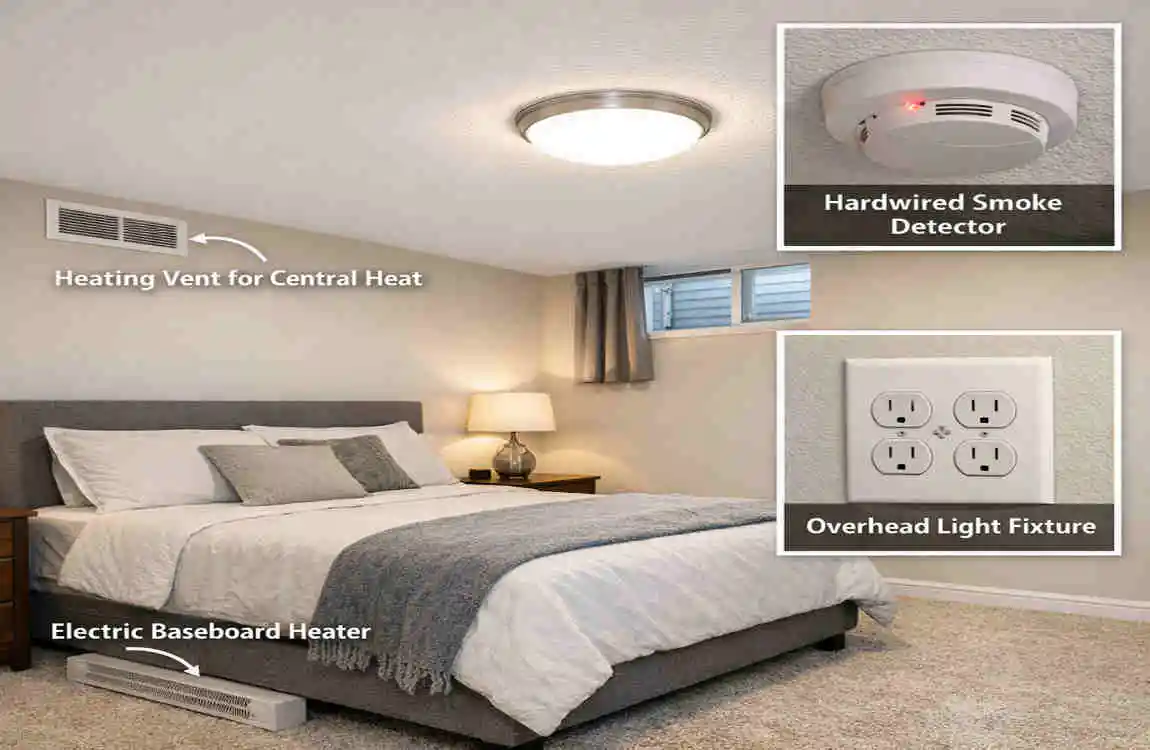
You cannot simply run an orange extension cord down the stairs, plug in a portable space heater, and call your new space a legal room. Code requirements for heating and electrical systems are incredibly strict because these are the two areas most likely to cause a catastrophic house fire if done incorrectly.
Keeping It Cozy: Heating Requirements
Lower levels are notoriously chilly. The surrounding earth acts as a massive heat sink, pulling warmth out of the room. To combat this, building codes require a permanent, fixed heat source capable of maintaining a consistent room temperature of at least 68°F (20°C) at a distance of three feet above the floor.
What does a “permanent” heat source mean? It means the system must be hardwired or plumbed into the home. Portable, plug-in space heaters are strictly prohibited as primary heat sources because they are massive fire hazards and can overload electrical circuits.
You have a few great options to meet this requirement. You can extend your home’s existing ducted HVAC system by adding new supply and return vents. Alternatively, you can install dedicated electric baseboard heaters, or even luxurious radiant floor heating underneath your finished flooring.
Powering Up: Electrical and Safety Codes
The modern bedroom requires a lot of electricity. From charging smartphones and laptops to powering televisions and lamps, you need accessible power.
The electrical code mandates that you must install wall outlets (receptacles) so that no point along any wall is more than 6 feet away from an outlet. Practically speaking, this means you need an outlet at least every 12 feet of continuous wall space. This rule prevents people from stringing dangerous extension cords across doorways or under rugs.
Furthermore, if your new suite includes an attached bathroom, or if any outlets are located near wet areas (like a basement bar sink), those specific outlets must be protected by GFCI (Ground Fault Circuit Interrupter) technology. These are the outlets with the little “Test” and “Reset” buttons on them, designed to shut off power instantly if water creates a short circuit.
Finally, safety alarms are non-negotiable. You are legally required to install hardwired smoke detectors and carbon monoxide (CO) detectors inside the bedroom, as well as in the immediate hallway outside the room. “Hardwired” means they are connected directly to your home’s electrical panel and interconnected with each other, so if one alarm goes off upstairs, the alarm downstairs goes off too. They must also have a battery backup in case the power goes out.
Expert Tip: Always, always hire licensed, professional electricians for this stage. Do-it-yourself (DIY) electrical work is incredibly dangerous. It frequently fails municipal inspections, delays your project, and can even start a fire behind your newly painted drywall. Leave the wiring to the pros who can pull the proper permits and guarantee their work.
Rule : Moisture Control and Insulation
Water is the absolute worst enemy of any underground living space. Before you can even think about framing walls or laying down carpet, you have to win the battle against dampness. A beautiful new room will be ruined in weeks if mold and mildew are allowed to take hold behind the drywall.
Winning the Battle Against Dampness
Moisture control starts from the outside in. The code requires you to address potential water intrusion aggressively. This means ensuring your exterior foundation is solid and your interior walls are properly prepped.
You must install continuous vapor barriers against the concrete walls before putting up any framing. A vapor barrier is a thick sheet of plastic (usually polyethylene) that prevents the natural moisture in the concrete from evaporating into your living space.
When you start framing the walls that will touch the concrete floor, you cannot use standard wood. You must use moisture-resistant framing materials, such as pressure-treated lumber, for the base plates. Standard wood will soak up moisture from the concrete like a sponge, eventually rotting away and feeding mold spores.
The Insulation Equation
Once your moisture barrier is in place, you need to insulate. Proper insulation not only keeps the room warm and meets energy codes, but it also prevents condensation. When warm, humid indoor air hits a cold, uninsulated concrete wall, it turns into water droplets. Insulation stops this temperature transfer.
Most building codes require a minimum of R-10 insulation on continuous foundation walls. You can achieve this using fiberglass batts placed between the studs, or for a superior seal, closed-cell spray foam insulation that acts as both an insulator and a vapor barrier in one single application.
Backup Systems for Peace of Mind
Even with the best preparation, heavy rainstorms can overwhelm a foundation. To truly protect your investment, you need active backup systems.
Installing a reliable sump pump is crucial. A sump pump sits in a pit carved into the lowest point of your concrete floor. If groundwater rises, it enters the pit, and the pump automatically shoots the water outside before it can flood your new floors. Additionally, running a high-capacity, continuous-drain dehumidifier will keep the ambient humidity levels low, making the space feel crisp and preventing that infamous, musty “basement smell.”
Expert Checklist Item: Walk outside your house and look at the dirt around your foundation. The soil must be graded so it slopes away from the house, dropping at least 6 inches over the first 10 feet. If your yard slopes toward your house, every time it rains, water is being funneled directly into your new living space. Fix your exterior drainage before starting interior work!
Rule : Permits and Final Inspections
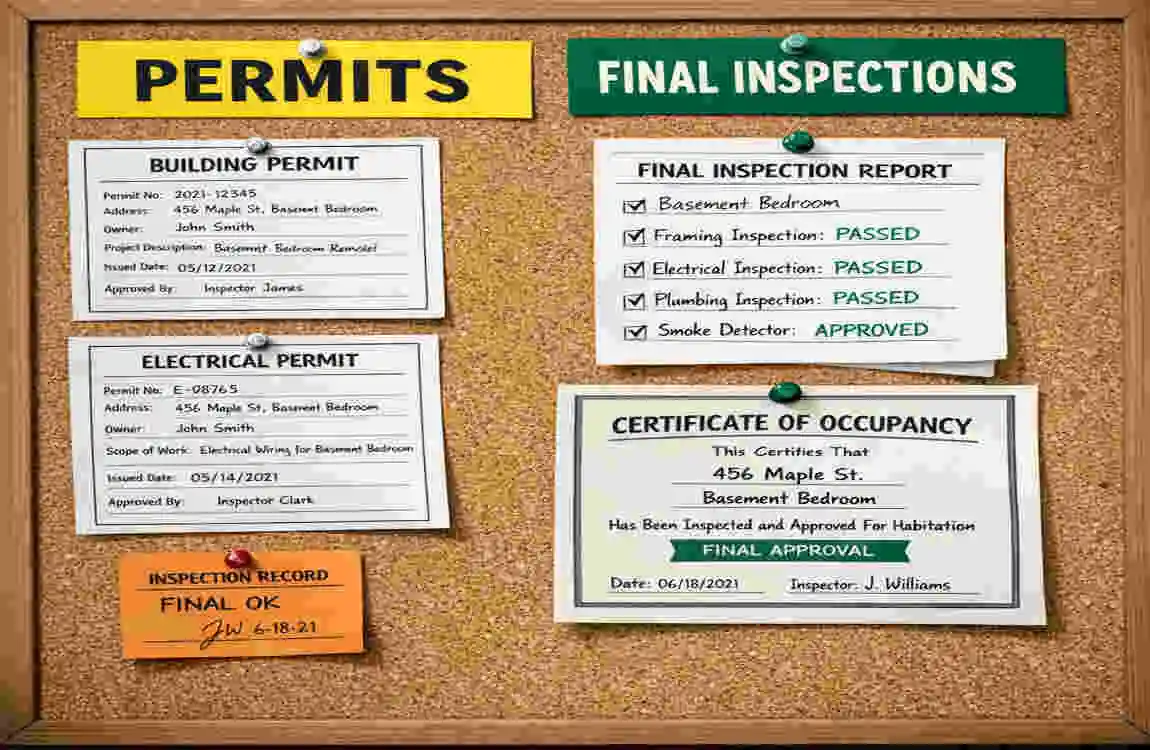
We have covered the physical rules of creating a legal space, but now we must address the administrative side. You cannot simply follow the rules in secret; you have to prove it to your local government.
The Paperwork Trail
You must always pull permits before work begins. Skipping the permit process to save a few bucks is the single biggest mistake a homeowner can make. If you are caught renovating without a permit, the city can issue massive fines, issue a stop-work order, or even demand a teardown order, forcing you to rip out all your hard work so they can see what is behind the walls.
Applying for a permit involves submitting a detailed floor plan showing the proposed layout, window sizes, electrical outlets, and heating solutions. The timeline for approval varies by municipality, but you should generally expect to wait 2 to 4 weeks for initial approvals before you can swing a hammer.
What the Inspectors Look For
Once you have your permits and begin construction, city inspectors will visit your home at several key milestones.
First is the rough-in inspection. Before you install any drywall, an inspector will come to look at the exposed framing, the electrical wire routing, the plumbing pipes, and the HVAC ductwork. They want to verify that the “bones” of the room are up to code.
Once the rough-in is approved, you can finish the walls, floors, and paint. Then comes the final inspection. Here, the inspector will check that the smoke detectors work, the GFCI outlets trip properly, the egress window opens smoothly, and the heat source is functioning. Once they sign off, you receive a certificate of occupancy for that room.
Expert Tip: Keep a detailed folder of all your approved plans, permits, and inspection sign-offs. Document everything! When you eventually sell your house, providing these official documents to prospective buyers provides immense peace of mind and justifies a higher asking price for the legally finished space.
Essential House Features for a Better Bedroom
Now that we have covered the strict legal requirements, let’s talk about livability. A room might be legally compliant, but that does not necessarily mean it is pleasant to live in. Beyond the rigid rules, you should prioritize a few essential house features that elevate the space from a mere “legal room” to a highly desirable suite.
First, as mentioned briefly before, prioritize closets. A custom built-in closet system makes the room instantly usable and keeps clutter off the floor.
Second, consider the layout and private access. Nobody wants to walk through an unfinished, spider-web-filled laundry room or a messy utility closet to get to their bed. Create a dedicated, finished hallway that leads directly to the suite.
Finally, invest heavily in soundproofing. Footsteps, flushing toilets, and television noise from the main floor above can echo loudly underground. Adding sound-dampening insulation (like mineral wool) in the ceiling joists, and using specialized acoustic drywall, will create a quiet, serene environment.
Implementing these features does not just improve quality of life; real estate experts note that these Premium touches can boost the usability and overall value of the finished space by 10% to 15%.
Expert Tips for a Successful Renovation
To wrap up your planning phase, here is a quick checklist of expert tips to ensure your project crosses the finish line smoothly:
- Consult Local Building Departments First: The IRC is a great starting point, but building codes vary wildly by city and county. Call your local zoning office to get their specific checklist before designing your space.
- Budget 20% Extra for Surprises: Renovating underground always uncovers hidden issues, whether it’s cracked concrete, outdated wiring, or hidden moisture. Pad your budget by 20% to absorb these shocks without stressing.
- Partner with Pros for Egress Installs: Cutting through foundation walls is not a weekend DIY project. Hire a specialized concrete cutting and egress company to ensure structural integrity is maintained.
- Maintain Annually for Longevity: Once finished, check your window wells every fall to clear out leaves, and test your sump pump every spring to ensure it is ready for heavy rains.
What Makes a Basement Bedroom Legal? — FAQ
Does a basement room automatically count as a bedroom?
No. A finished basement room is just a room unless it meets specific criteria like having an egress window and a closet. Adding a closet can often turn a basement room into a legal bedroom .
What is an egress window, and why is it important?
An egress window is a window large enough for a person to escape through in an emergency, like a fire. It must meet minimum size and height requirements to be considered legal. Without it, the basement room cannot be classified as a bedroom .
How big does a basement bedroom need to be?
Typically, a legal bedroom must have at least 70 square feet of floor space with no wall dimension less than 7 feet. For two occupants, the minimum size increases to about 100 square feet .
Does a basement bedroom need a closet?
Most building codes and real estate standards require a closet for a room to be officially called a bedroom. Without a closet, it might be considered a spare room or den instead .
What about natural light and ventilation?
Basement bedrooms must have windows that provide natural light and ventilation. The window size must meet local building codes, usually a percentage of the room’s floor area .
Is heating required in a basement bedroom?
Yes. A permanent heating source capable of maintaining a comfortable temperature year-round is required. Portable heaters do not meet this standard .
Can I call my home a 4-bedroom if the basement room meets these requirements?
Yes. If your basement bedroom meets all legal requirements (egress, size, closet, light, ventilation, heating), you can list your home as having that many bedrooms .