We have all been there. You walk into a tiny, cramped powder room, and immediately, you are faced with a frustrating dilemma. The sink is inches from your knees, the door barely clears the toilet bowl, and the toilet paper roll is either sitting precariously on the edge of the sink or rolling freely on the floor.
Dealing with a tiny bathroom is tough enough without the added annoyance of misplaced essentials. If you are constantly asking yourself where to put a toilet paper holder in small bathroom spaces, you are certainly not alone. It is a daily frustration that plagues renters, apartment dwellers, and homeowners alike.
When your square footage is severely limited, every single inch matters; you cannot afford to waste precious floor space, and you definitely do not want your counters cluttered with spare rolls. However, finding the perfect spot for your toilet paper holder is about much more than just keeping the room tidy.
Why Placement Matters More Than You Think
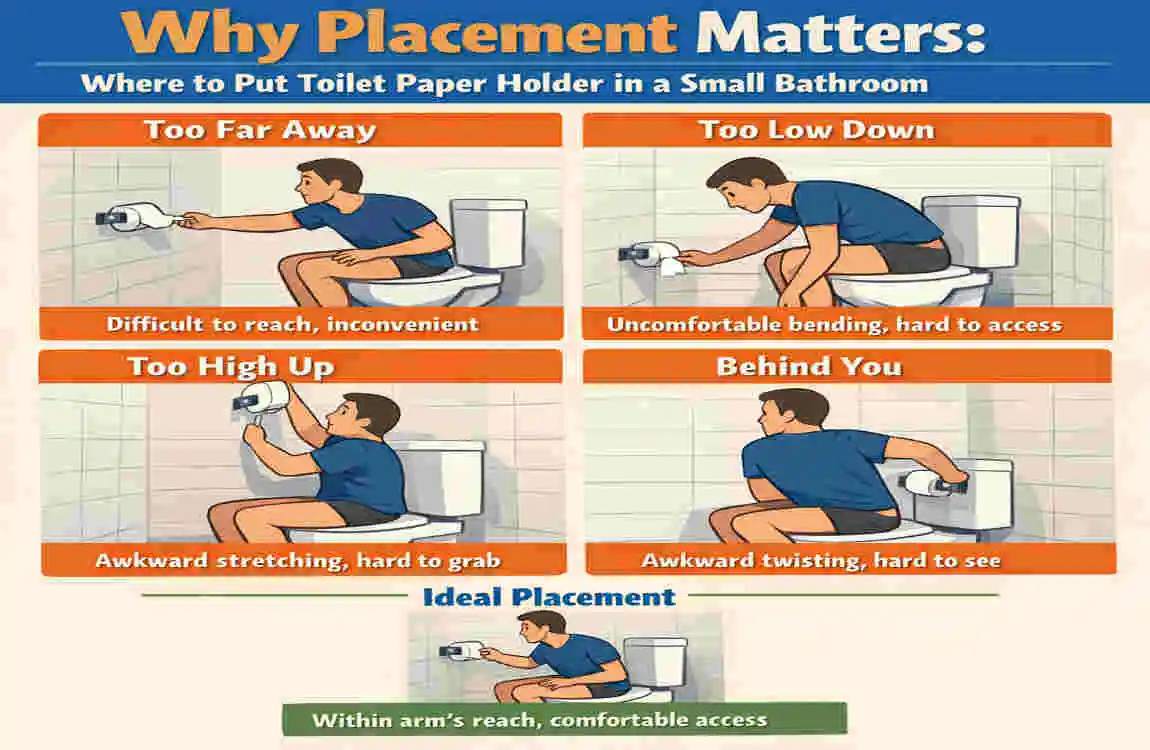
You might be thinking, “It’s just a toilet paper holder! Does it really matter where it goes?” The short answer is an absolute yes. Thoughtful toilet paper holder placement in a small bathroom design can make or break your daily routine.
The Science of Ergonomics
Let’s talk about human comfort. The ideal height for a standard toilet paper holder is roughly 26 inches from the floor. Furthermore, it should sit about 8 to 12 inches in front of the toilet bowl.
Why are these measurements so important? Because they prevent unnecessary straining. If the holder is placed too far back, you risk twisting your spine and straining your shoulder every time you reach for it. If it is too low, you are forced to bend awkwardly. For anyone with mobility issues, placing the holder at the correct ergonomic height is a game-changer.
Mastering Space Optimization
When you are dealing with a bathroom that is under 50 square feet, space optimization is your ultimate goal. The golden rule of small spaces is to look up and use your vertical space.
By taking advantage of vertical planes—like the empty wall space above your toilet or high on a side wall—you immediately free up your floor. Keeping the floor clear not only makes the room feel larger and more open, but it also makes cleaning and mopping a breeze.
Highlighting Design and Accessibility Benefits
Do not underestimate the power of design cohesion. When you match the finish of your toilet paper holder (like brushed nickel, matte black, or warm brass) to your sink faucet and towel racks, you create a polished, high-end look. It makes a tiny room feel intentionally designed rather than thrown together.
Additionally, proper placement ensures you remain compliant with ADA (Americans with Disabilities Act) guidelines, which is crucial if you plan to integrate grab bars or need a universally accessible bathroom. Getting the toilet paper holder height and the small bathroom dimensions right is the foundation of a safe, comfortable space.
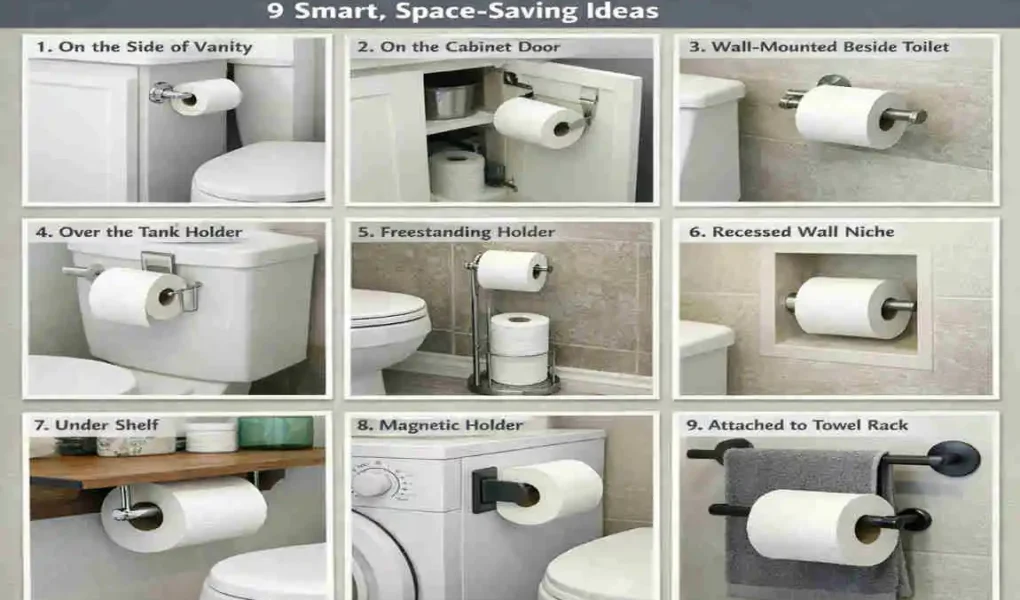
9 Smart, Space-Saving Ideas for Your Bathroom
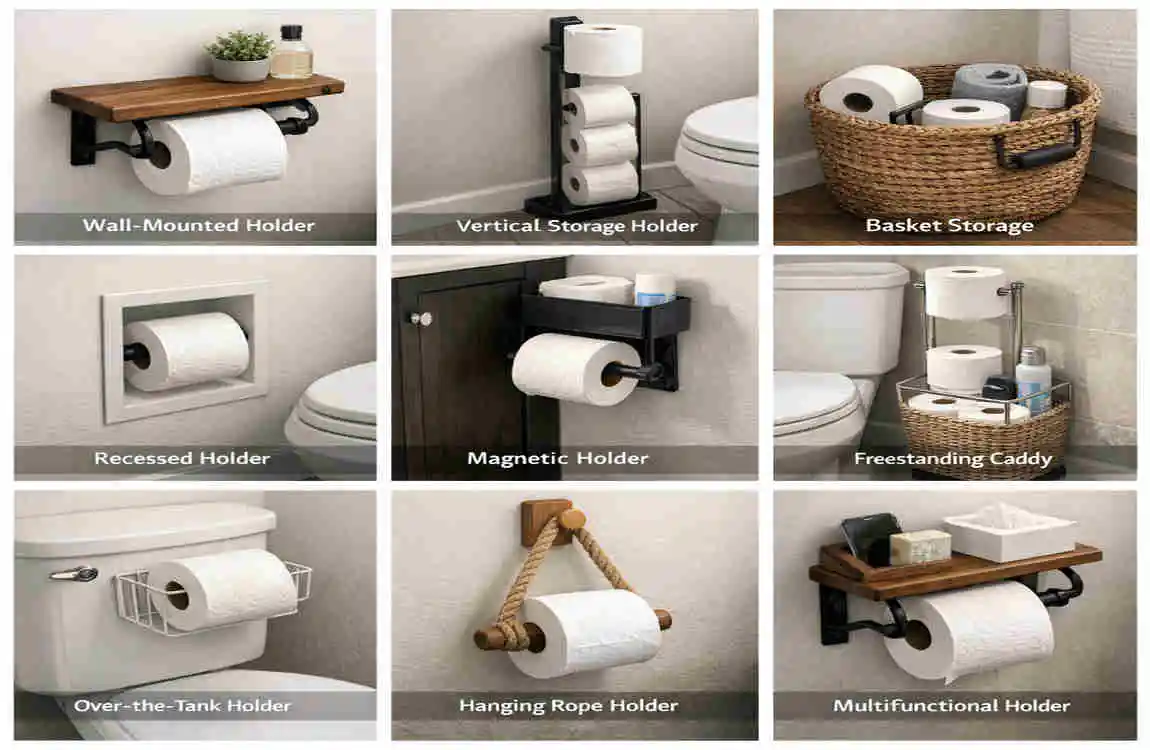
Are you ready to optimize your space? Here are nine brilliant solutions to answer the burning question of where to put a toilet paper holder in small bathroom designs. We will explore everything from classic mounts to innovative storage hacks.
The Classic Side Wall Mount
If you have a wall right next to your toilet, the classic side wall mount is usually the top choice. The ideal position is on the dominant-side wall, perfectly leveled at elbow height when you are seated.
This placement is incredibly intuitive. When you reach out, the roll is exactly where your hand naturally falls. It requires no stretching, bending, or twisting.
Why it fits small bathrooms: It uses zero floor space and keeps the roll perfectly tucked against the wall, maintaining a clean line of sight in your powder room.
AspectDetails
Space Saved Completely floor-free; utilizes dead wall space
Ease of Use : Maximum ergonomic comfort
Cost Estimate $10 – $30 for a quality holder
Tools Needed : drill, level, screwdriver, drywall anchors
Pros and Cons:
- Pros: It is highly stable, highly accessible, and offers a traditional, expected location for guests.
- Cons: It requires drilling into your drywall or tile, which might not be ideal for all renters.
How to install:
- Grab a measuring tape and measure 26 to 30 inches up from the floor.
- Measure 8 to 12 inches forward from the rim of the toilet bowl.
- Mark your drill holes with a pencil.
- Use a stud finder. If you hit a stud, great! If not, make sure you use sturdy drywall anchors before screwing the holder securely into place.
The Behind Toilet Wall Mount
Sometimes, you do not have a side wall. Your toilet may be sandwiched between a glass shower door and a vanity cabinet. In this scenario, mounting the holder on the wall directly behind the toilet is a brilliant workaround.
You will want to place it slightly off-center, leaning towards your dominant hand, so you can reach straight back to grab the paper.
Why it fits small bathrooms: It utilizes the often-ignored blank space directly behind the tank, keeping the sides of the toilet completely clear for foot traffic or opening cabinet doors.
Pros and Cons:
- Pros: Very unobtrusive and keeps the roll completely out of your direct line of sight when you enter the room.
- Cons: Reaching back can be awkward, and there is a slight risk of door interference if your entry door swings wide into that wall.
How to install: Similar to the side mount, you will need a drill and anchors. However, you must carefully measure the distance to ensure you aren’t placing it so low that the toilet tank lid blocks the roll. Aim for a few inches above the tank level, offset to the left or right.
The Over-Toilet Shelf
If you need small bathroom toilet paper storage that works double duty, the over-toilet floating shelf is a magnificent choice.
Instead of just mounting a single roll holder, you install a beautiful floating shelf above the toilet tank. You can attach a holder directly to the underside of the shelf while using the top to store extra spare rolls, a small plant, or a room diffuser.
Why it fits small bathrooms: It maximizes vertical storage to the fullest. You are turning dead air space into a functional storage hub without taking up a single inch of the floor.
Pros and Cons:
- Pros: Incredible vertical storage, adds decorative charm, and keeps spare rolls within arm’s reach.
- Cons: Shelves have weight limits, and you must be careful not to bump your head if you lean back too far.
How to install:
- Measure about 5 feet up from the floor (or roughly two feet above the toilet tank).
- Use a level to draw a straight pencil line.
- You absolutely must anchor this to wall studs, as the shelf will hold more weight than a standard holder.
- Drill your brackets, mount the shelf, and attach a simple under-mount paper holder to the bottom wood panel.
The Freestanding Vertical Holder
Are you a renter who cannot drill into the walls? Or maybe you have beautiful, expensive tile that you refuse to pierce? The freestanding vertical holder is your ultimate savior.
These are slim, tall stands that sit directly on the floor beside the toilet. Many modern designs feature a pivoting top to dispense the current roll, with a vertical pole underneath to stack up to four spare rolls.
Why it fits small bathrooms: They are incredibly slim. Most models are barely 6 inches wide, meaning they can easily slide into that narrow, awkward gap between your toilet and the vanity cabinet.
Pros and Cons:
- Pros: Absolutely zero installation required. You can move it around whenever you want. Great for renters.
- Cons: It does take up a tiny bit of floor space, which means you have to move it when you sweep or mop.
Product Tip: Look for a sleek bamboo model or a heavy-based matte black metal stand. Bamboo adds a lovely, warm, spa-like feel to a sterile powder room.
The Recessed Wall Niche
If you are currently renovating your bathroom and want a truly high-end, custom look, consider building a recessed wall niche.
This involves cutting into the drywall and installing a built-in alcove that sits completely flush with the wall. The toilet paper holder is installed inside this little cubby hole.
Why it fits small bathrooms: It is the definition of seamless. Because the roll is recessed into the wall cavity, it doesn’t protrude into the room at all. This means absolutely zero bumped elbows or snagged clothes.
Pros and Cons:
- Pros: A highly custom, seamless, and luxurious appearance. Maximizes physical room space.
- Cons: Requires actual renovation work, cutting drywall, and ensuring you don’t hit any hidden plumbing pipes or electrical wires.
Renter Hack: If you cannot cut into your walls, look for adhesive-backed, ultra-slim holders that mimic a low-profile look without the need for drywall saws.
The Over-Door Hook Rack
When we talk about space-saving TP holder ideas, we have to talk about utilizing doors. The over-door hook rack is a clever hack that many people overlook.
You can buy specialized hooks that drape over the top of your vanity cabinet door, holding a roll neatly on the inside or outside of the cabinet.
Why it fits small bathrooms: It utilizes an entirely unused surface—the back of a cabinet door. It keeps the toilet paper perfectly hidden away but instantly accessible when you are sitting down.
Pros and Cons:
- Pros: Completely portable, hidden storage, and requires no tools to install.
- Cons: You have to open a door to access the paper (if hung inside), and the holder might rattle against the wood when the door swings.
Pro Tip: Add a tiny felt bumper pad to the back of the metal hook. This simple trick completely eliminates the annoying rattling sound when you open and close the cabinet door!
The Corner Floor Basket
Sometimes, the best approach is the most relaxed one. A corner floor basket is a wonderful, cozy way to manage your toilet paper.
Find a beautifully woven wicker, hyacinth, or wire basket and tuck it securely into the corner of the bathroom, right next to the toilet. You can stack three or four rolls inside. You can even leave the top roll slightly pulled up for easy access.
Why it fits small bathrooms: It turns a mundane bathroom necessity into a piece of decor. Baskets easily mold into awkward corner spaces that otherwise wouldn’t be used.
Pros and Cons:
- Pros: Highly stylish, incredibly mobile, and acts as both a dispenser and a bulk storage unit.
- Cons: Baskets on the floor can become dust collectors, and you will need to bend down slightly to grab the paper.
Styling Idea: If you have a modern, industrial bathroom, choose a matte black wire basket. If you have a boho or farmhouse bathroom, natural seagrass is the way to go.
The Under-Sink Pull-Out
For those who crave ultimate minimalism and want everything completely out of sight, the under-sink pull-out drawer is a dream come true.
If you have a vanity right next to your toilet, you can install a slim, sliding track drawer inside the cabinet. You reach over, pull the drawer out, and grab your paper.
Why it fits small bathrooms: It keeps the visual clutter of the room at absolute zero. Your walls remain completely bare, making the tiny room feel much larger.
Pros and Cons:
- Pros: Completely hidden, highly organized, and protects the paper from bathroom moisture and humidity.
- Cons: You must carefully measure around your sink’s plumbing (the P-trap) to ensure the drawer actually fits.
Measurement Guide: Before attempting this, measure the clearance inside your cabinet. You will need a drawer with a maximum depth of about 4 to 5 inches to safely store toilet paper rolls without hitting the pipes.
The Ceiling or Track Mount
Let’s look into the future of ultra-small space design. Inspired by tiny homes, RV living, and micro-apartments in 2026, the ceiling or track mount is the ultimate innovative solution.
This involves installing a sliding rail system underneath a high floating vanity, under a heavy light fixture, or even dropping down from a low ceiling angle. The holder slides along the track exactly where you need it, and can be pushed away when not in use.
Why it fits small bathrooms: It is an out-of-the-box solution for rooms that literally have no standard walls, no cabinets, and no floor space.
Pros and Cons:
- Pros: Highly innovative, incredible conversation starter, and maximizes the most unconventional spaces.
- Cons: This is a rare, custom installation that might require specialized hardware and a bit of DIY confidence.
Trend Alert: As homes continue to prioritize smart, compact living, expect to see more track-mounted accessories hitting mainstream home improvement stores!
Installation Best Practices: Do It Right the First Time
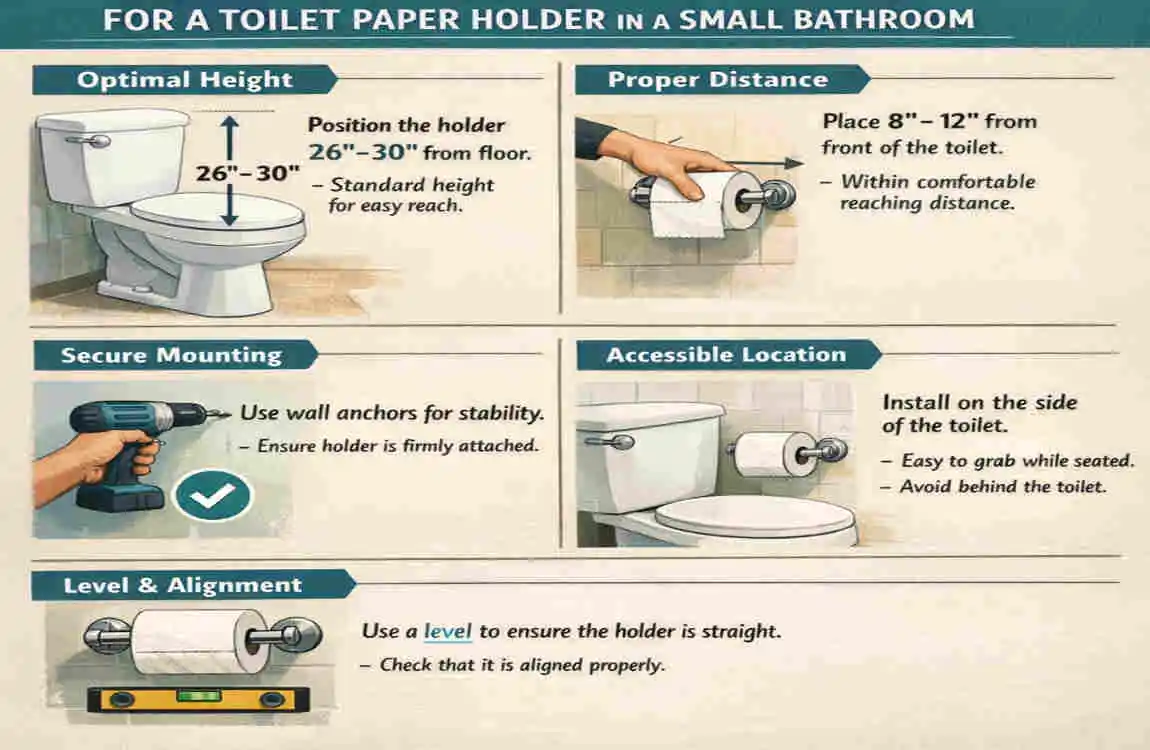
Now that you have chosen your favorite idea, it is time to talk about installation. Slapping a holder on the wall without a plan usually results in a wobbly, slanted mess. Here is how to ensure your new hardware stays firmly in place.
Gather the Right Tools. Do not try to eyeball this! You will need a measuring tape, a pencil, a reliable stud finder, a power drill, and a small bubble level. Using a level is non-negotiable; there is nothing more maddening than a crooked over-toilet-paper holder.
Beware the Moisture Zones. In a tiny bathroom, the shower is often very close to the toilet. Avoid placing your toilet paper holder in the “splash zone.” If your side wall is right next to a curbless shower, opt for the behind-the-toilet mount or an enclosed cabinet holder to prevent your paper from getting soggy.
Safety and Stability First. Always use a stud finder. Screwing directly into a wooden stud provides the ultimate stability. If you cannot find a stud in the perfect spot, do not panic. Use high-quality drywall anchors (like toggle bolts or threaded plastic anchors) to ensure the holder won’t rip out of the wall when pulled.
Avoid Common Mistakes. The most frequent mistake homeowners make is installing the holder too high or too low, completely ignoring the ergonomic 26-inch rule. Another massive error is ignoring the room’s circulation. Before you drill, sit on the toilet with the door closed, and have a family member open the door. Does it hit where your knees or the holder will be? Check your clearances first!
Styling and Product Picks to Elevate Your Space
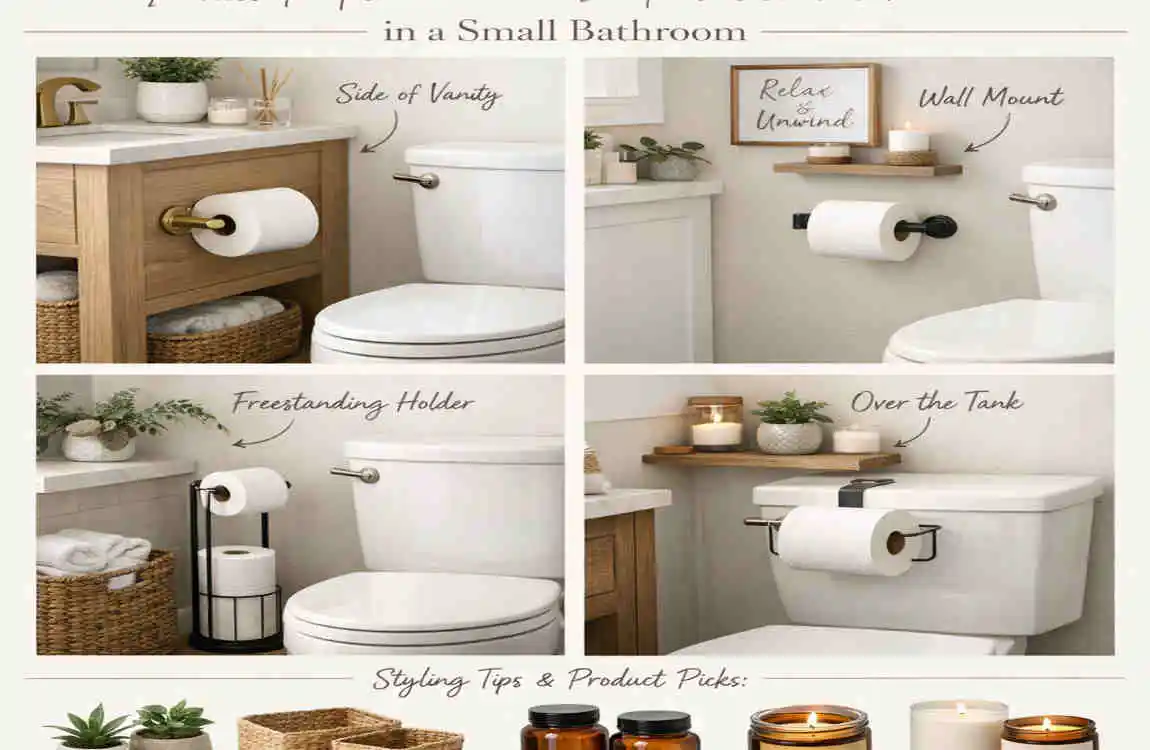
Your bathroom accessories should look like a family. When you are styling a small bathroom, mixing too many metals or finishes can make the room look chaotic.
Aim to match the finish of your toilet paper holder to your faucet, showerhead, and cabinet hardware. If your sink has a brushed brass faucet, get a brushed brass toilet paper holder.
Current Finish Trends:
- Matte Black: Perfect for modern, industrial, or high-contrast spaces.
- Brushed Brass/Gold: Adds warmth, elegance, and a touch of vintage charm.
- Polished Chrome: The classic, budget-friendly option that looks bright and clean.
Top Holder Categories to Consider:
Style Category, Ideal For, Price Range, Look to Buy
Pivoting Wall Mount Easy roll changes, no spring-loading $20 – $40 Heavy-duty metal options
Bamboo Freestanding Renters, warm aesthetics, eco-friendly , $25 – $50 Sturdy base models
Adhesive Under-Cabinet Zero-drill, hidden vanity storage $10 – $25 3M backed stainless steel
Over-Tank Organizer Dual-purpose storage, plant lovers $30 – $60 Rust-proof coated wire
Recessed Niche Box Custom renovations, sleek lines $40 – $80 Paintable or stainless finish
Whether you are shopping for a budget-friendly fix under $20 or a Premium, heavyweight brass fixture, focusing on cohesion will make your tiny bathroom look like it was designed by a professional.
Frequently Asked Questions (FAQs)
Still have a few lingering questions about your bathroom layout? We have compiled the most common queries to help you nail your design.
Where to put a toilet paper holder in a small bathroom with no walls? If you have a totally open-concept bathroom or glass walls, your best bet is a freestanding vertical holder. It sits directly on the floor beside the toilet and requires no wall mounting whatsoever.
What is the absolute best height for a wall-mounted holder? According to ergonomic standards, the perfect height is 26 inches from the floor to the center of the roll. It should also sit about 8 to 12 inches in front of the front rim of the toilet bowl.
Are there any renter-friendly options that won’t ruin my walls? Absolutely! Beyond freestanding stands, you can use over-the-cabinet hooks, suction-cup mounts (if you have large, smooth tiles), or heavy-duty adhesive-backed holders. Some people even use small tension rods cleverly placed in narrow gaps!